
"It was like an explosion": earthquake near Pisa halted trains and brought people out into the streets
A magnitude 4.3 jolt was felt in Pisa, Lucca, Livorno, Versilia and other areas of northern Tuscany. People left homes and offices, but there are so far no reports of injuries or serious damage.
On the morning of 4 August, a perceptible earthquake struck the northern part of Italy's Tuscany. The National Institute of Geophysics and Volcanology of Italy recorded the main shock at 10:15 am local time. Its magnitude was 4.3, with the focus located at a depth of about eight kilometres, and the epicentre approximately seven kilometres west of Pisa, in the San Rossore natural park.
Despite its relatively small magnitude, the earthquake was felt over a large area – from Pisa and Livorno to Lucca, Versilia and the province of Massa-Carrara. Some reports also came from the Florence area. In Pisa, hundreds of people took to the streets, and emergency line 112 received numerous calls.
Many eyewitnesses described the initial moment not as a familiar swaying, but as a strong blow or explosion. A resident of the area between Camaiore and Lucca told Kurs.com.ua that the shock was significantly sharper than stronger earthquakes that had previously occurred closer to his home.
"It felt like an explosion. At a friend's place a few kilometres from the epicentre, on the fourth floor, objects fell" , he said.
Such sensations are explained by the shallow depth of the focus and the abrupt nature of the initial impulse. According to the preliminary INGV shakemap, peak ground shaking intensity reached V on the Mercalli–Cancani–Sieberg scale. At that intensity, hanging objects may swing, doors swing open and unsteady small objects may be displaced, although structural damage to buildings is typically not expected.
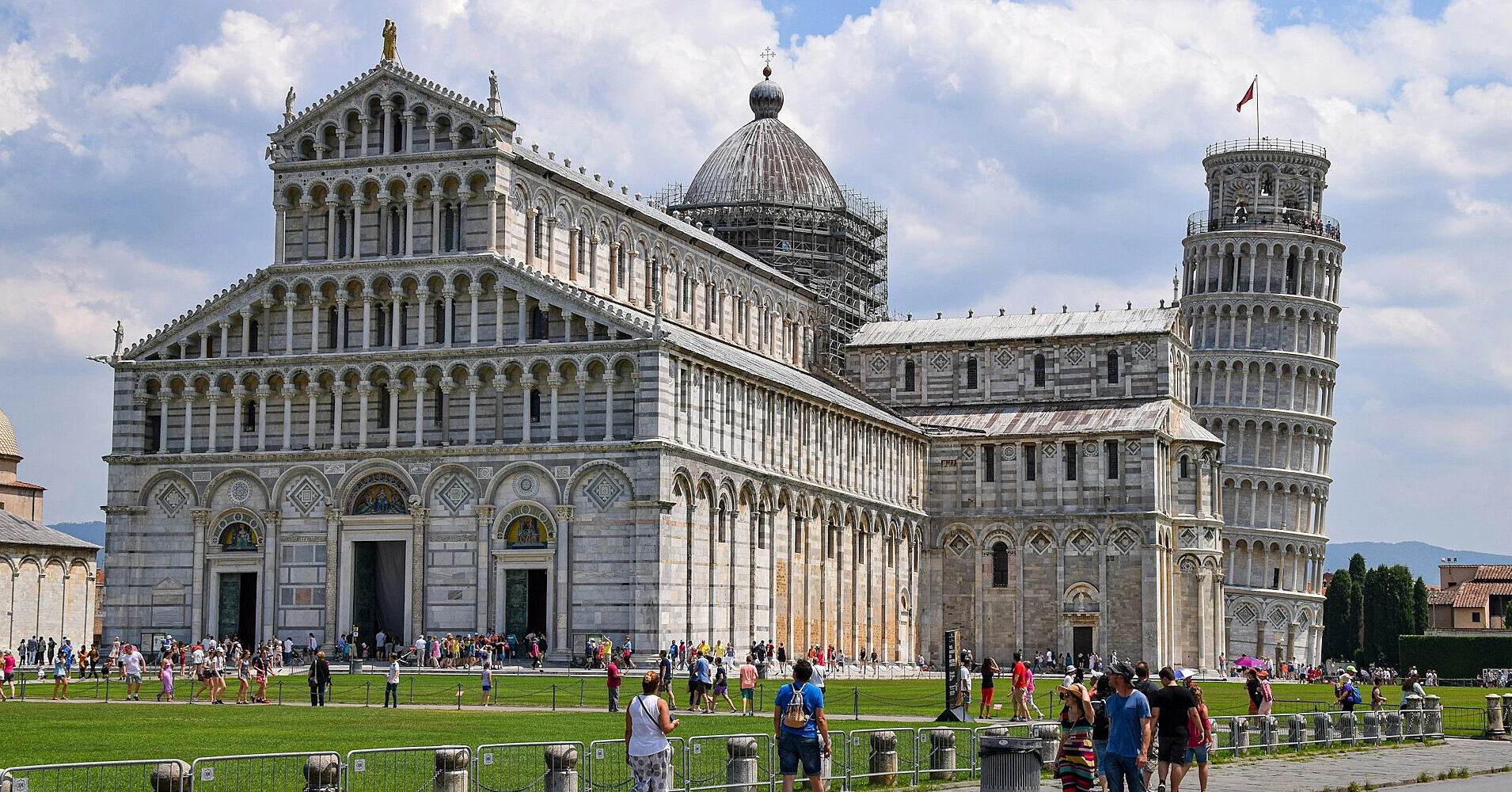
In central Pisa, the town hall, the court and several other public buildings were temporarily evacuated as a precaution. Court hearings were suspended but later resumed. After inspections, personnel returned to the premises. The Leaning Tower of Pisa, the cathedral and other monuments on Piazza dei Miracoli were not damaged and remain open to visitors.
The earthquake seriously disrupted rail traffic. From 10:30, traffic through the Pisa hub was suspended for track and infrastructure inspections. Restrictions affected the Pisa–Empoli, Pisa–Livorno, Pisa–Lucca and Pisa–Viareggio lines. Passengers were warned of delays, diversions and cancellations. As of midday, inspections were still ongoing.
Tuscan authorities reported that no casualties and no confirmed damage to homes, healthcare facilities or other infrastructure have been identified. Firefighters received a few requests to inspect residential buildings in the centre of Pisa, while specialists continued checking schools, public buildings and utilities.
After the mainshock, a series of weaker aftershocks began. During the first hour, the INGV recorded five events with magnitudes below 2. Later, at 12:47, an aftershock of magnitude 2.3 struck near Pisa at about ten kilometres depth.
Seismologists cannot say in advance whether the sequence is over or new perceptible tremors could occur in the coming hours. The regional civil protection service remains on heightened alert, but for now authorities see no need to declare a state of emergency.
Sources: INGV, Italian Civil Protection Department, Rete Ferroviaria Italiana, La Nazione, Il Tirreno.
