
In several regions, an industrial facility and gas stations were damaged; the Russian Defense Ministry confirmed an attack on Odesa's energy sector (Updated)
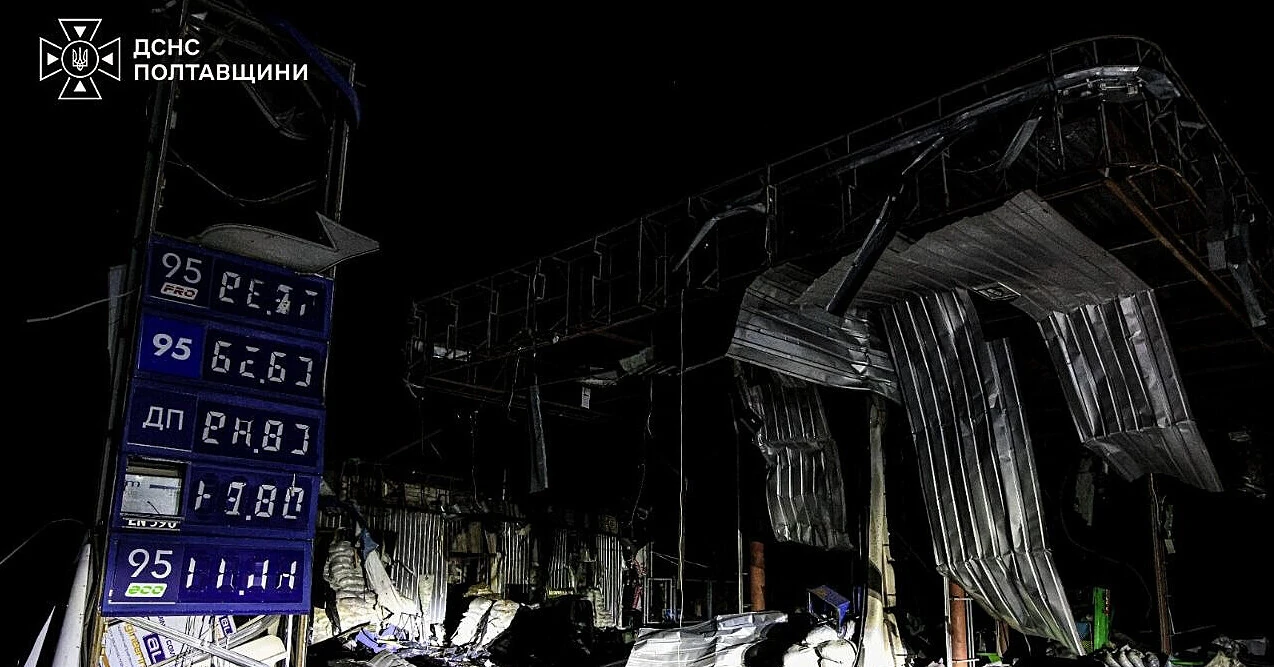
New Russian strikes damaged an industrial enterprise, gas stations, residential areas, and civilian infrastructure in Sumy and Poltava regions. In Odesa, due to power supply disruptions on August 10, the municipal electric transport is not operating; earlier, the region was shelled by Russia.
Enterprise and gas stations targeted in Poltava region
On the evening of August 9, Russian drones attacked several facilities in Poltava district. Hits were recorded on the territory of an industrial enterprise, gas stations, and a private household.
As a result of the strikes, fires broke out at several gas stations, an industrial facility, and a residential building. Emergency units extinguished all fires. There was no information about fatalities or injuries.
The attack caused damage to several components of the local economy — industrial production and fuel infrastructure, on which transport and enterprises depend. The final scale of damage and possible recovery timelines are yet to be announced.
Civilian infrastructure damaged in Sumy
On the night of August 10, Russian forces launched five strikes with guided aerial bombs on Sumy. Hits were recorded at three locations in two districts of the city.
According to the Sumy Regional Military Administration, civilian infrastructure and residential areas were damaged. Specialists continue to inspect the territories and assess the full extent of destruction.
The number of injured rose to 14, including a 14-year-old child. There are no severe injuries: most people were diagnosed with minor injuries or acute stress reactions. All received necessary medical assistance.
As of the morning of August 10, power cuts persisted in Odesa following a massive rocket and drone attack carried out by Russian forces the previous night.
Due to power supply issues, electric public transport completely halted in the city. To maintain connectivity, the city authorities deployed social buses and mini-buses that partially duplicate tram and trolleybus routes.
The suspension of electric transport complicated movement around the city and increased the burden on bus services. Power disruptions also affected businesses, trade, and services.
The number of people injured as a result of the attack on Odesa region rose to 14. Eleven people were hospitalized, the condition of one patient is assessed as serious, and five as moderate.
The Russian Ministry of Defense stated that Russian forces deliberately targeted the region's energy infrastructure. The Russian department claims that strikes were launched against Odesa CHP and seven electrical substations with voltages of 110 and 330 kV. There is no independent confirmation of damage to all listed facilities.
Thus, the latest Russian strikes targeted not only residential areas but also facilities that support daily economic activity: industrial enterprises, fuel infrastructure, energy supply, and public transit. for daily economic activity . According to .
Based on materials: Sumy Regional Military Administration, Poltava Regional Military Administration
