
Poverty level in Ukraine doubled during war years - World Bank
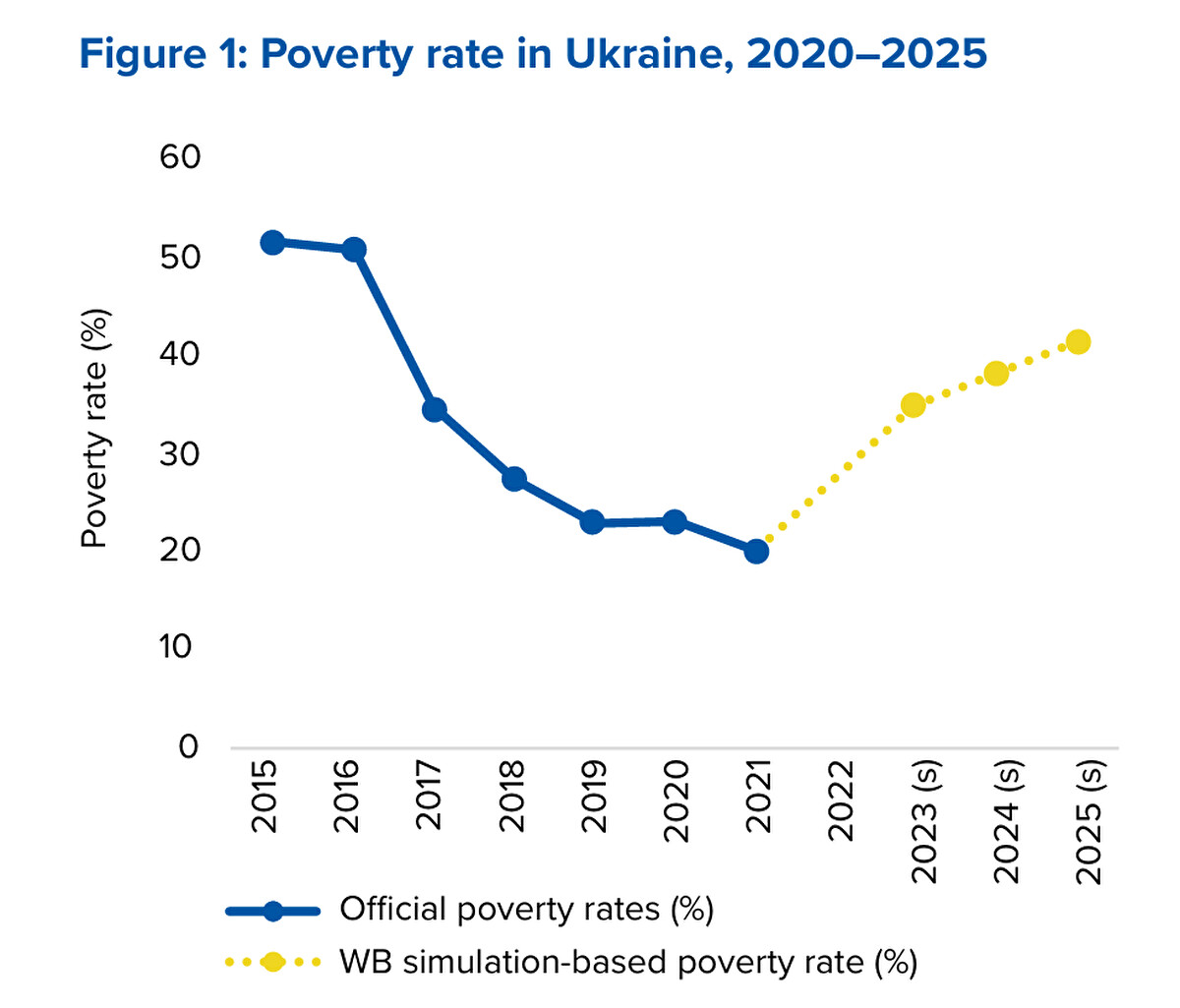
The poverty level in Ukraine in 2025 rose to 41.6% of the population, against 37% a year earlier. Compared to 2021, the figure has virtually doubled.
Such estimates are contained in the World Bank's updated report on living conditions in Ukraine.
The 2025 figure is not official government statistics. The World Bank obtained it through microsimulation, combining pre-war household surveys of the State Statistics Service with the results of its own Listening to Ukraine telephone surveys.
The poverty line in the study is the actual subsistence minimum published by the Ministry of Social Policy, per adult household member.
At the beginning of 2026, the World Bank revised calculations for 2023-2025. Analysts unified the methodology and clarified data on the growth of wages and pensions, social assistance recipients and the number of internally displaced persons. As a result, the new poverty estimate turned out to be higher than in previous reports.
Income gap widens
At the same time, wealth inequality has increased in Ukraine. The Gini coefficient rose from 0.41 in 2023 to 0.44 in 2024 and 0.50 in 2025.
Real labor income of the poorest 20% of households decreased by more than 30% during 2025. In wealthier groups, it increased by more than 10%.
The World Bank explains the deepening inequality by differential access to jobs and levels of remuneration. Over 90% of the wealthiest households received income from salaried work, agriculture or entrepreneurship. Among the poorest families, less than 20% received a salary.
Prices are rising faster than incomes
One of the main reasons for the worsening situation of the population was a prolonged jump in the cost of living. By 2025, prices for housing and utilities increased by approximately 50-70% compared to the 2020 level. Food products rose in price by 70-80%, and in some regions the increase approached 90%.
In the fourth quarter of 2025, about 70% of households reported that their financial situation had become worse than before the full-scale invasion. Approximately 17% of families borrowed money to cover basic needs, and 6% were forced to sell property.
Only about one in five households was able to save money during the previous 30 days. At the same time, 35.4% of respondents said they were eating a limited range of foods, and about a quarter could not afford healthy and nutritious food.
The telephone surveys covered the territories where Ukrainian mobile communications were available. The sample did not include Crimea and Luhansk Oblast, and coverage of Donetsk and Kherson Oblasts remained limited.
Based on materials from: World Bank
