
Reactive "Shakhed" reached Volyn: flight range exceeded previous record
On the morning of August 28, a Russian jet-powered drone flew from the direction of temporarily occupied Crimea to Volyn Oblast. According to Ukrainian monitoring resources, the craft covered about 960 km from the launch site—approximately 60 km more than in the previous farthest recorded flight of a jet-powered drone on August 18. Near Torchyn in Lutsk district, the UAV was shot down.
The Air Force of the Armed Forces of Ukraine warned in the morning about the movement of a jet-powered UAV toward Lutsk. Local media reported an explosion, after which information appeared about the shooting down of an aerial target near Torchyn.
Monitoring channels Mon1tor and "Oko Hora" estimated the distance traveled by the drone at approximately 960 km from the launch point in occupied Crimea. They called it the greatest recorded flight distance of a Russian jet-powered strike UAV over Ukraine.
The Air Force has not officially confirmed the range record, so the 960 km estimate remains a calculation by monitoring resources.
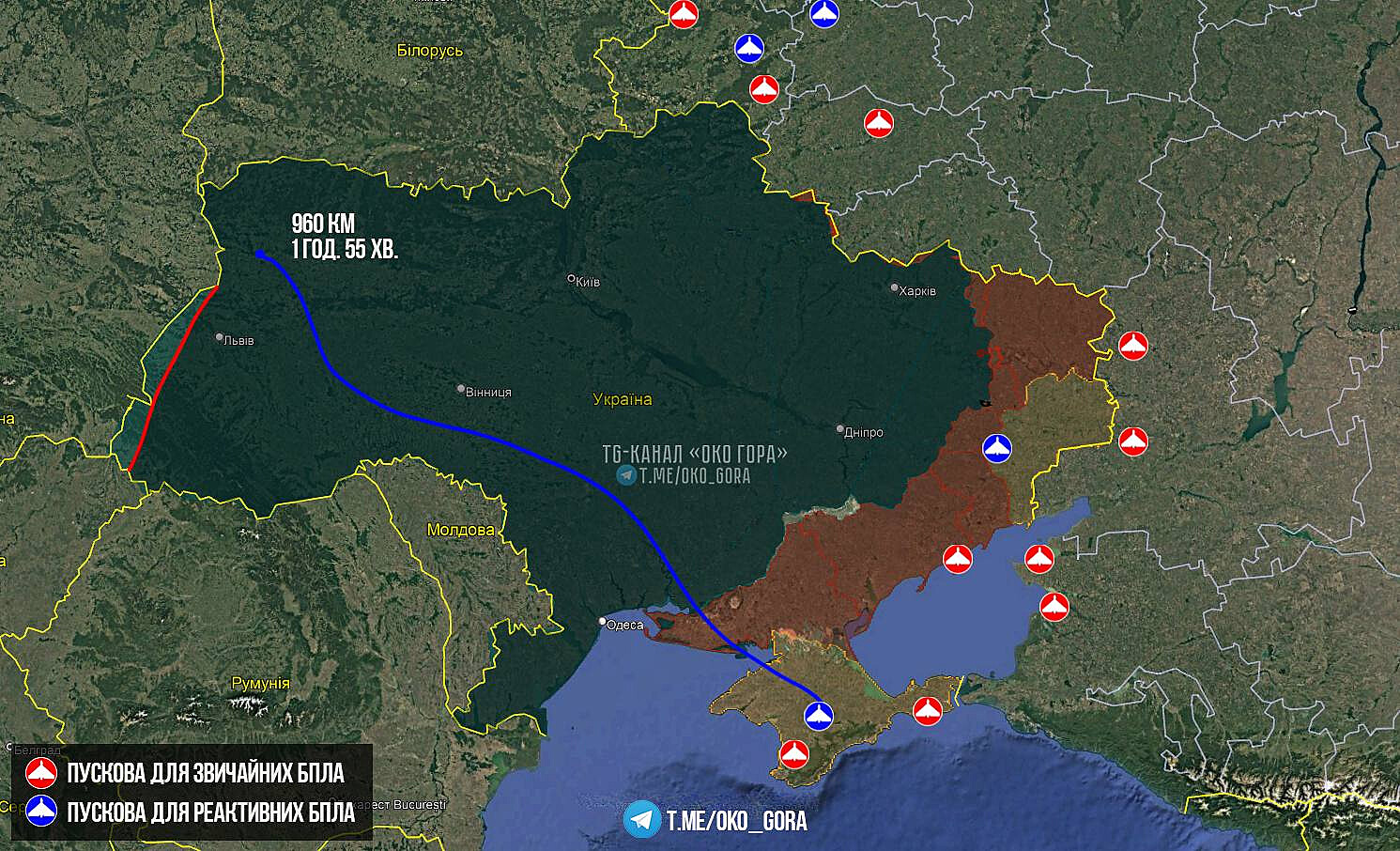
Previous maximum was recorded ten days ago
On August 18, a jet-powered Russian drone reached Rivne Oblast for the first time. At that time, monitors estimated its route at approximately 900 km from the launch point in occupied Crimea.
The drone flew through several oblasts and was shot down in the south of Rivne Oblast. Head of the Rivne Oblast Military Administration Oleksandr Koval officially confirmed the work of air defense and the downing of the enemy target at that time.
Thus, in less than two weeks, the recorded maximum flight distance of a jet-powered Russian UAV increased from approximately 900 to 960 km.
As of August 18, massive use of jet-powered "Shakheds" by Russia was already reported: in a single day, the occupiers launched 76 such drones.
Which drone exactly reached Volyn
The exact modification of the drone that reached Volyn has not been officially named. Monitoring resources call such crafts jet-powered "Shakheds" or "Gerans".
According to previously published specifications by the Main Intelligence Directorate, the Russian "Geran-4" has a claimed range of about 770 km at a cruising speed of about 320 km/h.
At the same time, another jet modification, the "Geran-5", has a significantly greater claimed range—about 950 km—and a cruising speed of 450–600 km/h. Defense Express noted after the attack on August 18 that it is precisely the characteristics of the "Geran-5" that allow it to cover such a distance from launch positions in Crimea to western regions of Ukraine.
Therefore, without official identification of the downed craft, claiming that the "Geran-4" covered 960 km is premature.
Monitors estimate potential coverage of 96% of Ukraine's territory
Based on the recorded range, "Oko Hora" estimated that jet-powered Russian drones could potentially reach about 96% of Ukraine's territory. This is also an assessment by the monitoring resource, not an official calculation by the Air Force.
The actual area of operations depends not only on the maximum range of the craft, but also on the launch point, altitude, route, the need to avoid air defense zones, and other flight conditions.
During the attack on the night of August 28, Russia used a total of 164 strike and imitation drones. According to the Air Force, about half of them were jet-powered. Hvardiyske in temporarily occupied Crimea was named among the launch sites.
As of 09:00, Ukrainian air defense shot down or suppressed 137 enemy drones. Hits were recorded at 16 locations, and falling debris from downed targets at four more.
Sources: "Oko Hora", Defense Express, Volyn24
