
Rhein shallows again: fuel transportation by river under threat
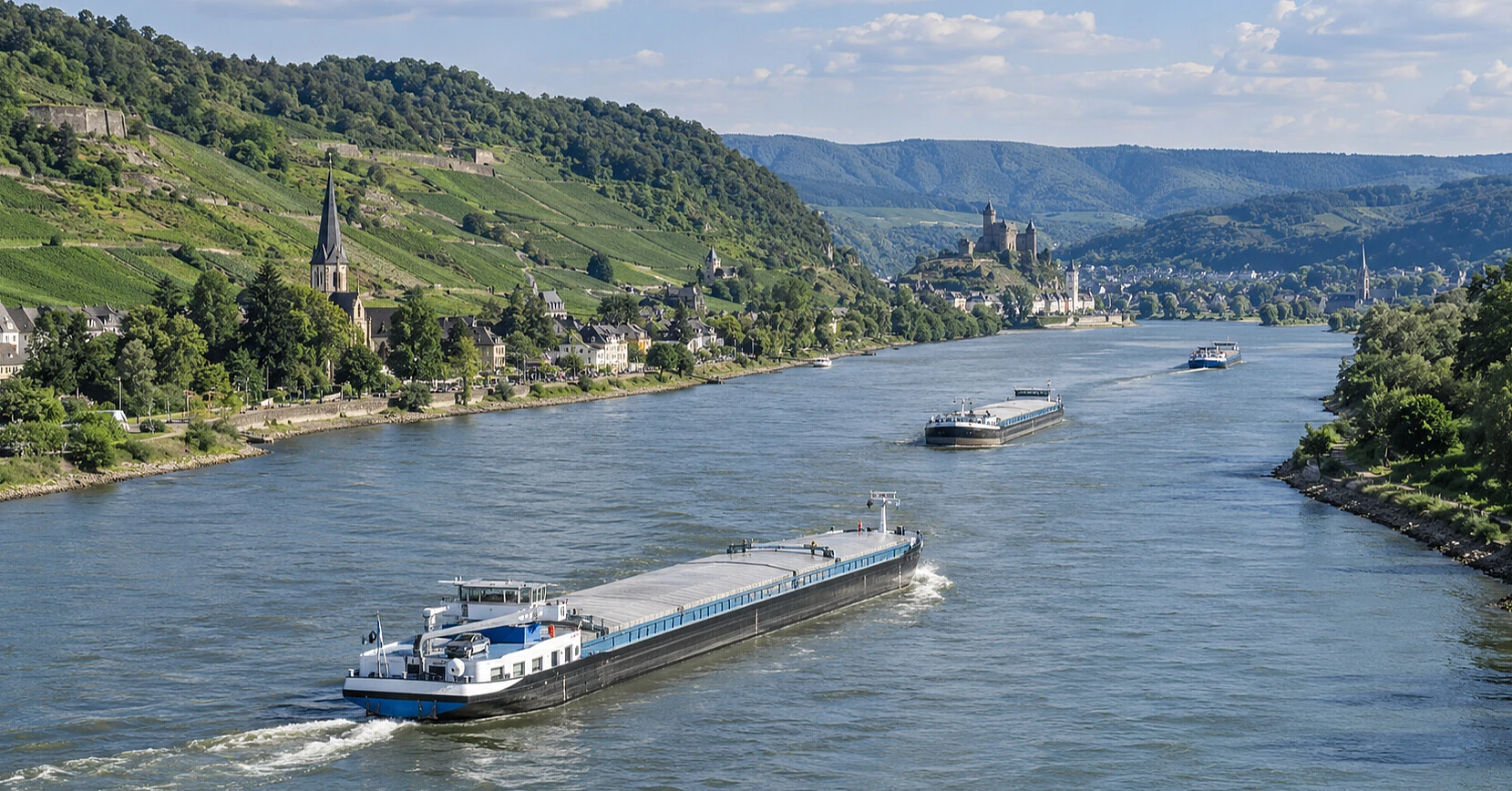
The water level in the Rhine has once again dropped to critical values, threatening fuel supplies along one of Europe's most important river transport arteries. If forecasts prove correct, barge traffic on certain sections could nearly come to a halt by the end of September.
At the Kaub water level gauge—one of the shallowest and most critical sections for navigation on the Middle Rhine—the level on September 18 stood at about 20 cm. According to the forecast of the German Waterways and Shipping Administration WSV, by September 28 it could approach the zero mark and remain around that level for several days.
The gauge reading does not indicate the actual depth of the river: the navigable channel is deeper. However, the value at Kaub determines how much operators have to reduce barge loading.
Due to the shallowing, vessels are already forced to carry less fuel per trip. Market participants surveyed by S&P Global Energy note that deliveries to the Upper Rhine regions are approaching a virtual standstill. If water levels continue to fall, only a few vessels with minimal loading will be able to operate on some routes.
The problems have already sharply increased transport costs. Freight rates for oil products from the Amsterdam–Rotterdam–Antwerp region to Basel reached 215 euros per tonne, up from 165 euros on September 11. Thus, transport costs rose by roughly 30% in just one week.
In early September, transport on some routes cost around 100 euros per tonne. The drop in the Rhine level forces the same volume of fuel to be spread across a larger number of barges, rapidly driving up costs.
Carriers and traders are trying to reroute cargoes to rail, road, and pipelines. However, these alternatives are already operating at high capacity and cannot fully replace normal river transport volumes.
An additional problem for Germany remains the closure of the railway line on the right bank of the Middle Rhine—one of the country's key freight routes. It has been shut since July until mid-December, limiting the ability to quickly shift cargoes from river to rail.
The situation is especially important for refineries and fuel markets in Germany, France, and Switzerland. The Rhine is used to transport crude oil and oil products between the major ports of Northwest Europe, refineries, and inland terminals.
Some plants have alternative supply channels. For example, facilities in Wesseling and Karlsruhe are connected to oil pipelines. However, S&P Global analysts warn that rail, road, and pipeline infrastructure cannot fully compensate for the loss of river capacity. As a result, fuel delivery becomes slower and more expensive.
Against this backdrop, diesel prices in Europe remain high. S&P Global estimated that diesel with 10 ppm sulfur content in Northwest Europe cost $1,558.75 per tonne on September 18, compared with an average of about $1,291 in August. The shallowing of the Rhine is one of the factors exacerbating logistical constraints in an already tight fuel market.
In August, the Rhine had already reached record low levels, causing commercial shipping to nearly cease on some sections. After a temporary improvement, the water level began to decline again in September. No significant recovery in navigation is expected without sustained rainfall in the river basin.
Based on materials from: SAFETY4SEA, S&P Global Energy, Reuters
