

Rivers in western Ukraine approaching record low water levels, level III danger announced
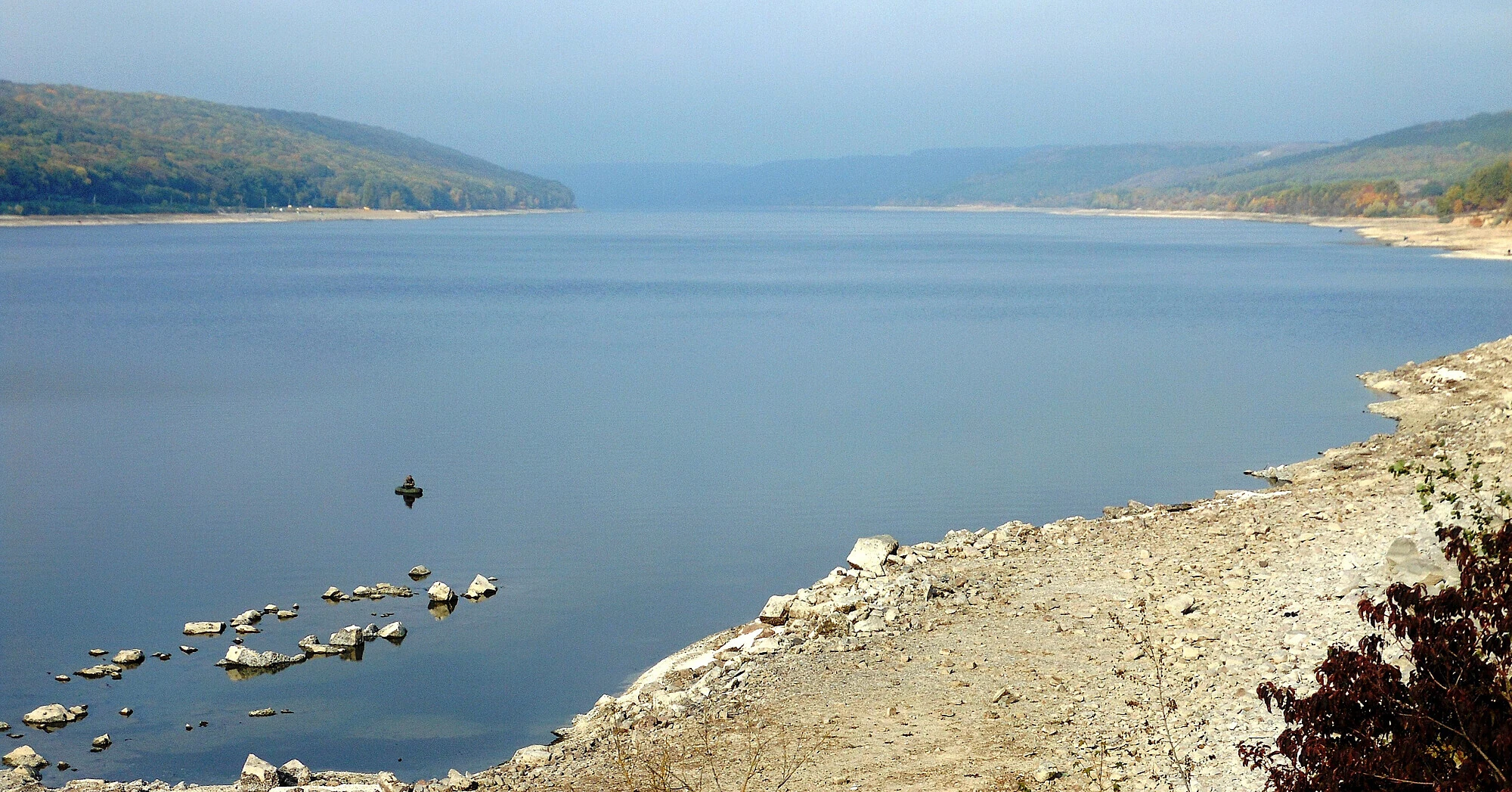
Water levels in rivers in western Ukraine may drop to their lowest values in the entire period of observations, and in some sections - even below historical minimums. On small rivers, in places, complete cessation of flow is possible. The Ukrainian Hydrometeorological Center announced level III, brown, danger level.
The warning is in effect from August 26 to 31 and applies to the rivers of the Dniester basin in Lviv, Ivano-Frankivsk, Ternopil, and Khmelnytskyi regions, the San sub-basin in Lviv region, and the Western Bug in Lviv and Volyn regions.
According to hydrologists' forecast, water levels will continue to decline. River water levels will reach low water criteria, and in some sections of small rivers, the flow may completely disappear.
The Ukrainian Hydrometeorological Center warns that such a situation could complicate the functioning of the water management complex.
Dniester already set a low water record
The current warning is a continuation of a long period of extremely low water. As early as July 8, the average daily inflow of water to the Dniester reservoir decreased to 51 cubic meters per second - the lowest figure since the reservoir began operating in 1985 and only about 16% of normal.
For most of July, the inflow was only 51-90 cubic meters per second. At the same time, compensating discharges of no less than 100 cubic meters per second continued from the reservoir, as a result of which by the end of July its level decreased by 1.18 meters.
Hydrologists had previously warned: if there are no stream-forming precipitation, prolonged low water could lead to a drop in the Dniester reservoir level to critical marks for some drinking water intakes in Chernivtsi and Khmelnytskyi regions.
Low water covers a significant part of Europe
The problem is not limited to Ukraine. Prolonged lack of precipitation combined with heatwaves has caused a large-scale drought in Europe. The European Commission's Joint Research Centre reported that in August, four major European rivers - the Loire, Po, Rhine, and Danube - dropped to record low levels.
The consequences for navigable waterways were particularly tangible. On the Rhine in mid-August, the water level at the key Kaub measuring station dropped to a record 6 cm. Low water significantly restricted navigation: carriers were forced to reduce vessel loadings, and some ferry and cruise routes temporarily suspended operations.
After rainfall, the situation on the Rhine improved somewhat: on August 25, the ferry at Kaub resumed operations after a nine-day break. At the same time, operators warn that stabilization remains dependent on new precipitation.
On the Danube, low water already hits transportation
The situation remains difficult on the Danube, one of the main transport arteries of Central and Eastern Europe. In early August, the European Space Agency recorded record low river levels in Hungary and also reported records in Romania. Low water has already created problems for barges and ferries.
The Danube Commission stated on August 12 that low water levels already have a significant impact on navigation. Vessels have to reduce draft and cargo volume, transit times increase, and shipment planning becomes more difficult. As a result, transport costs rise and pressure on road and rail routes increases.
In Austria at the beginning of August, the situation was so difficult that freight navigation on certain sections of the Danube practically stopped, and cruise navigation was significantly limited. On free-flowing sections, levels were about 60 cm below long-term low water indicators.
Thus, the record drop in river levels currently being recorded in Ukraine is part of a much broader problem. Drought and precipitation deficits are already affecting not only water resources and ecosystems, but also water supply, energy, and transportation along key European river routes.
Based on materials: Ukrainian Hydrometeorological Center, Joint Research Centre European Commission, Danube Commission