

Drones attacked Russian industrial facilities, Moscow airports grounded
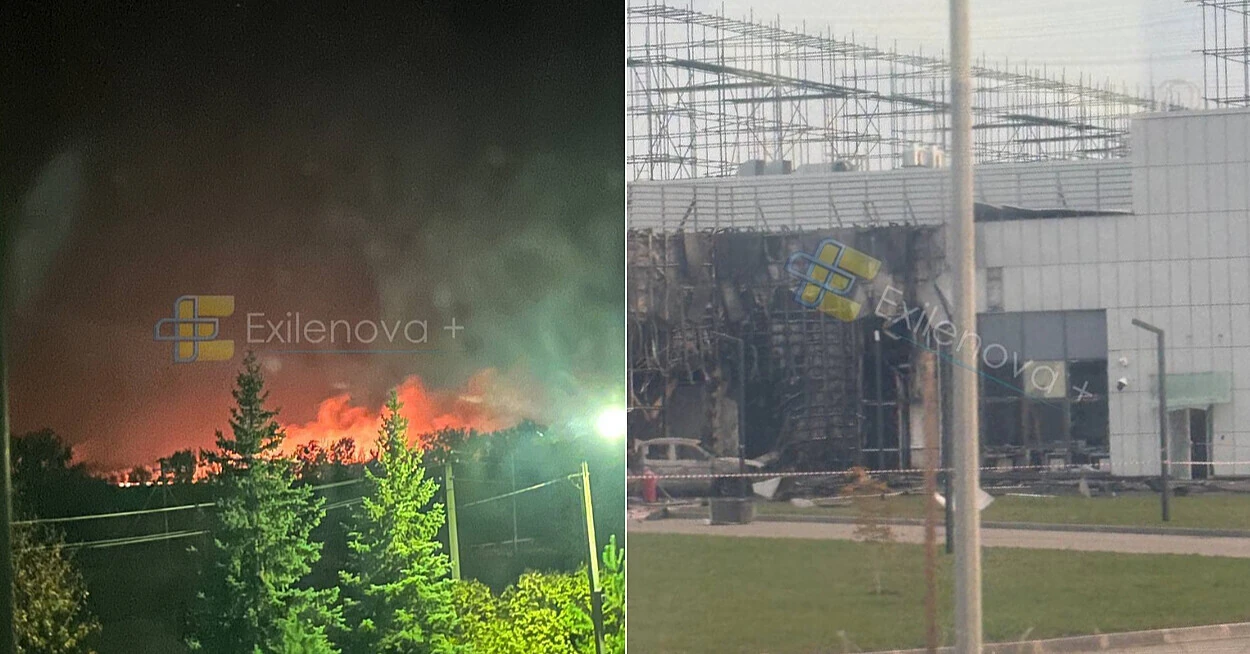
On the night of October 14, Russia faced a new wave of massive drone attacks. In the Saratov region, strikes were reported on industrial and energy facilities; in Rostov-on-Don, an oil loading terminal has been burning for the fourth day, and Moscow airports suspended operations for several hours.
The consequences of the attacks were reported by the Russian independent outlet Astra and the Ukrainian monitoring channel Exilenova+.
In Rostov-on-Don, a drone strike disabled at least 8 of 12 tanks at the oil loading terminal of the Novoshakhtinsk Oil Products Plant (NZNP). OSINT analysts from Astra reached this conclusion after examining new videos from witnesses.
The terminal was attacked on the night of October 10. The fire continued over the following days. In footage from October 12, open flames were no longer visible, although smoke remained over the facility. At that point, the outlet's analysts identified damage to seven tanks.
However, on the evening of October 13, a new explosion occurred at the terminal. According to Exilenova+, another tank exploded, followed by a massive fire. The published videos show a tall column of flames. The new footage allowed Astra to determine that the number of disabled tanks had risen to at least eight.
The NZNP oil loading terminal, formerly known as "Yug Rusi", belongs to the Novoshakhtinsk Oil Products Plant. Its capacity ranges from 2.5 to 3.5 million tons of oil products per year. The facility is used for transshipment of fuel for export, providing foreign currency earnings to the Russian Federation, and is also involved in supplying fuel to the Russian army.
Another target of the night attack was the city of Balakovo in the Saratov region. Local residents reported dozens of explosions over several hours. Fires broke out in the city, and power outages were observed.
The monitoring channel Exilenova+ published videos that, according to its claim, confirm strikes on the territory of a large data center of Sberbank and the industrial zone of the metallurgical plant "MZ Balakovo".

According to the channel, the NASA FIRMS satellite service recorded fire hotspots in the industrial district of the city. However, independent confirmation of the extent of damage to both facilities is not yet available.
The Sberbank data center is one of the largest infrastructure projects of the Russian bank. Its cost is estimated at 122.2 billion rubles. The complex is designed for approximately 3,000 server racks and 120,000 servers with a total electrical capacity of up to 82 MW. Construction is still ongoing, although some parts may already be operational.
The metallurgical plant "MZ Balakovo" specializes in the production of steel, rebar, and other rolled metal products. The enterprise's capacity exceeds 1 million tons of rolled steel per year.
The governor of the Saratov region, Roman Busargin, confirmed the drone attack on Balakovo. According to him, several residential buildings were damaged and one person died. Astra analysts also identified the location of damage to one of the buildings near the Balakovo CHP plant, which is the main source of heat supply for the city. There is no confirmed data on damage to the thermal power plant itself.
Meanwhile, the Moscow region also suffered a massive drone attack. According to Moscow Mayor Sergei Sobyanin, from the evening of October 13 to the morning of October 14, 493 drones flew toward the region. Russian authorities claimed that most of them were neutralized on distant approaches, and another 180 were shot down as they approached the capital.
Due to the drone threat, all four Moscow airports - Sheremetyevo, Domodedovo, Vnukovo, and Zhukovsky - temporarily suspended arrivals and departures.
The longest restrictions were in effect at Vnukovo, which was out of operation for more than eight hours. Passengers who were already on board planes were returned to the terminals. On the morning of October 14, Russian aviation authorities reported the cancellation of restrictions, but the disruptions affected flight schedules.