

Stablecoins in the crypto market: largest players and risks for holders
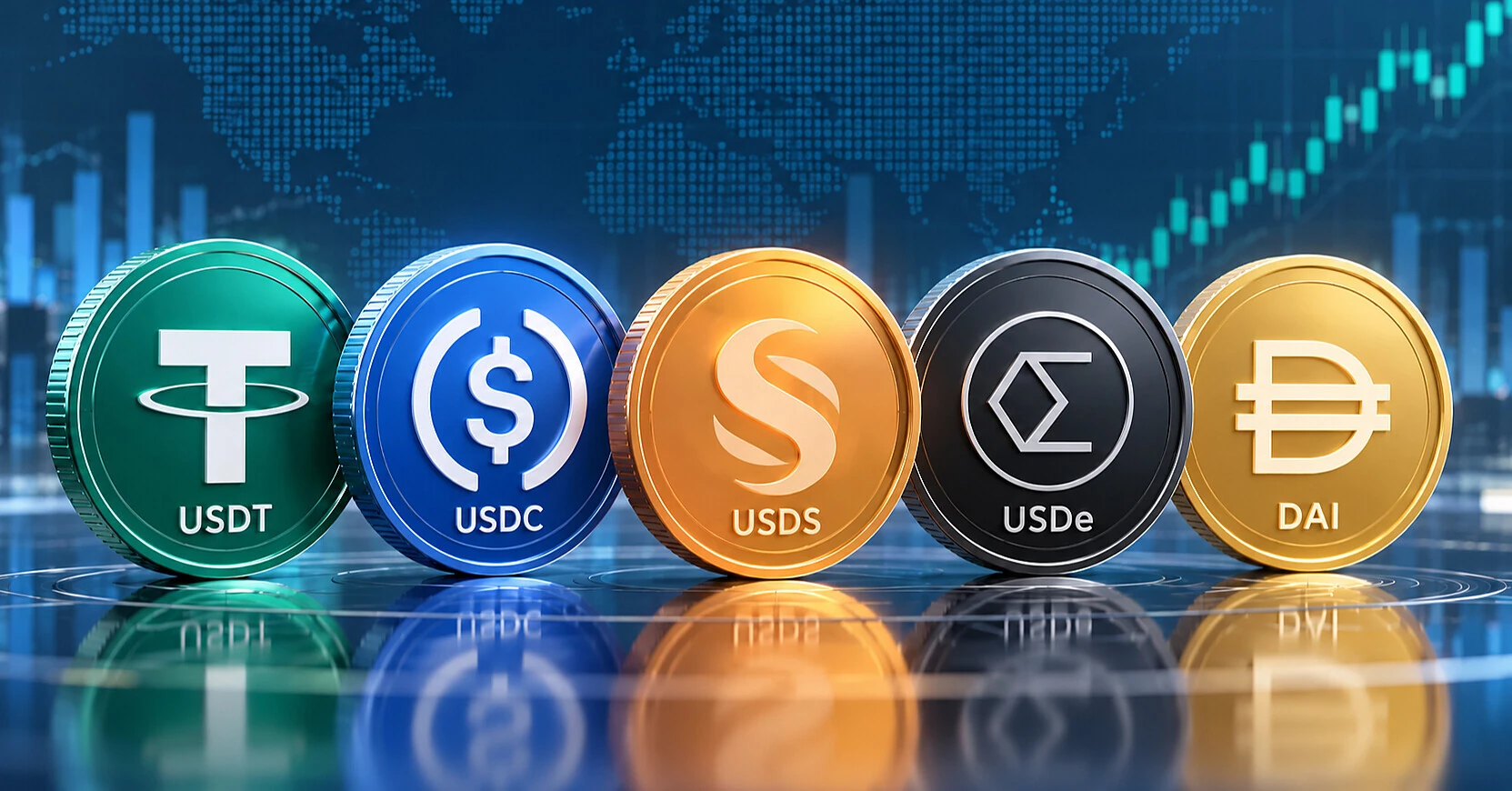
Stablecoins have become one of the key instruments of the cryptocurrency market. They are used for settlements between exchanges, trading Bitcoin and other digital assets, transfers between crypto wallets, and storing funds without constant exposure to price fluctuations of cryptocurrencies.
Unlike Bitcoin or Ethereum, most stablecoins are pegged to a specific currency — most often the U.S. dollar — and aim to maintain a value of about $1. However, such a peg does not mean a complete absence of risks: the token price may temporarily deviate from the target level, and the reliability of different projects varies significantly.
Largest stablecoins: issuance volume and issuers
According to a market aggregator, as of October 15, 2026, the total capitalization of tracked stablecoins is about $300 billion. The largest market shares are held by USDT and USDC.
Capitalization and price data are approximate as of October 15, 2026. The indicators change in real time.
| Stablecoin | Issuer / project | Circulating supply, approx. | Market capitalization |
| USDT | Tether | 184.1 billion tokens | $183.9 billion |
| USDC | Circle | 72.7 billion tokens | $72.7 billion |
| USDS | Sky Protocol | about 10.2 billion | $10.2 billion |
| USDe | Ethena | 4.77 billion tokens | $4.76 billion |
| DAI | Sky Protocol, formerly MakerDAO | 4.52 billion tokens | $4.52 billion |
| USD1 | World Liberty Financial / BitGo | about 4.1 billion | $4.1 billion |
| USDG | Paxos / Global Dollar Network | about 3.1 billion | $3.1 billion |
| PYUSD | PayPal USD, issuer Paxos | about 2.9 billion | $2.9 billion |
| RLUSD | Ripple, through a regulated subsidiary | about 2.4 billion | $2.4 billion |
Sources: market aggregators CoinMarketCap, DefiLlama and issuer data. Capitalization approximately corresponds to the value of tokens in circulation, but may differ slightly due to price deviations from $1 and differences in calculation methodologies.
USDT — the largest stablecoin in the market
Tether (USDT) $0.9986
Capitalization — about $183.9 billion
USDT is the most widely used stablecoin, employed on cryptocurrency exchanges, in international transfers, and in settlements among participants of the digital market. It is issued by Tether.
The token's backing includes cash, short-term U.S. Treasury bills and other assets reflected in the company's reporting. The issuer maintains a mechanism for token issuance and redemption designed to keep their value at about one dollar.
On October 15, the price of USDT was approximately $0.9986, i.e. about 0.14% below the target level. Under normal conditions, deviations are generally small, but during market turmoil, liquidity problems, or doubts about reserve quality, they may increase.
USDC — Tether's main competitor
USD Coin (USDC) $0.9997
Capitalization — about $72.7 billion
USDC is issued by Circle. The token is backed by reserves, mainly cash and short-term U.S. Treasury securities. Circle publishes information about reserves and uses independent procedures to confirm their composition.
USDC is widely used in settlements, decentralized finance (DeFi) services, and corporate payment solutions. Its capitalization is about 40% of USDT's.
At the considered moment, USDC was trading around $0.9997 — only 0.03% below the target rate. However, even this stablecoin has experienced serious deviations: in March 2023, after problems with access to part of its reserves in Silicon Valley Bank, its price on some markets fell significantly below $1.
USDS and DAI — Sky ecosystem stablecoins
Sky Dollar (USDS) $1.00
Capitalization — about $10.2 billion
USDS is a dollar stablecoin of the Sky Protocol ecosystem, formerly known as MakerDAO. Its backing model involves crypto collateral and other permissible assets. The token is used in DeFi and is part of the project's updated infrastructure.
Dai (DAI) $0.9996
Capitalization — about $4.52 billion
DAI is an earlier stablecoin of the same project. Unlike USDT and USDC, its peg maintenance mechanism is based on a system of collateral, smart contracts, and protocol governance.
Both assets maintain a $1 target, but the risks differ from traditional stablecoins: price and stability can be affected by collateral value, liquidations, technical failures, and protocol governance parameters.
USDe — Ethena's synthetic dollar
Ethena USDe (USDe) $0.9993
Capitalization — about $4.76 billion
USDe differs from stablecoins directly backed by cash and government bonds. Its value maintenance mechanism relies on crypto assets and hedging positions on derivative markets. This design aims to reduce the impact of changes in underlying asset prices.
The main advantage of the model is the ability to integrate with crypto financial services. But the risks are higher and more complex: the reliability of exchanges and counterparties, funding of derivative positions, liquidity, and correct functioning of hedging mechanisms all matter. Therefore, USDe should not be considered a complete analogue of a bank dollar.
USD1, USDG, PYUSD and RLUSD: other notable market participants
USD1
The project is connected with World Liberty Financial (Trump's company), and token issuance is carried out by BitGo. USD1 is a stablecoin with traditional backing. Capitalization is approximately $4.1 billion.
Global Dollar (USDG)
Issued within the Global Dollar Network with participation from Paxos. It is intended for settlements and use in digital financial services. Capitalization is about $3.1 billion.
PayPal USD (PYUSD)
Branded by PayPal, but the legal issuer is Paxos. The token is backed by reserve assets and used in payment and cryptocurrency infrastructure. Capitalization is about $2.9 billion.
Ripple USD (RLUSD)
Issued through Standard Custody & Trust Company, associated with Ripple. The backing is oriented towards cash and liquid reserve assets. Capitalization is about $2.4 billion.
How much do stablecoin prices fluctuate?
Stablecoins are not intended for profit through rate growth. Their task is to maintain value close to the established target. Therefore, deviations from $1 are more important than percentage changes typical of ordinary cryptocurrencies.
Below are indicators of prices for several dollar stablecoins at the time of report preparation.
| Token | Price | Deviation from $1 |
| USDT | $0.9986 | −0.14% |
| USDC | $0.9997 | −0.03% |
| USDe | $0.9993 | −0.07% |
| DAI | $0.9996 | −0.04% |
These figures show that at the time of checking, the prices were close to the target level. However, the table does not reflect maximum historical deviations. For a full risk assessment, one must consider the token's behavior during crisis periods, trading depth, and redemption ability at par.
Why a stablecoin can lose its dollar peg
Main reasons for deviation from $1:
- Reserve problems. If the market doubts that the issuer has sufficient liquid assets, demand for the token may sharply decline.
- Liquidity shortages. During mass selling, a token may temporarily cost less than a dollar even with backing.
- Banking and counterparty risks. Problems at banks, custodians, or trading platforms may hinder reserve operations.
- Smart contract and collateral risks. For decentralized models, technical vulnerabilities and sharp drops in collateral value are significant.
- Regulatory restrictions. Bans, blockages, and redemption limitations can affect token access for certain users.
The history of USDC in March 2023 shows that even a large stablecoin with traditional backing is not immune to sharp exchange rate deviations.
What to choose for storing funds
The choice depends on the purpose of use. USDT stands out with the greatest scale and widespread presence on crypto exchanges. USDC may be convenient for those who place particular importance on reserve disclosure. USDS and DAI are focused on decentralized financial services, and USDe uses a more complex synthetic peg-maintenance model.
At the same time, no stablecoin is equivalent to a bank deposit in U.S. dollars: its holder may face peg loss, restricted access to funds, technical problems, or issuer risks. Before purchasing, one should verify the transfer network, fees, liquidity, redemption conditions, and up-to-date reserve information.
The main conclusion: the stablecoin market remains highly concentrated — USDT and USDC significantly outpace other participants. But capitalization and price proximity to $1 do not by themselves guarantee reliability. For assessing a specific token, the quality of backing, transparency of the issuer, and stability of the peg-maintenance mechanism are primarily important.