

Massive drone attack on St. Petersburg: oil terminal and Ruchyi oil depot caught fire, casualties reported
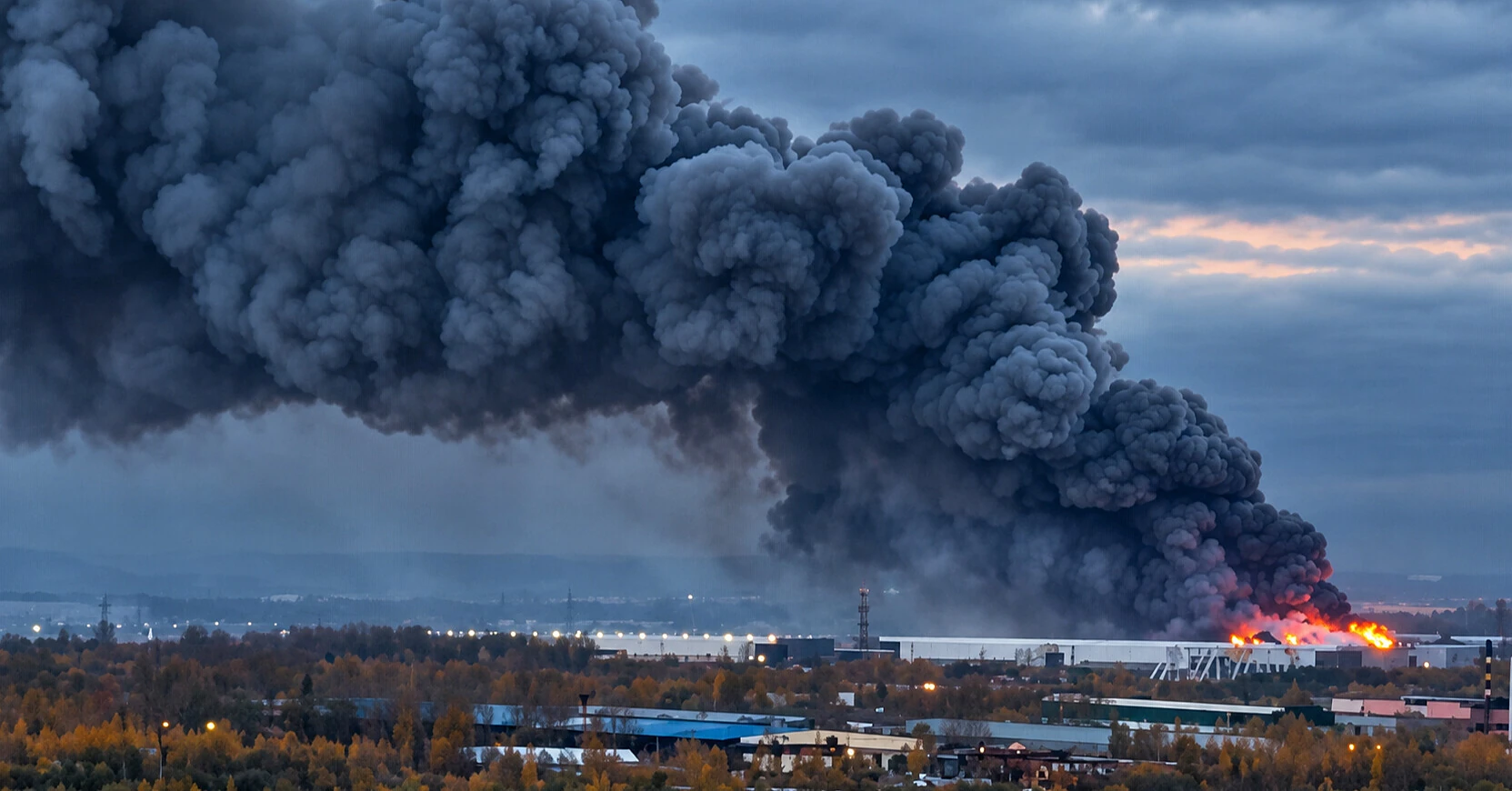
On the night of October 18, St. Petersburg and the Leningrad region came under a massive drone attack. The Petersburg Oil Terminal, the Ruchyi oil depot, and industrial warehouses caught fire in the city. According to Governor Alexander Beglov, one person died and five others were hospitalized as a result of the attack. Residential buildings were damaged, and Pulkovo Airport did not accept flights for more than seven hours. The extent of damage to oil infrastructure and possible consequences for exports are not yet known.
Russian authorities reported fires at oil facilities on Sunday morning. St. Petersburg Governor Alexander Beglov said the city was attacked by drones, which he called Ukrainian.
Damage to infrastructure and residential buildings was also reported in the neighboring Leningrad region. Governor Alexander Drozdenko said 144 drones were shot down over the region.
This number refers specifically to the Leningrad region, not St. Petersburg. There is no independent confirmation of the total number of drones involved in the attack yet.
What happened at the oil terminal and Ruchyi oil depot
Initial reports of explosions and air defense operations began coming in at night. Residents of various districts of St. Petersburg reported loud sounds, and local authorities announced a drone attack threat.
Around 05:30 a.m., Beglov confirmed that fires had broken out at several infrastructure facilities.
Among them was the Petersburg Oil Terminal, a large complex for storage and transshipment of petroleum products located in the port area of the city.
Later, the governor clarified that firefighters were also working at the Ruchyi oil depot and industrial warehouses in the Kolpinsky district.
According to RBC, a warehouse of Ozon company on Sofiyskaya Street also caught fire as a result of the attack. Company representatives said that staff were evacuated and there were no injuries among employees.
Fires and infrastructure damage were recorded in the Nevsky, Krasnoselsky, Krasnogvardeysky, and Moskovsky districts of St. Petersburg.
At the same time, the exact nature of damage to the Petersburg Oil Terminal has not yet been disclosed.
It is unknown whether petroleum storage tanks, pumping equipment or other production facilities were damaged. There is also no confirmed information about a complete halt in cargo transshipment through the terminal.
Russian authorities report ongoing firefighting efforts but provide no estimates of economic damage.
One dead and five hospitalized
Initially, on the morning of October 18, Russian authorities reported no deaths in St. Petersburg.
However, later Governor Alexander Beglov clarified data on the consequences of the attack.
According to him, one person died, five others were injured and are in hospitals.
Also, 12 apartment buildings and two private houses were damaged.
In some buildings, residents were evacuated overnight. After the air danger was canceled, people began returning to their apartments.
City services have begun restoration work.
At the same time, Beglov did not specify where exactly the person died and under what circumstances the victims were injured.
Therefore, there are no grounds yet to link the death directly to the fire at the oil terminal or the Ruchyi oil depot.
144 drones shot down reported in Leningrad region
Large-scale consequences of the night attack were also recorded outside St. Petersburg.
Leningrad Region Governor Alexander Drozdenko reported that 144 drones were shot down over the region.
According to local authorities, drone debris fell on residential buildings in Vsevolozhsk and Gatchina, as well as two private houses in the Kirovsky district.
In the Vsevolozhsky district, after a fire, a woman and three children were hospitalized with signs of carbon monoxide poisoning.
In the settlement of Yanino, power supply disruptions occurred. According to RBC, about 20 thousand people were temporarily without electricity.
In addition, a data center of VK company was attacked.
Company representatives confirmed the report of an attack on the facility but stated that the main VKontakte services continued to operate normally.
In St. Petersburg, disruptions in mobile internet and electricity were also reported in some districts.
Pulkovo Airport did not accept flights for more than seven hours
The attack seriously affected the operation of the largest airport in St. Petersburg.
Pulkovo temporarily suspended the reception and departure of aircraft. Restrictions lasted for more than seven hours.
According to information from the airport's press service, cited by RBC, as of 08:00 Moscow time, 32 flights were delayed and 21 more departures were canceled.
Eleven aircraft heading to St. Petersburg were diverted to alternate airfields.
Passengers at the airport during the restrictions were directed to safe zones.
Pulkovo warned that to fully restore normal schedule after a prolonged shutdown, at least 24 hours may be required.
The consequences of the attack also affected road traffic.
In the city, traffic was temporarily restricted on certain sections of the Western High-Speed Diameter and in the area of the Bolshoy Obukhovsky Bridge.
After the air danger was lifted, transport services began restoring traffic.
Why the Petersburg Oil Terminal matters for Russian exports
The Petersburg Oil Terminal is located in the seaport of St. Petersburg, on the shore of the Gulf of Finland.
It is one of the major complexes for transshipment of petroleum products in northwestern Russia.
According to the company, its total capacity is 12.5 million tons per year.
The terminal occupies an area of about 37 hectares and has a tank farm, railway infrastructure, and berths for servicing sea vessels.
The enterprise handles reception, storage and loading of various petroleum products, including diesel fuel and fuel oil.
Its location in the Baltic region makes the complex an important element of transport infrastructure related to deliveries of petroleum products to external markets.
However, the capacity of 12.5 million tons is a technical characteristic of the terminal, not the actual annual export volume and certainly not an assessment of losses after the attack.
To determine the real consequences of the fire, it is necessary to establish which specific capacities were damaged and how prolonged the disruption to the plant may be.
As of the morning of October 18, there is no such data.
The oil terminal was already attacked in June and July
This is not the first report of an attack on the Petersburg Oil Terminal in 2026.
On June 3, drones struck the facility during the St. Petersburg International Economic Forum. Reports of the fire then appeared in Russian and Ukrainian media, and later satellite images of the aftermath were published.
On July 4, the Security Service of Ukraine officially announced a new hit on the terminal as part of a joint operation with other units of the Ukrainian Defense Forces.
According to the SBU, at that time, as a result of several hits, at least three fires broke out on the territory of the enterprise.
Ukrainian intelligence explained the strikes as aimed at limiting Russia's ability to receive income from oil infrastructure and support its own military logistics.
The current attack on October 18 is a separate event. Its consequences cannot be automatically equated with the damage from previous strikes.
What is known about the results of the attack on October 18
According to the latest available reports from Russian authorities on Sunday morning, extinguishing of fires at the oil terminal, the Ruchyi oil depot, and a number of industrial facilities continues in St. Petersburg.
The authorities confirmed one death and five hospitalizations in the city. Residential buildings were damaged, and restoration work continues.
In the Leningrad region, authorities reported 144 downed drones, infrastructure damage, and electricity disruptions.
The attack also caused a prolonged shutdown of Pulkovo Airport and disruptions in road traffic.
At the same time, the key question how seriously the oil infrastructure was damaged is still open.
Official information on the extent of tank damage, shutdown of petroleum transshipment or reduction in export supplies has not been published.
Russian authorities blamed the attack on Ukraine. However, there was no separate official statement from the Ukrainian military or intelligence services confirming their involvement specifically in the events of October 18 at the time of preparation of this material.
Thus, so far only reports of fires, casualties and disruptions in city infrastructure are reliably known. Economic consequences of the strike on the oil terminal will become clearer after data appears on the actual state of the facility and the duration of possible restrictions on its operation.
Based on materials of: RBC - consequences of the massive attack on St. Petersburg and Leningrad region, RBC - data on the dead and injured, Suspilne - attack on the oil terminal and VK data center, Petersburg Oil Terminal - about the company, SBU - report of previous strike on July 4, 2026.