
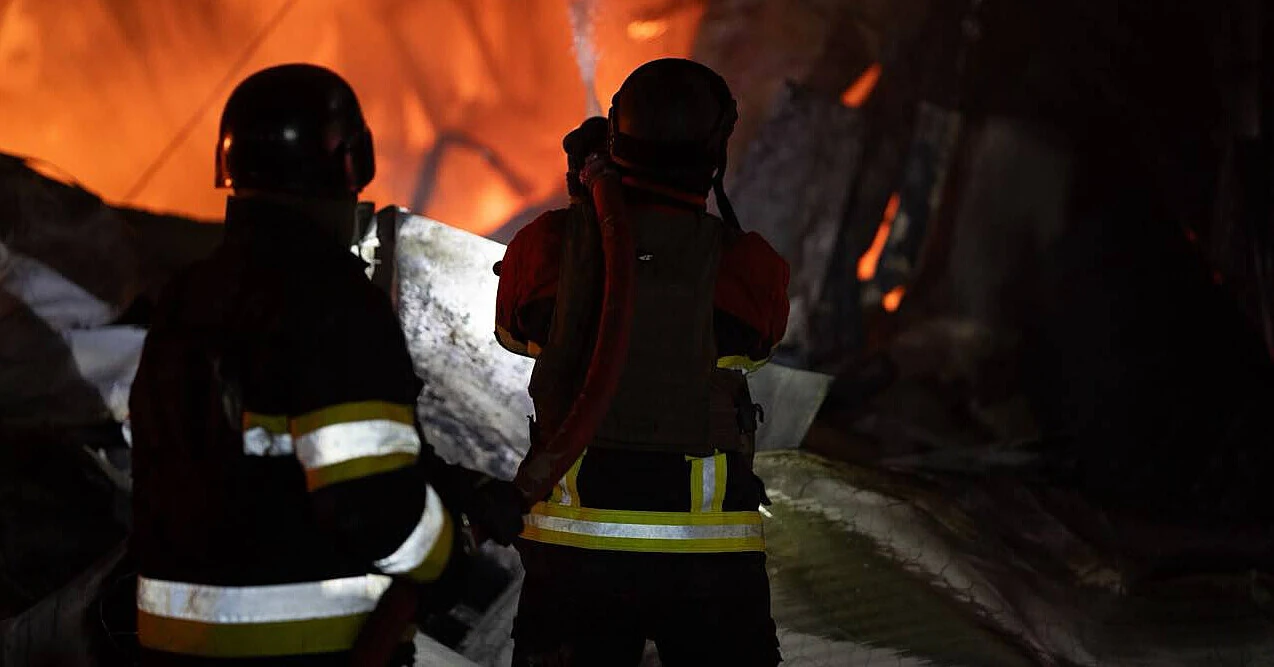
During a massive attack on Kyiv in the night of October 22, Russian troops used three ballistic missiles with cluster warheads. One of them struck the historic center of the capital, hitting the area between the Kyiv-Pechersk Lavra and the Holy Vvedensky Monastery. Buildings of the monastery, residential houses, shops, cafes and other civilian infrastructure were damaged.
This was reported by President of Ukraine Volodymyr Zelensky after reports on the elimination of the consequences of Russian shelling.
According to the head of state, the cluster warheads of the used missiles deploy in the air while approaching the target, ensuring the destruction of an area with a diameter of about 400 meters. Due to the scattering of submunitions, such weapons can simultaneously hit a large number of objects over a significant area.
The President clarified that one of the three missiles struck in the Pechersk district of Kyiv, not far from two famous monastic complexes. As a result of the strike, historic buildings and civilian objects were damaged.
Zelensky emphasized that there were no military objects in the affected area. In his conviction, the use of cluster munitions in the densely built part of the city demonstrates a deliberate desire of the Russian troops to inflict maximum harm on the civilian population.
"This is a deliberate choice of weapon, a deliberate choice of the area of use," the president stated.
He also noted that the nature of the attack does not indicate a change in Russia's approach to waging war or readiness to cease hostilities.
Earlier, the use of a cluster ballistic missile on the historic center of Kyiv was reported by the president's advisor on defense technologies, Serhiy Beskrestnov, known as "Flash". According to his information, Russian troops used an "Iskander" missile with a K5 cluster warhead.
Beskrestnov explained that such a warhead contains 58 submunitions that explode in the air. According to his assessment, they can affect an area of approximately 400 by 400 meters. The specialist also believed that the use of this munition in the center of the capital was aimed at inflicting significant casualties among the civilian population.
Meanwhile, in his first statement after the night attack, Zelensky reported that Russian troops carried out three waves of ballistic strikes on Kyiv, launching a total of 21 missiles. The new message from the president clarifies that three of these missiles had cluster warheads.
During the attack, residential buildings, energy facilities, infrastructure of one of the railway stations and the metro, shopping centers and enterprises were also damaged.
According to the Air Force of the Armed Forces of Ukraine, during the combined strike, Russia used missiles "Iskander-M", S-400, "Zircon" and "Oniks". In addition, the enemy launched 210 drones of various types, including 110 jet drones.
As of 09:00, air defense forces shot down or suppressed 181 drones, including 87 jet drones. Hit of air attack means were recorded at 32 locations, and falling debris were detected at another eight.
In total, on the night of October 22, 12 regions of Ukraine were subjected to Russian attacks. In his first morning report, Zelensky noted that across the country there were two killed and 34 wounded, including five children.
The President emphasized that the attack occurred almost immediately after another round of negotiations on a possible end to the war. In his opinion, to stop Russian strikes, increased international pressure and accelerated supply of air defense systems to Ukraine are necessary.
Based on materials: Volodymyr Zelensky, Serhiy Beskrestnov, Air Force of the Armed Forces of Ukraine
