
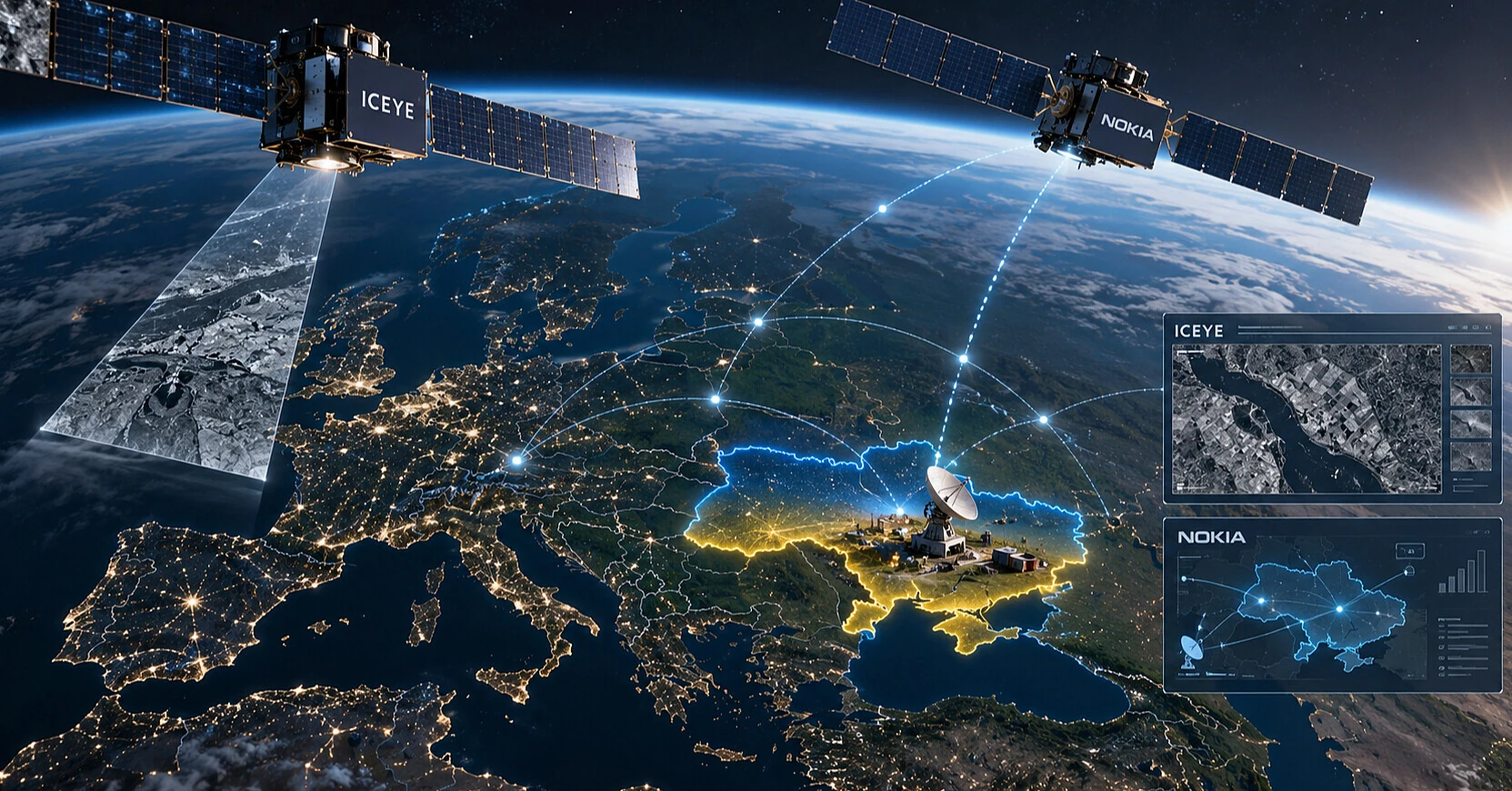
The Ministry of Defense of Ukraine signed a letter of intent with Finnish technology companies ICEYE and Nokia on cooperation in the space sector. One of the main areas of partnership may be the creation of its own protected satellite communications system that will be under Ukraine's control.
ICEYE and Nokia announced the signing of the document on October 22. The agreement was announced during the visit of Finnish Prime Minister Petteri Orpo to Ukraine.
The signed letter envisages exploring cooperation opportunities in creating a sovereign satellite communications system for defense needs. A key feature of the future system is Ukraine's ability to independently control the satellites, ground infrastructure, and communication terminals, without depending on the operating conditions of a third-party commercial operator.
This concerns secure broadband communications using low Earth orbit (LEO) satellites. Such systems provide high data transmission speeds with low latency and can maintain communications even in conditions where ground telecommunications networks are damaged.
ICEYE CEO and co-founder Rafal Modrzewski emphasized that Ukraine needs satellite infrastructure that it can control independently. According to him, the company has experience in rapidly creating such systems and will continue to support Ukraine, with which it has cooperated since 2022.
Nokia Defense head Mikko Hautala noted that satellite networks are capable of providing reliable communications in situations where ground infrastructure is damaged or unavailable. He confirmed the company's readiness to explore together with Ukraine and ICEYE the possibilities of creating a protected system that will strengthen the resilience of Ukrainian communications.
Earlier, on October 1, Nokia and ICEYE already announced a partnership to develop low-orbit satellite communications systems for governments and military customers. They are intended not only for defense needs, but also for border guard, rescue services, and disaster response.
The companies plan to launch the first communication satellites under this project into orbit in 2028. However, this is the overall technology development timeline, not a confirmed launch date for the Ukrainian system.
ICEYE will be responsible for space technology and satellite constellation operations experience, while Nokia will handle secure telecommunications networks and communication infrastructure.
Currently, the parties have signed a letter of intent, not a contract for creating a satellite constellation for Ukraine. The cost of the potential project, funding sources, number of satellites, and implementation timelines have not yet been announced.
President of Ukraine Volodymyr Zelenskyy confirmed the agreement on broader use of Finnish satellite capabilities to strengthen Ukrainian defense. According to him, during Petteri Orpo's visit, the parties signed seven documents with a total agreement volume of about 300 million euros. However, the president did not name a specific funding amount for the satellite project.
ICEYE already cooperates with Ukraine in the field of space reconnaissance. In January 2026, it announced expanded access of the Ukrainian Ministry of Defense to high-resolution radar satellite imagery that can be obtained regardless of weather conditions and time of day.
The new agreement concerns a different direction - the creation of its own satellite communications infrastructure. It potentially will allow Ukraine to reduce dependence on commercial systems, including Starlink and the military service Starshield, whose operations are determined by the supplier's conditions and relevant decisions of the American side.
This is especially relevant in light of recent Starshield restrictions for the Ukrainian military, which, among other things, affected long-range strikes. At the same time, US President Donald Trump stated that Elon Musk canceled speed limitations on satellite communications for the Ukrainian military.
Meanwhile, Nokia and ICEYE position their future satellite systems as a complement to existing military and commercial networks, not a full replacement.
Sources: ICEYE, Nokia, Volodymyr Zelenskyy
