
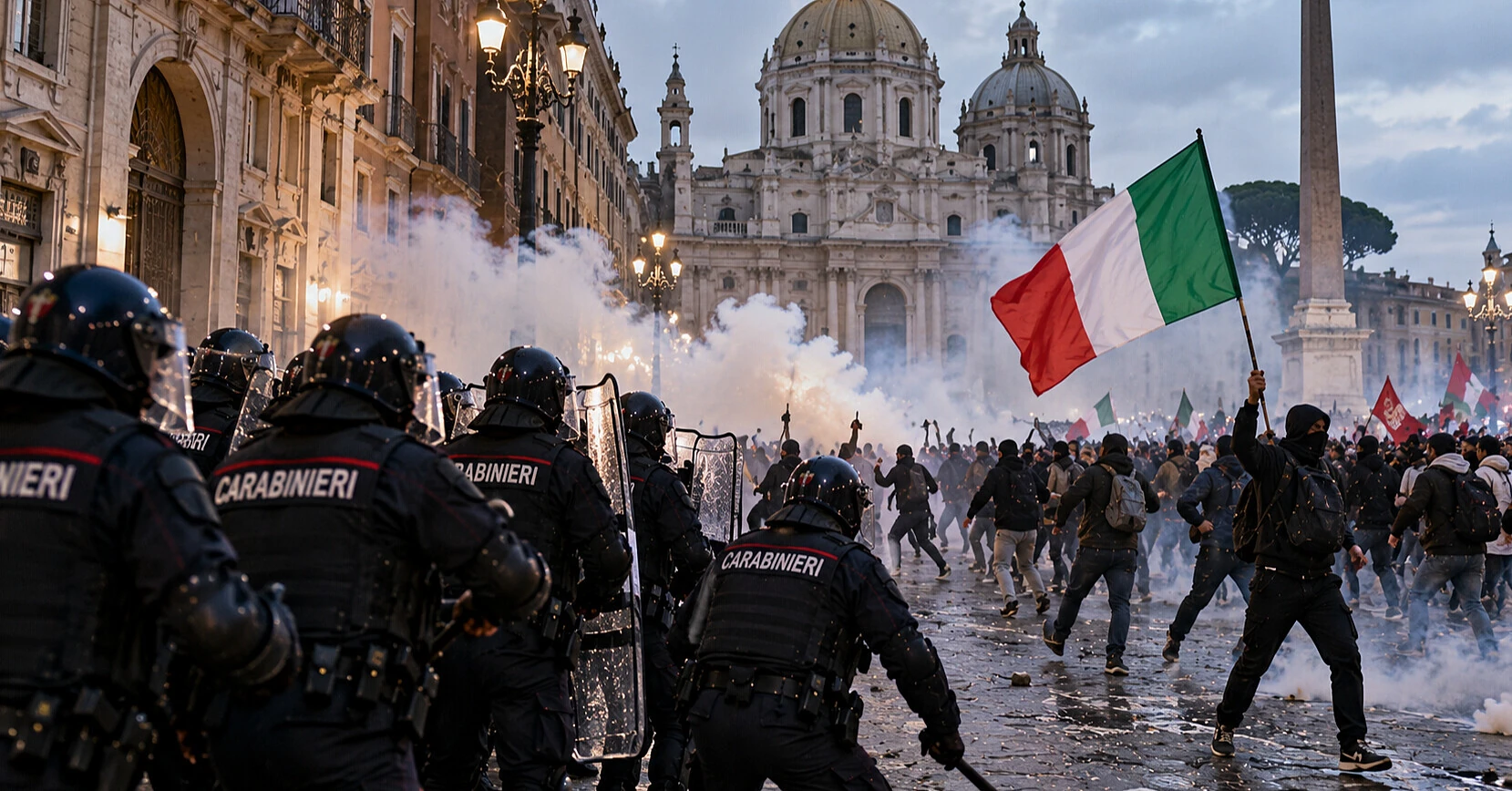
Italian authorities are strengthening security measures ahead of new mass protests scheduled for Saturday, October 24. In several major cities, additional law enforcement units have been placed on alert, and 500 troops have been sent to Milan.
This was reported on October 23 by German news agency dpa. Further details are provided by Italian media outlets Corriere della Sera and La Repubblica.
The strictest security measures are being introduced in Milan, where authorities fear a repeat of the riots and clashes with police that occurred on October 17–18.
500 troops from the Folgore parachute brigade have been deployed to the city. They will assist police and carabinieri in patrolling streets, guarding railway stations, important institutions, and other facilities.
Interior Minister Matteo Piantedosi said that reinforced patrols must be ready for rapid response in different parts of the city. Particular attention is being paid to the historic center of Milan, including Piazza del Duomo and surrounding shopping streets, where the most serious riots previously occurred.
However, the military will not receive additional police powers. Their tasks will be limited to patrolling, surveillance, and guarding facilities under the ongoing Strade Sicure (“Safe Streets”) program.
Authorities are also increasing control at railway stations in the Lombardy region to prevent the arrival of organized groups that could take part in riots.
According to Corriere della Sera, police are preparing to apply legally prescribed measures for preventive detention of persons against whom there are relevant grounds.
Authorities intend to ban mass demonstrations in central Milan over the weekend. At the same time, they do not plan to impose a curfew similar to the restrictions that were implemented in neighboring France.
Shops, museums, and metro stations are expected to remain open for now. They may be temporarily closed only if the situation deteriorates.
Protests expected in several Italian cities
According to Italian media, new protests are planned not only in Milan but also in Rome, Turin, Bologna, Florence, and other cities.
Calls for demonstrations are being spread via social networks and messaging apps. Among the organizers and participants are student collectives, civic movements, and groups protesting against the high cost of living, expensive housing, and the government’s economic policies.
In some cities, law enforcement also fears clashes between protest participants and representatives of radical movements.
Authorities are monitoring social media messages containing calls to repeat the riots that occurred a week ago.
As La Repubblica reports, some groups have withdrawn from previously planned demonstrations, but organizers of the “October 17” movement continue to spread calls for new actions.
In Rome, Turin, and other major cities, police presence has also been reinforced. Additional measures are being taken near transport hubs, public buildings, and central squares.
Police conducted searches in 18 cities
In parallel with preparations for new protests, Italian law enforcement is conducting large-scale investigative activities following the riots of October 17–18.
According to ANSA, on October 23, officers of the Digos political police units carried out searches in 18 Italian cities.
The investigative actions involved around 100 people identified during the investigation into the mass riots. Among them are 51 minors.
Searches were conducted, in particular, in Bologna, Genoa, Naples, Bari, Florence, Verona, and other cities.
Interior Minister Matteo Piantedosi said investigators are examining possible coordination among riot participants through nationwide networks.
According to him, law enforcement has already found signs of coordination among certain groups. However, the question of whether there were organizers who directed the protests remains under investigation.
Earlier, Kurs.com.ua reported that Italian intelligence services are also checking for possible foreign interference in organizing the mass riots, including alleged activities by Russian structures. There are no confirmed conclusions regarding such interference yet.
Following the previous protests, the government of Prime Minister Giorgia Meloni also approved a tightening of legislation in the field of public security. The new measures provide for additional liability for violence during demonstrations and expand the powers of law enforcement agencies.
