
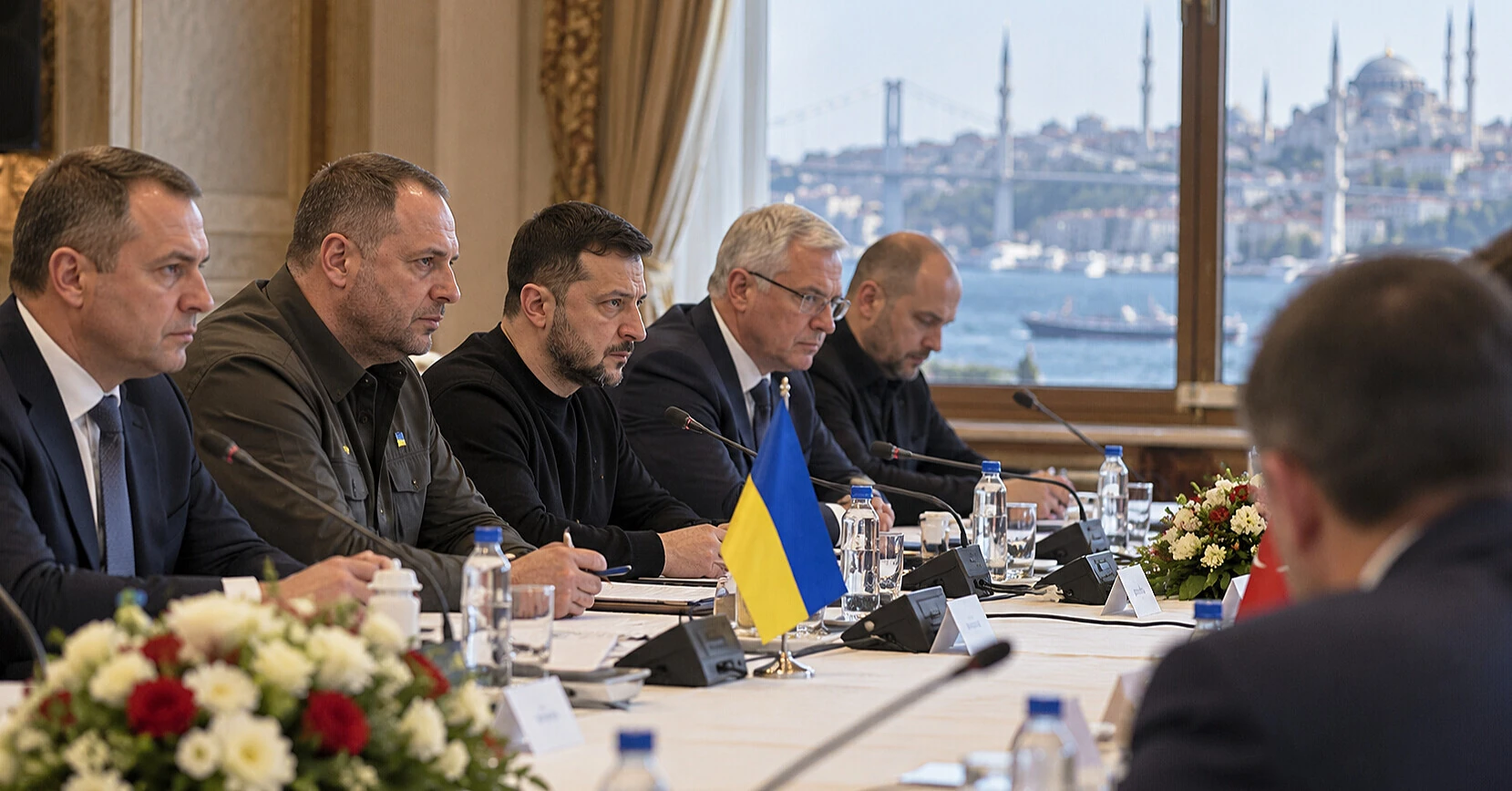
During previous peace talks in Istanbul, the Ukrainian delegation considered the possibility of returning Russian gas to the European market in exchange for directing part of future revenues to Ukraine. Such revenues could become one of the sources of financing for post-war reconstruction. At the same time, Kyiv insisted that resuming supplies would be possible only after the end of the war.
This was reported on October 26 by "Ukrainska Pravda", citing a source from the close circle of President Volodymyr Zelensky.
According to the media outlet's interlocutor, Ukrainian negotiators used the prospect of returning Russian gas to the European Union as one of the possible economic incentives for Moscow to end the war.
The idea envisaged that after the end of hostilities, Russia would be able to regain access to the European gas market, while Ukraine would receive part of the revenues from these supplies to finance the restoration of damaged infrastructure and the economy.
This mechanism was unofficially called "shadow reparations" in the presidential circle. It was considered as a potential alternative or supplement to traditional compensations, obtaining which from Russia remains a difficult issue.
However, there is currently no approved agreement on the distribution of gas revenues. There is also no information about a specific percentage that Ukraine could receive, the volumes of future exports, or the mechanism of transferring funds.
Ukraine and Germany oppose the return of Russian gas before the end of the war
The UP interlocutor emphasized that a fundamental condition of the Ukrainian side was the end of the war before the resumption of Russian gas exports to Europe.
According to him, Kyiv is now actively cooperating with German partners, trying to convince US President Donald Trump not to agree to the resumption of Russian gas supplies while hostilities continue.
Thus, the Ukrainian proposal differs from the approach that, according to UP, some American negotiators have begun to promote.
US President's Special Representative Steve Witkoff and Jared Kushner, in parallel with peace consultations, are discussing opportunities for economic cooperation with Moscow.
According to the media outlet's sources, after Witkoff intensified contacts with the Russian President's economic adviser Kirill Dmitriev, the American side began to consider economic agreements with Russia even before the end of the war.
Among the areas mentioned by UP are operations with foreign assets of Russia's Lukoil, diesel fuel trade, and potential expansion of cooperation in the mineral fertilizer market.
At the same time, reports of such negotiations do not mean that the US and Russia have already reached final agreements on all these areas.
EU has already adopted a ban on Russian gas imports
The possible return of Russia to the European gas market is complicated by the current decisions of the European Union.
On January 26, 2026, the EU Council finally approved a regulation on the phased termination of imports of Russian pipeline and liquefied natural gas.
For short-term contracts, the restrictions have already entered into force. A full ban on imports of Russian LNG under long-term contracts will take effect from January 1, 2027.
For long-term pipeline gas contracts, the ban will apply from September 30, 2027. Under certain conditions related to the filling of gas storage facilities, this deadline may be postponed until November 1.
Therefore, even in the event of a peace agreement between Ukraine and Russia, the resumption of large-scale supplies will require a separate EU decision to change the current regulation.
For the European gas market, the issue remains fundamental. According to the EU Council, the share of Russian gas in the European Union's total imports decreased from 45% in 2021 to about 13% in 2025.
US previously proposed returning Russian gas transit through Ukraine
Earlier, "Kurs Ukrainy" reported, citing The New York Times, that Witkoff and Kushner discussed with Ukrainian and European representatives the possibility of restoring Russian gas transit through Ukraine.
American negotiators considered the return of gas exports as one of the possible economic incentives for Russia to agree to end the war.
For Ukraine, such a scenario could also mean restoring part of the transit revenues that stopped on January 1, 2025, after the contract with Gazprom expired.
However, transit payments and the share of revenues from Russian gas exports proposed by Ukrainian negotiators are not necessarily the same mechanism. UP does not provide details of calculations or the financial structure of the latter.
According to The New York Times, the American initiative has already caused objections among European partners, particularly in Germany, where there are fears of renewed energy dependence on Moscow.
Currently, there is no confirmation that Russia has agreed to the post-war compensation mechanism proposed by Ukraine or that EU countries are ready to reconsider their decisions on abandoning Russian gas.
