
Magnitude 5.0 earthquake in Spain: more than 50 aftershocks, people on the streets and damaged buildings in Granada
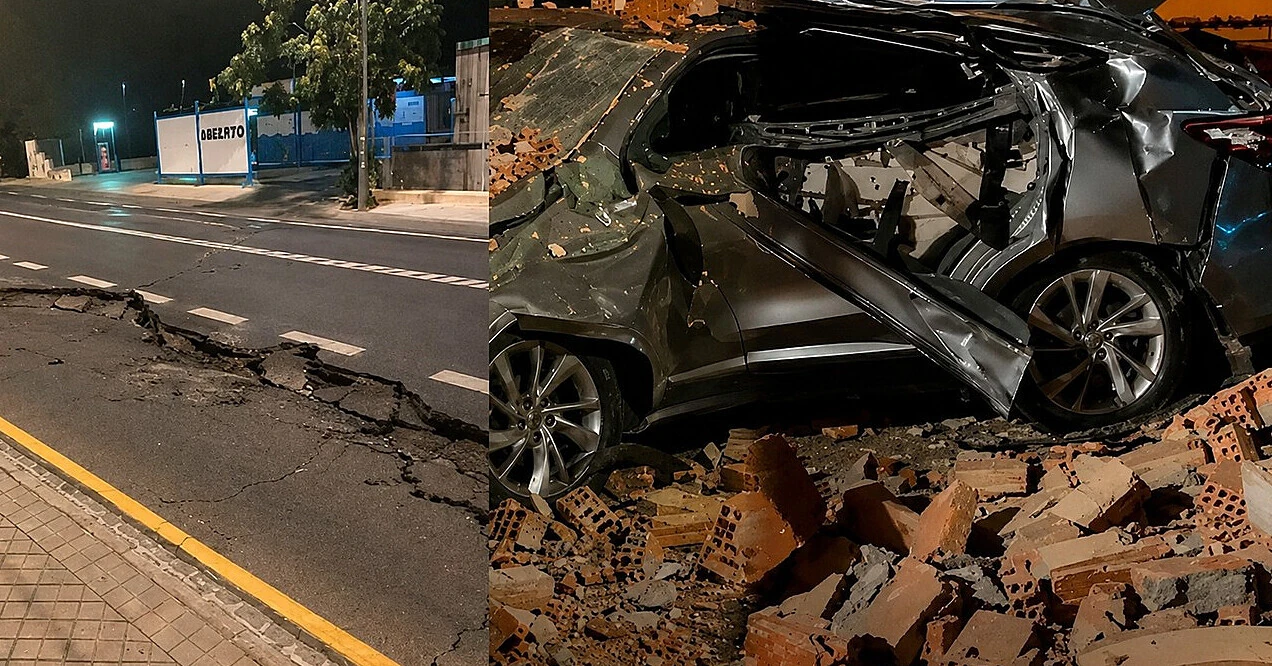
A strong earthquake woke residents of the Spanish province of Granada in the night of August 15. A magnitude 5 tremor occurred at about 01:04 local time, with its epicenter near the municipality of Alhendín in the outskirts of Granada.
The earthquake was felt far beyond the epicenter. Reports of tremors came from different parts of Andalusia and several other regions of Spain.
According to preliminary data, there are no dead or injured. However, the earthquake damaged buildings and cars, and in several localities cornice pieces, facade fragments and other structural elements fell onto the streets.
What is known at this time:
- earthquake magnitude — 5.0;
- epicenter was near Alhendín in the province of Granada;
- no dead or injured have been registered;
- there are cracks, damage to facades, collapses of cornices and walls;
- 112 emergency service received over 200 calls;
- about fifty weaker earthquakes have been recorded after the main tremor.
The earthquake occurred late at night
According to the National Geographic Institute of Spain (IGN), the main tremor occurred at 01:04:40 local time.
Initially some Spanish media reported a magnitude of 4.8, but after data processing, IGN raised the estimate to 5.0. The earthquake was assigned the code es2026pwyek.
The maximum recorded intensity was V–VI on the European Macroseismic Scale. At this level, tremors are strongly felt by the population and may cause minor damage to buildings.
Debris damaged cars
The main consequences so far are material.
Residents reported cracks in walls, falling cornices, facade fragments and masonry. In Alhendín, a collapsed part of a building damaged a parked car.
Damage was also recorded in Granada itself. In particular, the authorities restricted access to certain areas near buildings where there is a risk of further falling elements from facades.
Some historic structures were also affected. Damage was found on the bell tower of the San Miguel Church in the Albaicín quarter, and in La Magdalena Church in the city center some decorative elements fell.
Municipal authorities note that most of the detected damage concerns non-structural elements of buildings.
Authorities raised the response level
The Government of Andalusia activated the Emergency Plan for Seismic Risk in the emergency phase and raised it to operational level 1.
This mode allows for enhanced coordination between regional authorities, municipalities, firefighters, police and other emergency services.
112 Andalucía received more than 200 calls related to the earthquake. Most calls concerned cracks, falling cornices, debris, walls and building damage.
The authorities also engaged the Group of Volunteer Architects of Andalusia to inspect buildings, whose specialists must assess possible risks to structures.
Tremors were felt far from Granada
The earthquake was felt almost throughout the province of Granada and in many other areas of southern Spain.
According to Spanish media and reports collected by IGN, residents of Málaga, Jaén, Almería and Seville felt the tremors.
Some reports also came from Murcia, Cáceres, Ciudad Real, Albacete, Madrid and Toledo.
Many residents of Granada left their homes after the main tremor and spent part of the night on streets, squares and open spaces.
After the first tremor, a series of earthquakes began
The main earthquake was not the only one.
In the first hours after it, IGN registered a series of weaker tremors in the area of Alhendín, Armilla, Ogíjares, Gójar, Otura and other localities around Granada.
By morning, the number of registered aftershocks approached fifty. One of the most notable tremors had a magnitude of 3.3.
Emergency services urge residents not to approach damaged facades, cornices and walls and to follow the instructions of police and firefighters.
Why earthquakes occur in Granada
The province of Granada is one of the most seismically active areas of Spain.
The south of the Iberian Peninsula is in the interaction zone of the Eurasian and African lithospheric plates, so small earthquakes occur here regularly.
Seismic series also periodically occur in the Granada area. One of the most notable ones took place in early 2021, when residents of the region felt many tremors over a short period.
The current earthquake was significantly stronger than most ordinary tremors in the region and occurred at night, when people were at home, causing noticeable panic.
No serious consequences recorded so far
Despite the strength of the tremor and numerous reports of damage, the authorities have not reported any dead or wounded.
Firefighters, police and specialists continue to inspect buildings and cordon off areas where there is a danger of falling damaged elements.
The situation remains under the monitoring of regional authorities, the National Geographic Institute and the Andalusian Institute of Geophysics.
For residents and tourists, the main risk in the coming hours is not so much a new strong earthquake, which cannot be predicted in advance, but possible aftershocks and the fall of already damaged parts of buildings.
Based on materials from: Instituto Geográfico Nacional, El País, Cadena SER
