
Damage from fire in Danube Biosphere Reserve after Russian strike estimated at 14.8 billion UAH
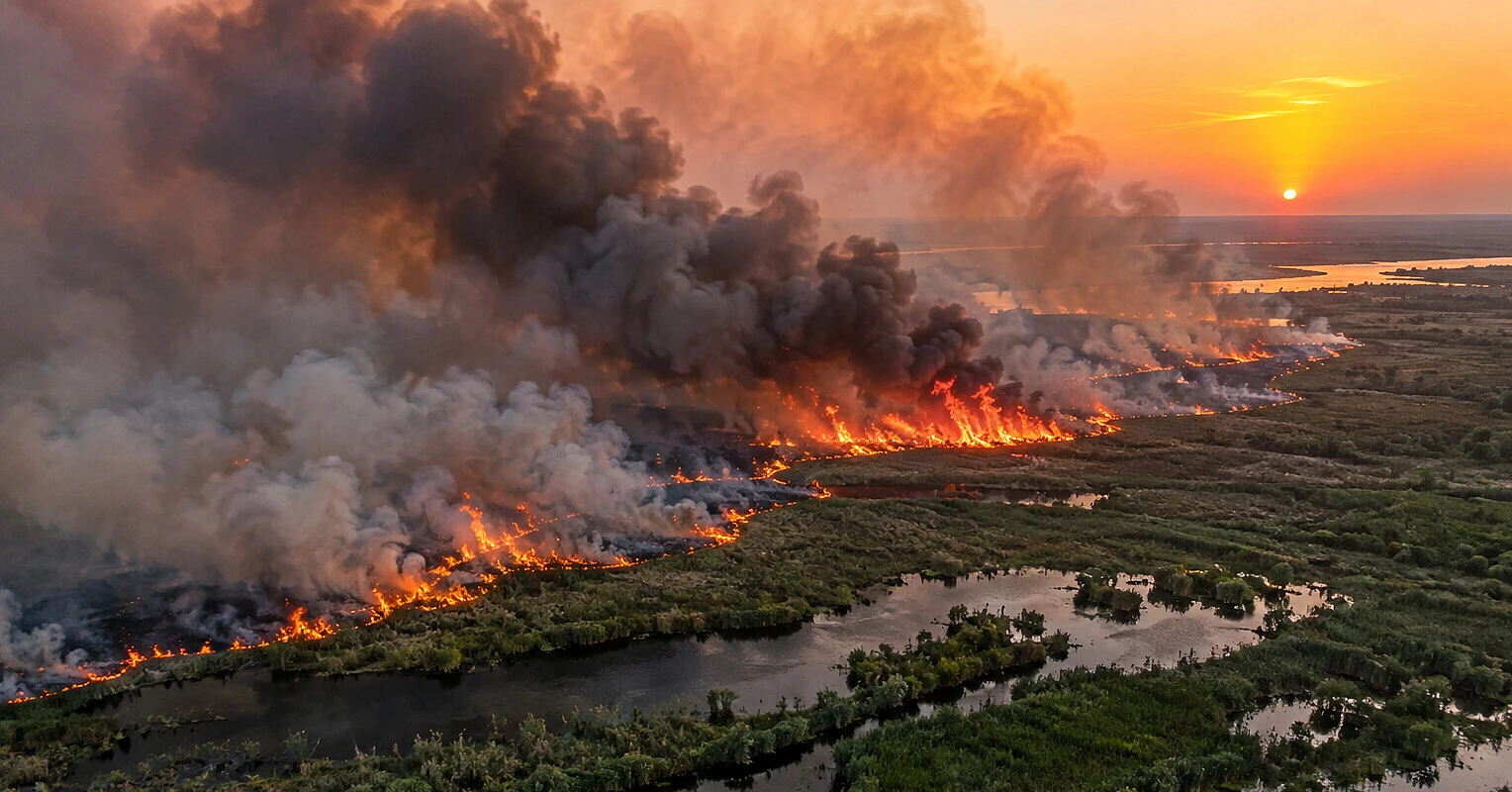
Environmental damage from a large-scale fire in the Danube Biosphere Reserve, which broke out after a Russian shelling of Odesa region, has exceeded 14.8 billion UAH. The fire destroyed 1,072 hectares of floodplains.
The State Ecological Inspectorate of the South-Western District reported this on September 7.
The fire occurred after the Russian attack on August 16. The outbreak started on Bilhorodskyi Island within the Danube Biosphere Reserve. The fire spread to floodplain vegetation and reeds.
In total, 1,072 hectares of natural area burned. Environmental inspection specialists calculated the volume of pollutants released into the atmosphere as a result of the large-scale burning and estimated the environmental damage at over 14.8 billion UAH.
The calculation of air pollution damage is carried out according to the methodology approved by the Ministry of Environmental Protection. The assessment takes into account the volume of emissions, types of pollutants, scale and duration of the incident, and the fact that the cause of the environmental damage was military action.
The materials with the calculation results were transferred to the Operational Headquarters of the State Ecological Inspectorate of Ukraine. They will be used to document the environmental consequences of Russian armed aggression and to account for the damage caused to Ukraine.
The Danube Biosphere Reserve has repeatedly suffered from large-scale fires during the war. In January 2026, about 645 hectares of vegetation were destroyed by fire in the Stentsivsko-Zhebriianivski floodplains, and the damage was estimated at almost 5 billion UAH. In May after another drone attack, about 1,080 more hectares burned, and the damage approached 8 billion UAH.
Thus, just a few major fires in the reserve during 2026 led to multi-billion environmental losses and the destruction of significant areas of one of the most valuable protected areas in southern Ukraine.
Based on materials from: State Ecological Inspectorate of the South-Western District, Suspilne Odesa
