
General Staff: Ukraine has disabled more than 45% of the design capacity of Russian refineries
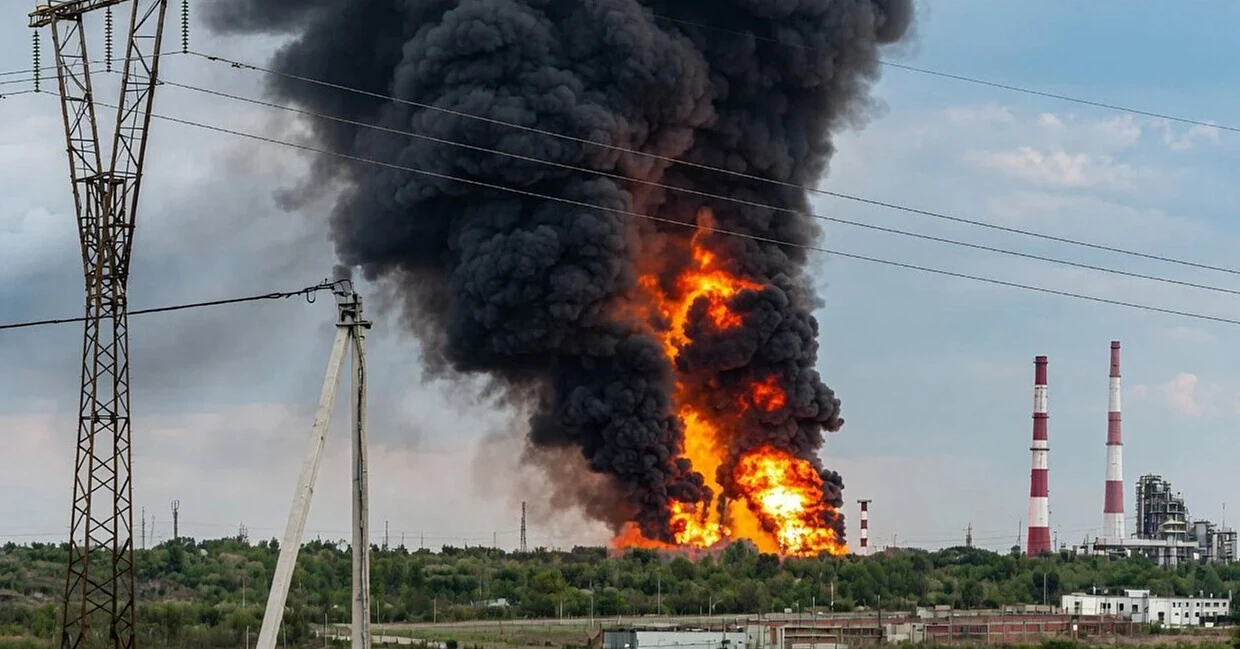
As of September 21, Ukraine's Defense Forces have disabled more than 45% of the design capacity of Russian oil refining. This result was assessed by the General Staff of the Armed Forces of Ukraine after the latest strike on the Moscow Oil Refinery.
The General Staff summed up the results of strikes on important targets in Russia and in the temporarily occupied territories for the week from September 14 to 20. The main industrial targets were enterprises that, according to the Ukrainian command, ensure Russia's military-economic potential.
On the night of September 15, the Syzran refinery in Samara Oblast was hit. The General Staff reported a strike on the primary oil refining unit AVT-6 and the tank farm. The same night, in Taganrog, the Atlant Aero enterprise was hit, which, according to the Ukrainian side, produces the Molniya strike-reconnaissance drones and components for the Orion UAVs.
On the night of September 17, the Defense Forces struck the Slavneft-YANOS refinery in Yaroslavl. Its design capacity is about 15 million tons of oil per year. According to the General Staff, the AVT-3 primary refining unit was hit at the enterprise.
The next major target was the Gazpromneft-Moscow Refinery. The strike on this enterprise was carried out on September 20. The General Staff announced the defeat of the AVT-6 unit, the integrated oil refining unit, and the isomerization unit. The Special Operations Forces previously reported that the design capacity of the Moscow Refinery reaches about 12 million tons of oil per year.
After that, the General Staff estimated the total scale of disabled design capacities of Russian oil refining at more than 45%. This refers specifically to the design, or nominal, capacity of the affected units and plants: this figure does not mean that the actual volume of oil refining in Russia has simultaneously decreased by the same 45%.
Meanwhile, independent industry data confirm a significant drop in actual production. On September 17, the International Energy Agency reported that Russia has about 6.5 million barrels per day of installed oil refining capacity. In June, actual refining fell to 3.8 million barrels per day — a minimum in more than 20 years and about 30% below the level of a year earlier.
According to IEA estimates, gasoline production in Russia decreased by about 20% compared to 2025, and diesel fuel output by almost 30%. The Agency expects the average utilization of Russian refineries until the end of 2026 and in 2027 to be around 4 million barrels per day.
The situation is especially noticeable in the diesel fuel segment. According to Reuters calculations, by mid-September, three of the six largest Russian diesel refineries had completely stopped or sharply reduced production after drone strikes. These six plants provide about half of Russia's diesel output. The Kirishi refinery was shut down, while the Volgograd refinery and the NORSI plant operated at about a quarter of nominal capacity.
In the General Staff, one of the consequences of the strikes is also cited as a shortage of high-quality fuel in Russia and a sharp decline in the production of gasoline and diesel fuel of the Euro-5/K5 standard. Against the background of production problems, Russian authorities restricted the export of petroleum products to increase supply on the domestic market.
In addition to oil refining, during the week Ukrainian forces struck Russian air defense systems, radar stations, electronic warfare means, drone infrastructure, airfields, and fuel and lubricant depots. The General Staff stated that such operations are aimed at reducing Russia's military-economic capabilities.
Sources: General Staff of the Armed Forces of Ukraine, International Energy Agency, Reuters
