

For the first time in Ukraine, suspicion announced under new article on organizing fraudulent call centers
In Lviv region, law enforcement uncovered a fraudulent call center, whose members, according to the investigation, defrauded at least 80 Ukrainians and foreigners through online dating services. To gain access to victims' bank accounts, the suspects used malicious software and a neural network for voice alteration.
Three men were notified of suspicion, including under a new article of the Criminal Code that provides liability for organizing fraudulent call centers.
This was reported on October 14 by the Prosecutor General's Office and the Cyber Police Department of the National Police of Ukraine.
According to cyber police, this is the first case in Ukraine of a suspicion notice for creating a fraudulent call center under the new Article 255-4 of the Criminal Code. It entered into force on September 18, 2026.
Law enforcement established that the call center in Stryi was organized by two local residents aged 23, involving a 21-year-old acquaintance in the scheme.
They rented two apartments, which they equipped with computer equipment and communication means.
Fraudsters used online dating and neural networks
According to the investigation, group members created fake female profiles on dating sites and messengers. Through these accounts, they began communicating with men and gradually gained their trust.
To prevent callers from suspecting deception, the suspects used a neural network that real-time changed male voice to female.
After establishing trust relationships, potential victims were sent files disguised as photos.
In fact, according to cyber police, they contained malicious software of Remote Access Trojan (RAT) type - a tool that allows remote access to a device.
After opening the infected file, suspects could remotely control the victim's smartphone and access confidential information.
In addition, during communication men were persuaded to enable screen sharing and perform certain phone settings. This allowed obtaining additional data for access to banking applications.
According to law enforcement, the use of malicious software allowed bypassing two-factor authentication when entering online banking.
Having gained access to accounts, scheme participants transferred victims' money to controlled accounts. Part of illegally obtained funds was later converted into cryptocurrency.
Victims include Ukrainians and citizens of other countries
According to preliminary data from the prosecutor's office, at least 80 people suffered from the group's activities.
Among the identified victims are at least 50 citizens of Ukraine and 30 foreigners, including citizens of Poland, Germany and Georgia.
Law enforcement also reports that among the victims there were Ukrainians who were abroad, in particular in Czechia and Poland.
The total amount of losses is not yet disclosed. Investigators continue to identify other potential victims of the fraudulent scheme.
Organizers kept most of the stolen money
According to the prosecutor's office, the suspects organized the call center's work with a clear division of responsibilities.
A closed Telegram group was used for coordination. Work schedules were determined, instructions given to executors, and received funds accounted for.
Direct executors received 15% of stolen money as remuneration. The rest was distributed by organizers, who also used part of the funds for further activities of the fraudulent network.
Within the investigation, law enforcement conducted nine searches. Investigative actions took place, in particular, at the residences and registration of alleged participants of the scheme, as well as at a crypto exchange where they used services.
During searches, computers, storage devices, dozens of smartphones and SIM cards, bank cards, cryptocurrency wallet and rough notes were seized.
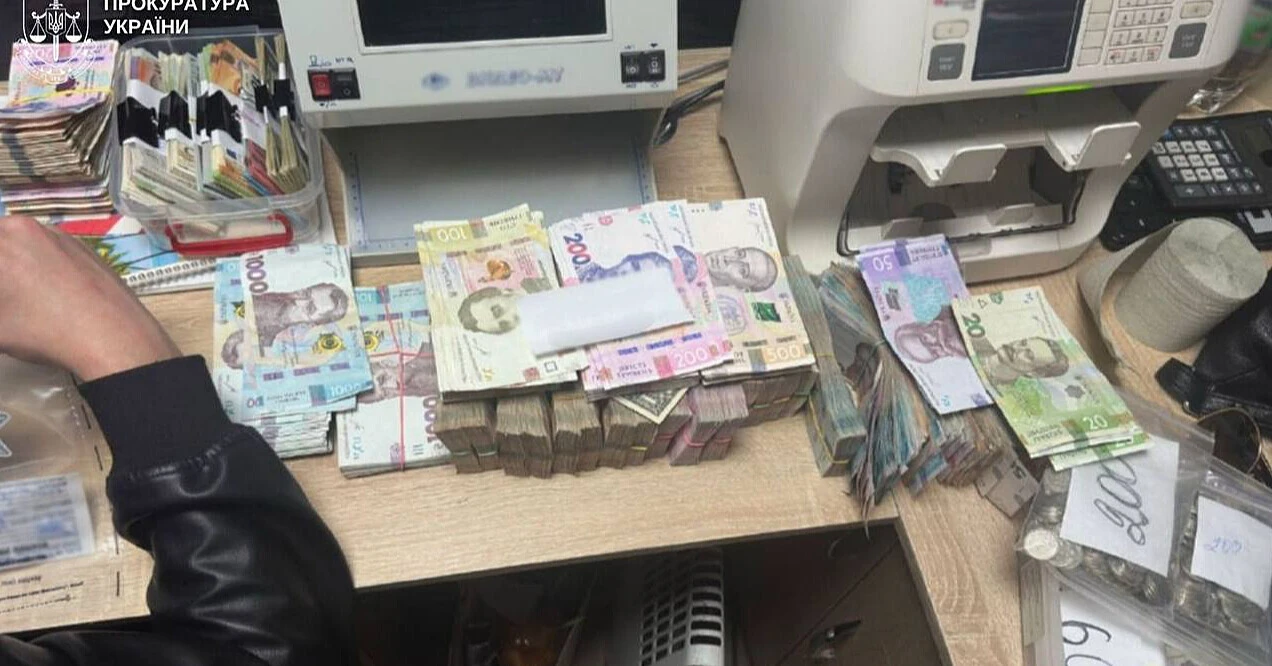
In addition, law enforcement seized over 1.2 million hryvnias in cash and foreign currency worth over 800 thousand hryvnias in hryvnia equivalent.
The total value of seized funds is about 2 million hryvnias. This sum should not be identified with total losses of victims, which are still being established.
New article on fraudulent call centers applied for the first time
Three detainees were notified of suspicion under several articles of the Criminal Code of Ukraine:
- Parts 1, 2 of Art. 255-4 - creation, leadership of an electronic communication fraudulent organized group or participation in it;
- Part 5 of Art. 190 - fraud;
- Part 5 of Art. 361 - unauthorized interference with operation of information and electronic communication systems.
For the aggregate of alleged offenses, suspects face up to 15 years of imprisonment, according to cyber police.
The court imposed custody as a preventive measure for all three, with bail of 998,400 hryvnias each.
The call center's activities were terminated. The pre-trial investigation is ongoing; law enforcement identifies other potential participants and victims.
Ukraine strengthens liability for fraudulent call centers
On September 16, the Verkhovna Rada adopted Law No. 4986-IX, which supplemented the Criminal Code with new Article 255-4. The law entered into force on September 18, 2026.
The document introduced for the first time a separate criminal-legal norm on creation, leadership and participation in electronic communication fraudulent organized groups.
For creation of such a group or leadership over it, imprisonment from seven to twelve years with confiscation of property is provided.
For willful participation in a fraudulent organized group, imprisonment from five to ten years with possible confiscation of property.
Liability also extends to persons who wittingly support activities of fraudulent call centers, in particular provide equipment, services, information or other assistance knowing about illegal nature of the group's work.
The law also provides liability for recruiting new members to fraudulent schemes, in particular by offering jobs or remuneration.
At the same time, for certain participants the possibility of exemption from criminal liability is provided if they voluntarily report the group's activities before receiving suspicion and actively contribute to its detection. This provision does not apply to organizers and leaders.
Previously, criminal proceedings regarding fraudulent call centers were investigated mainly under general articles on fraud, criminal organizations and illegal interference with information systems.
According to Opendatabot, from early 2022 to September 2026, Ukrainian courts issued at least 18 verdicts in cases related to fraudulent call center activities. Real prison terms were imposed only in two cases.
Therefore, the case in Stryi is remarkable precisely in terms of the first reported application by law enforcement of new Article 255-4, not the first criminal prosecution of fraudulent call centers in Ukraine.
So far it concerns a notice of suspicion, not a conviction. According to the Constitution of Ukraine, suspects are considered innocent until their guilt is proven in court.
Based on materials: Prosecutor General's Office, Cyber Police Department, Kurs Ukraine