
Russian ports in the Black and Azov Seas almost stopped working: business asks government for help
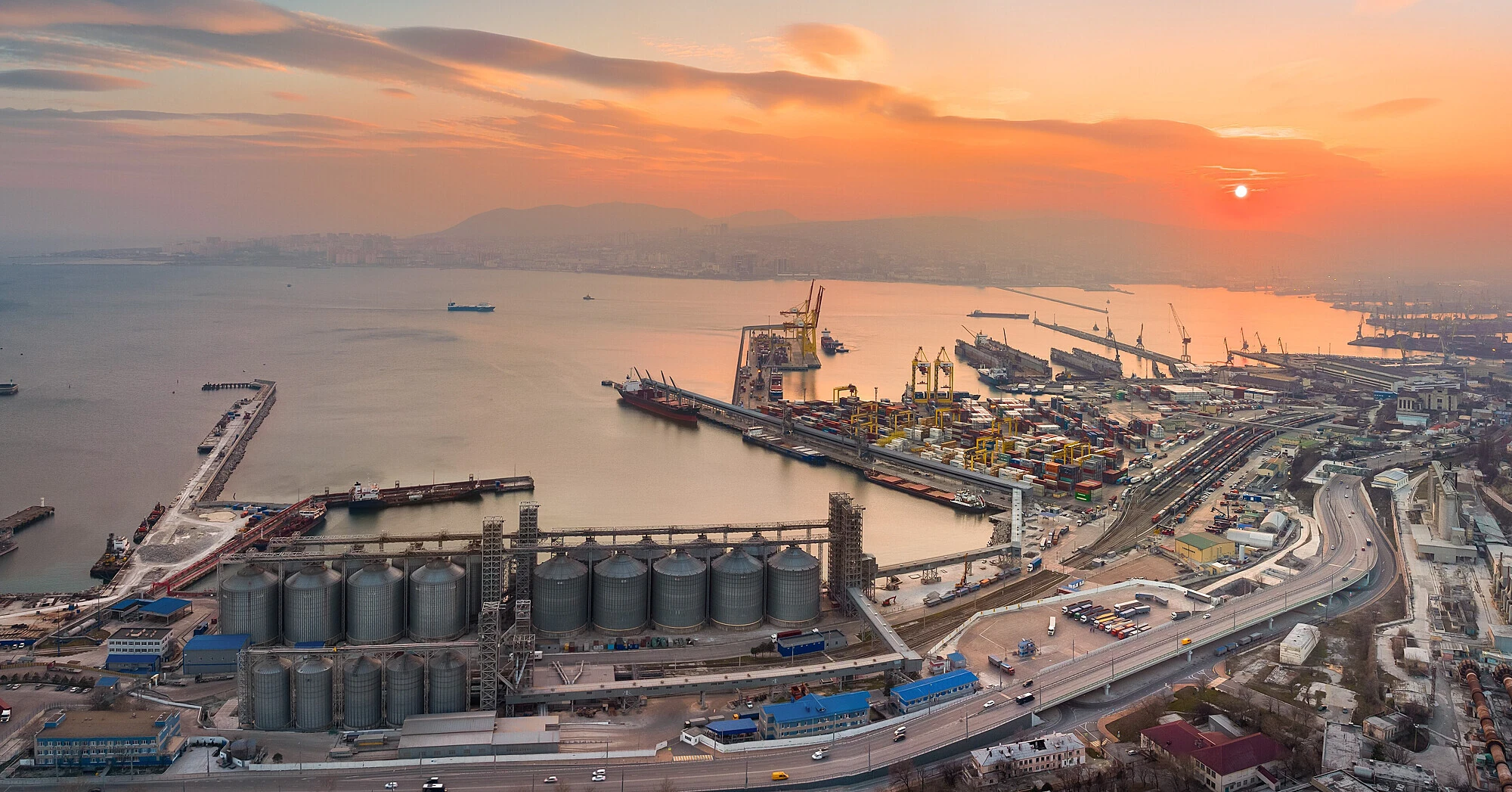
The operation of the largest Russian ports in the Black and Azov Seas is under threat of prolonged downtime due to attacks by drones and unmanned boats. In September, cargo transshipment volumes at terminals of the Azov-Black Sea basin, according to market participants, decreased by 95-100%. Total monthly losses of businesses and budgets at various levels are estimated at over 200 billion rubles.
Russian media reported this, citing documents from Russian government agencies, representatives of the port industry, and the company "OTEKO", which manages terminals in Taman.
According to a source in the port industry cited by the publication, after attacks by drones on facilities in the Azov Sea and later the Black Sea, cargo transshipment practically stopped. Main cargo flows were redirected to ports in northwestern Russia or through land border crossings.
Problems affected the largest ports in southern Russia, including Novorossiysk, Taman, and Tuapse. According to media reports, port operators are cutting staff, moving employees to part-time workweeks, or sending them on unpaid leave.
Grain terminals suffered significant losses first. Governor of Krasnodar Krai Veniamin Kondratiev, in an appeal to the Russian government, said that the operation of key grain complexes of the Azov-Black Sea basin has effectively been suspended.
In July-August 2026, 3.8 million tons of agricultural cargo were transshipped through the seaports of Krasnodar Krai. In the same period last year, the figure was 7.9 million tons. Thus, volumes have more than halved.
The company "OTEKO" estimated the total losses of budgets and business from disruption of the transport system in southern Russia at over 200 billion rubles per month. The company noted that the consequences are felt not only by seaports but also by producers, transport enterprises, and small businesses dependent on cargo transportation.
However, this sum is an expert assessment by Russian market participants, not the officially confirmed amount of direct losses to ports. It covers the broader economic consequences of infrastructure downtime.
Russian port operators ask for state assistance
Against the backdrop of falling cargo turnover, Russian regional officials and port industry representatives have appealed to the government to introduce financial support.
Among the proposed measures are compensation for wages, terminal upkeep, equipment maintenance, electricity, and other mandatory payments.
In addition, businesses are requesting deferral of lease payments for state infrastructure, preferential loans, and improved war-risk insurance conditions.
According to estimates by sources of the publication, about 20-25 thousand people work in the port industry of the Azov-Black Sea basin. Partial compensation of wages to preserve jobs alone could require from 550 million to 670 million rubles per month.
A separate problem is port property insurance. According to market participants, in some cases insurance premiums have increased 25-fold, while compensation limits remain significantly lower than the cost of expensive equipment.
The Russian government has already instructed relevant ministries to consider the proposed support measures. However, a final decision on large-scale funding for the port industry has not yet been announced.
Russia has alternative ports, but they do not compensate for losses
Unlike Ukraine, Russia has the ability to redirect export cargo through ports in other sea basins—primarily the Baltic Sea, as well as the Far East and the Caspian Sea.
In particular, the Baltic ports of Ust-Luga and Vysotsk are used for grain transportation. However, their capacity, transportation costs, and geographical location do not allow for a quick replacement of Black Sea routes.
As previously reported by Kurs.com.ua, in the 2025/2026 season, Russia exported about 90% of grain cargo shipped by sea through the ports of the Black and Azov Seas. Therefore, shifting exports to other regions involves significant logistical difficulties.
At the same time, the availability of alternative port capacities allows Russia to preserve at least part of its sea exports outside the dangerous Azov-Black Sea basin.
Ukrainian ports suffer Russian attacks without possibility of reorientation to other seas
Ukrainian ports also suffer significant losses due to strikes on maritime infrastructure, but its ability to redirect cargo is even more limited.
Russia systematically attacks Ukrainian Black Sea ports, tries to disrupt the operation of the sea corridor, and strikes port infrastructure on the Danube. Not only berths and terminals are under threat, but also civilian merchant vessels, warehouses, transport approaches, and routes to ports.
According to the Ministry for Communities and Territories Development of Ukraine, as of September 14, since the beginning of the full-scale invasion, Russian attacks have damaged or partially destroyed 1,173 objects of Ukrainian port infrastructure and 274 civilian vessels.
The ministry also reported that after July 22, 2026, cargo handling volumes in the ports of Greater Odesa decreased by more than 15 times. This directly affected Ukrainian exports and the operation of enterprises dependent on maritime logistics.
Alternatives for Ukraine remain the Danube ports of Izmail, Reni, and Ust-Dunaisk, as well as road and rail routes through the European Union. However, the Danube infrastructure is also under Russian strikes, and land transportation cannot fully replace the capacity of large seaports.
Unlike Russia, Ukraine does not have its own seaports on the Baltic Sea or the Far East to which exports could be directly redirected. Using foreign ports through land corridors requires additional transportation, transshipment of products, and increases logistics costs.
Therefore, while both countries suffer serious economic consequences from disruption of Black Sea shipping, their ability to compensate for the loss of port capacity differs.
At the same time, a direct comparison of monetary damages is currently impossible: the Russian estimate of 200 billion rubles refers to monthly losses of business and budgets according to the methodology of market participants, while the Ukrainian data presented describe infrastructure damage and decline in cargo turnover over other periods.
Based on materials: Russian media, Ministry for Communities and Territories Development of Ukraine, 14.09.2026, Ministry for Communities and Territories Development of Ukraine - on the situation on the Danube
