
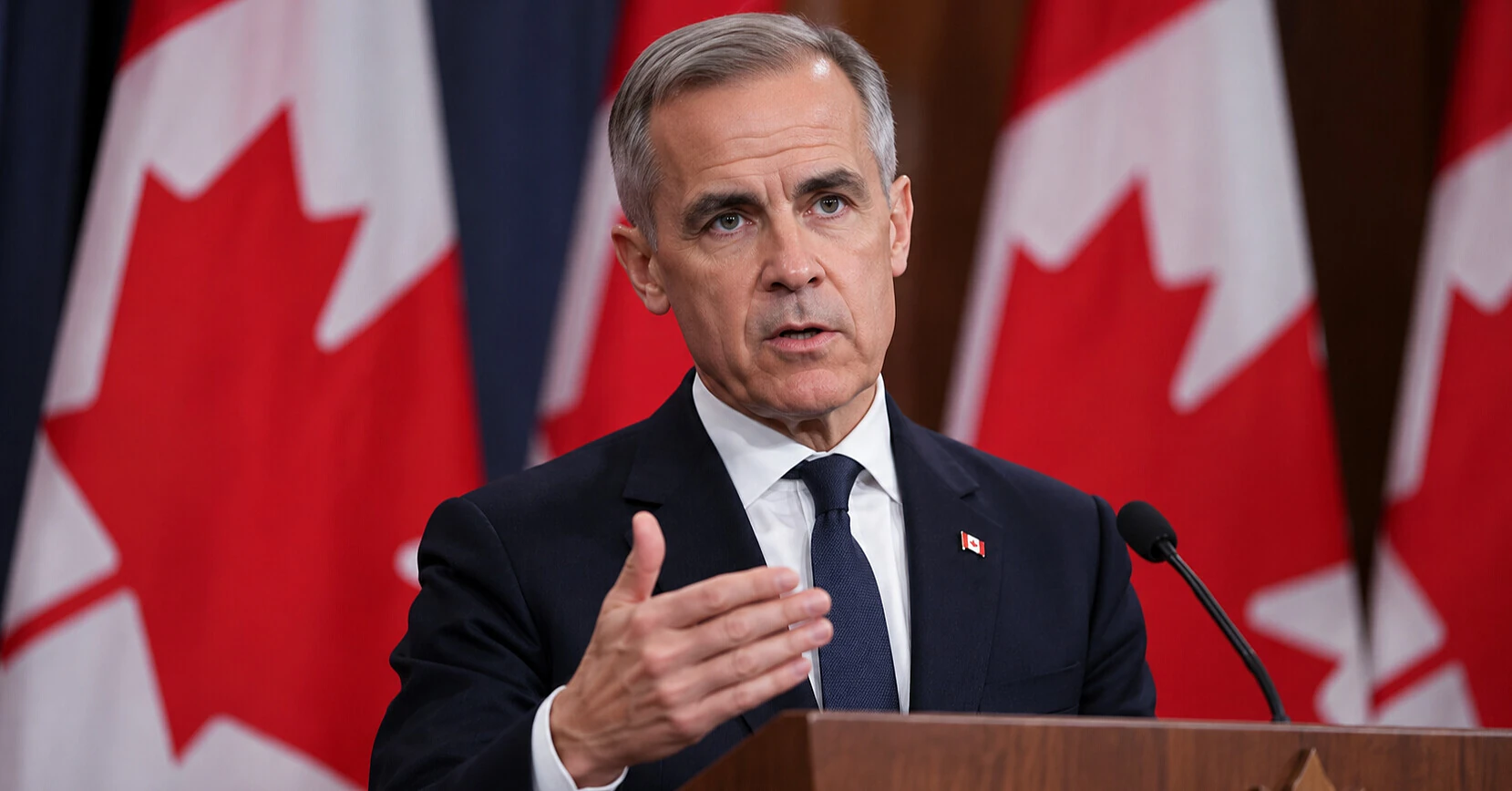
Prime Minister of Canada Mark Carney expressed serious concern about the restrictions on the satellite system Starlink, which complicated Ukraine's defense. In his words, the situation demonstrated the danger of a state's dependence on the technologies and decisions of a single foreign supplier.
Carney said this on October 23 while speaking with journalists in Istanbul, reports Bloomberg.
The Canadian prime minister commented on reports that SpaceX founder Elon Musk ordered the speed of the military version of the Starlink satellite system, known as Starshield, to be limited. These restrictions made it difficult for the Ukrainian military to use drones and other systems that depend on satellite communication.
Carney emphasized that he is especially concerned about the consequences of such decisions for a country defending itself from Russian aggression.
In his words, it is hard to find an appropriate definition for the actions of the person or group of people who made such a decision regarding Ukraine, where citizens face threats to their lives every day.
When asked by journalists whether the situation causes concern for the Canadian government, the prime minister answered affirmatively.
At the same time, Carney did not claim who exactly is responsible for the introduction of restrictions. Earlier, The Wall Street Journal, citing American officials, reported that the corresponding order was given by Musk. The entrepreneur himself has stated that the restrictions on the use of Starshield are set by the US military, and the final decision depends on the US president.
According to the publication, Donald Trump subsequently contacted Musk and asked to lift the restrictions.
Canada intends to reduce technological dependence
Carney stated that the situation with Ukraine confirms the need to diversify Canada's technological supplies and international partnerships. This is especially important for systems on which national security and defense capability depend.
The prime minister explained that Canada does not want to find itself in a position where crucial technology is controlled by a single supplier capable of changing the terms of its use by its own decision or under the influence of another state.
In such a case, he emphasized, the security of Canadian citizens and the country's sovereignty could be threatened.
That is why the government seeks to expand trade relations, including in the technological sector, and develop cooperation with various international partners.
However, Carney admitted that reducing dependence will take time. Canada is now deeply integrated into the technological systems of other states and cannot quickly replace its existing infrastructure.
The statement was made during the first official bilateral visit of the Canadian prime minister to Turkey. On the previous day, October 22, Carney and Turkish President Recep Tayyip Erdoğan announced a new strategic partnership that provides for expanding cooperation in the defense industry, energy, trade, and technology.
According to a statement by the Canadian government, the parties agreed to strengthen ties between the defense enterprises of the two countries and develop joint projects. Carney also expressed interest in Turkish military technologies, including unmanned and autonomous systems.
Carney discussed Starlink restrictions with Zelensky
The Canadian prime minister said that during the past week he spoke with Ukrainian President Volodymyr Zelensky. One topic of discussion was the situation with satellite communication.
Carney emphasized that Ottawa interacts with Kyiv directly and does not need additional appeals from the European Union to discuss support for Ukraine.
Meanwhile, the situation with the operation of Starshield remains unresolved. Despite Trump's statement about restoring Ukrainian military access to the satellite system, Kyiv reported that restrictions continue to apply.
As previously reported by Kurs.com.ua, on October 23, the adviser to the President of Ukraine on communications, Dmytro Lytvyn, stated that the Ukrainian side had not recorded the lifting of speed restrictions.
According to The Wall Street Journal, problems arose after restrictions were imposed on the military satellite system on October 14, which affected the operation of drones. Despite some reports of improved communication, as of October 23, some Ukrainian units continued to face the previous restrictions.
Thus, Carney's statement concerns not only Ukraine's current problems with satellite communication but also the broader issue of technological independence of states using foreign infrastructure to ensure their own security.
