
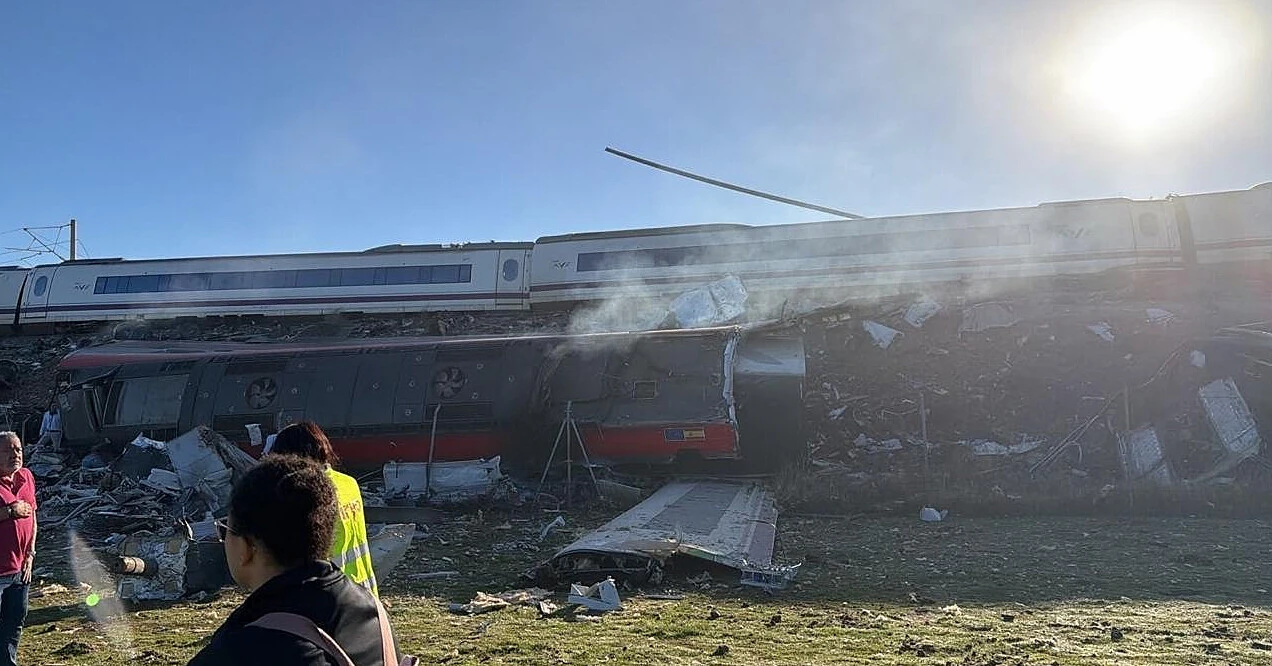
At least 50 people were killed in Spain as a result of two high-speed trains colliding, and more than 179 were injured. The accident occurred on the morning of October 28 in the province of Toledo, on the railway line between Madrid and Andalusia.
Updated casualty figures from El Español, citing the civil protection service of the autonomous community of Castile-La Mancha. The rescue operation is ongoing, so the number of dead and injured may change.
The collision occurred at approximately 08:54 local time between the towns of Los Yébenes and Urda. The AVE high-speed train of the state-run company Renfe, traveling from Madrid to Seville, collided with the rear of a stopped train of the private operator Iryo.
As a result of the impact, two Iryo carriages derailed. Preliminary information indicates that the Renfe train carried 397 passengers, and Iryo had 147. Some carriages sustained significant damage.
A train collision in Spain today has killed at least 46 people, according to local media. This is the second train collision in Spain this year, with another crash occurring in January on the same line between Madrid and Andalusia. https://t.co/R30KmSqTYA pic.twitter.com/JS9a3EoygC
— euronews (@euronews) October 28, 2026
Firefighters, medical teams, three air ambulance helicopters, and Civil Guard units were dispatched to the accident site. The regional government has raised the emergency response level and requested assistance from the military emergency unit.
According to the government of Castile-La Mancha, a temporary accommodation point for victims has been organized in the sports pavilion in Urda. Assistance points for relatives of passengers have also been opened at railway stations in Madrid, Seville, and Córdoba.
Due to the disaster, high-speed train service between Madrid and Andalusia has been completely suspended. The Spanish railway infrastructure operator Adif reported suspension of services in both directions, with no timeline for resumption yet.
The cause of the collision is under investigation. According to RTVE, there was a fault in the primary automatic train control system LZB in the section where the accident occurred prior to the incident. Because of that, trains had been temporarily transferred to an alternative signaling system, which does not provide the same level of continuous speed and distance monitoring.
Spanish investigators are considering the possibility of human error during railway traffic control, specifically how permission was granted for the Renfe train to continue while the Iryo train was stationary ahead. The official cause has yet to be determined.
This is already the second major rail disaster in Spain this year. In January, two high-speed trains of Renfe and Iryo collided near Adamuz in the province of Córdoba, killing 46 people.
Based on materials from: El Español, Government of Castile-La Mancha, RTVE
