
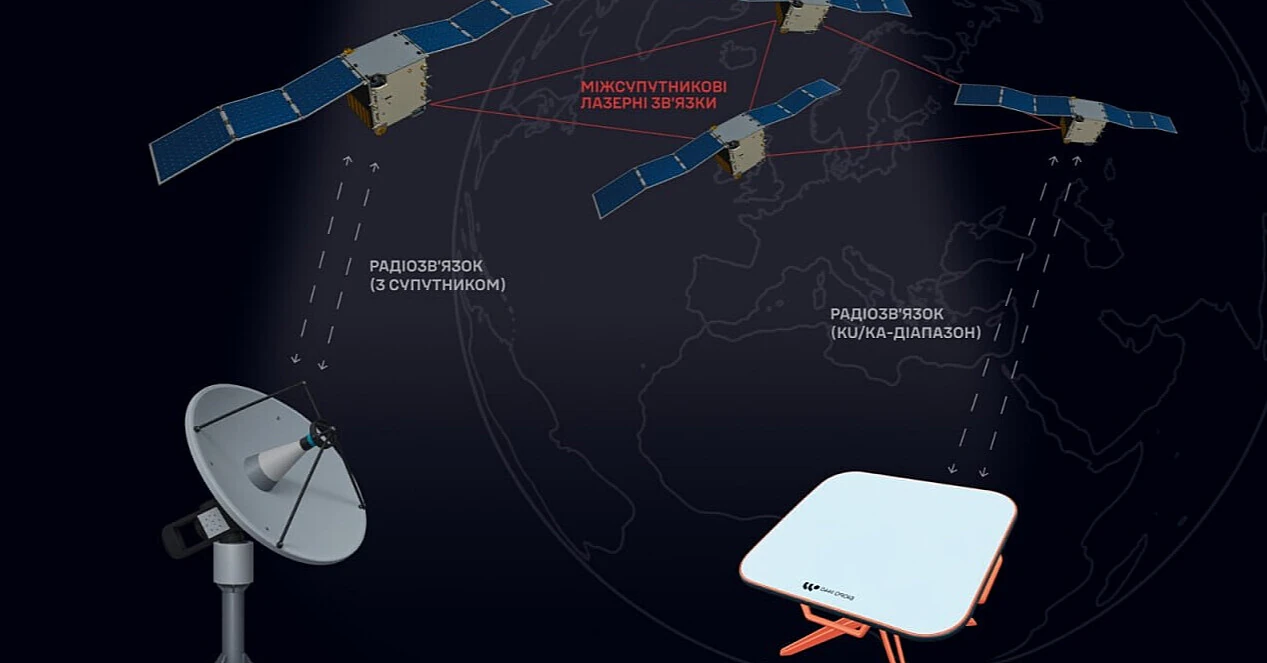
The Main Intelligence Directorate of the Ministry of Defense of Ukraine has identified 49 Russian and Belarusian enterprises involved in the creation of the satellite communication system "Rassvet", which Russia is developing as its own analogue of Starlink. Nearly half of the project participants have still not been sanctioned by Ukraine's partner countries.
The relevant data was released on October 28 by the GUR on the War&Sanctions portal.
According to intelligence, 23 of the 49 enterprises and institutions involved in the creation of the system are not under sanctions from any country of the sanctions coalition. Among them is the Russian state corporation "Roscosmos".
The main developer and future operator of the satellite system is the company "Bureau 1440", which is part of the technology group "ICS Holding". Enterprises of the holding are engaged in the production of satellite components, solar panels, electronic modules, printed circuit boards and subscriber equipment.
Russian microelectronics manufacturers, research organizations, space industry enterprises and structures of the Ministry of Defense of the Russian Federation are also involved in the project.
In particular, "Roscosmos" provides preparation and launch of satellites into orbit. According to the GUR, the project in the corporation is directly supervised by its head Dmitry Bakanov, who previously headed the company "Satellite System "Gonets".
One of the financial partners in the creation of the system was the Russian bank VTB. The complete list of involved enterprises with details of their role has been published on the War&Sanctions portal.
The GUR emphasizes that "Rassvet" is being developed primarily for military use. The Russian army plans to use the satellite network for secure communications, command and control of troops and unmanned systems, as well as ensuring the operation of military equipment and command posts.
According to Ukrainian intelligence, Russia is also considering the possibility of using the new system to support missile weapons, in particular "Iskander-M" complexes.
The planned coverage area primarily covers Ukraine and the countries of the European Union. The GUR warns that after deploying a sufficient number of satellites, the system could potentially be used for hybrid operations against other states.
Ukrainian intelligence calls on international partners to increase sanctions pressure on project participants, limit supplies of necessary technologies, equipment and software. It also concerns the prohibition of cooperation with companies that ensure the creation of Russian satellite infrastructure.
Recall that in August, the GUR reported on the accelerated deployment of the Russian analogue of Starlink. At that time, Deputy Head of Intelligence Vadym Skibitskyi noted that the creation of the satellite network is happening faster than Russia's initial plans anticipated.
According to: GUR MOU, War&Sanctions
