
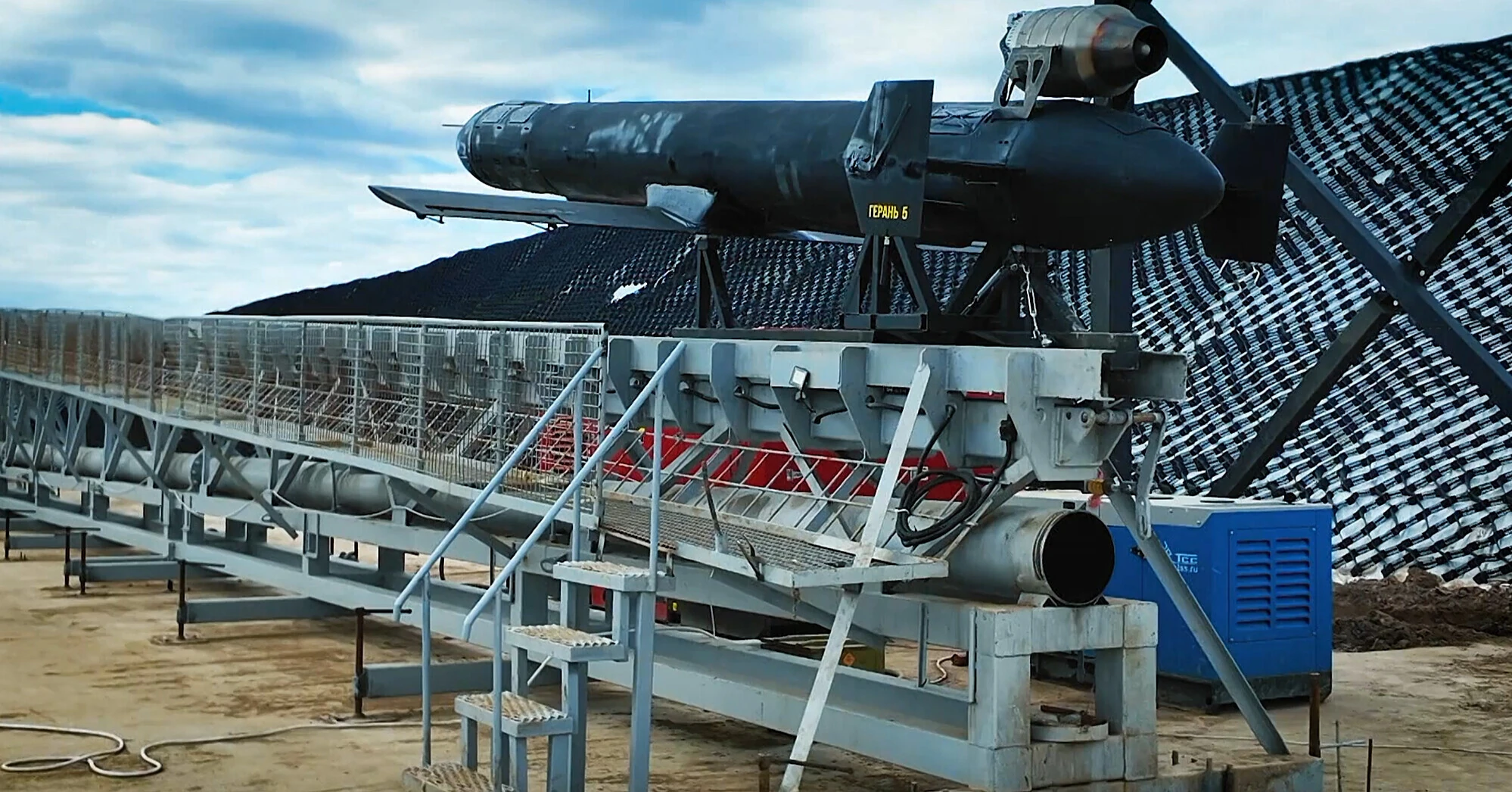
Russia continues to increase production of jet strike drones and is stockpiling weapons for attacks on Ukraine in the winter. Some new modifications of "Geran-5" drones during maneuvering already reach speeds of up to 1000 km/h, which creates additional difficulties for Ukrainian air defense.
This was reported on October 29 by the adviser to the President of Ukraine on defense technologies, Serhiy Beskrestnov, known as Flash, in a comment to journalist Halyna Ostapovets of Novyny.LIVE.
According to Beskrestnov's estimates, the Russian defense industry produces up to 3,000 jet drones of the "Shahed" type monthly, as well as about 700 "Geran-5" devices. At the same time, Russian enterprises continue to increase production capacities and work on new types of strike weapons.
These indicators are estimates by the Ukrainian specialist, not confirmed production statistics from Russia. They also do not mean that all produced drones are immediately used for attacks: the enemy may stockpile some of the weapons.
According to the presidential adviser, Russian forces are changing the geography of air strikes. Recently, they are paying more attention to western and other regions of Ukraine, so the intensity of attacks directly on Kyiv has decreased somewhat.
A separate threat is the increase in the speed of Russian drones. As Beskrestnov explained, earlier the jet "Geran-3" reached speeds of about 280-300 km/h. Instead, newer modifications "Geran-5" during maneuvering can already briefly accelerate to 1000 km/h.
This makes interception of air targets more difficult and forces Ukrainian manufacturers to improve their own interceptor drones. According to Flash, the key challenge is not only achieving the required speed, but also creating a reliable serial product that can be mass-used for air defense.
He noted that Ukrainian enterprises have already demonstrated jet interceptor drones. However, the transition from prototypes to mass production remains difficult due to the need to improve control systems, targeting, and automatic target tracking.
In parallel, Russia is developing new relatively cheap jet missiles. According to Beskrestnov, the Russian side plans to produce such weapons in significant quantities - potentially tens of thousands of units per year. It is about production plans, not already achieved output volumes.
Earlier, "Kurs Ukrainy" reported, citing estimates by the Main Intelligence Directorate of the Ministry of Defense of Ukraine, that as of October Russia had stockpiled approximately 6,200 strike drones of the "Geran" family. The intelligence also assessed production capabilities of jet modifications "Geran-4" and "Geran-5" combined up to 4,000 units per month.
In addition, on October 23, it became known that Russia has used a modified "Geran-5 K5-K" with optical navigation and improved flight characteristics. Beskrestnov's new statements indicate further technological improvement of Russian aerial attack means and the need to ramp up Ukrainian production of interception systems.
Separately, Beskrestnov drew attention to the spread of artificial intelligence technologies in Russian strike drones. According to him, autonomous target recognition systems are already used on "Molniya", V2U, "Lancet", and certain "Geran" modifications. Such devices are able to navigate based on terrain images and perform part of tasks without constant operator control.
As Flash explained, the use of autonomous navigation reduces drones' dependence on satellite signals, making counteraction by certain electronic warfare means more difficult. He estimates that Russia has already moved to serial use of such technologies, so Ukraine needs to accelerate development and scaling of its own countermeasure systems.
Based on materials from: Novyny.LIVE
