
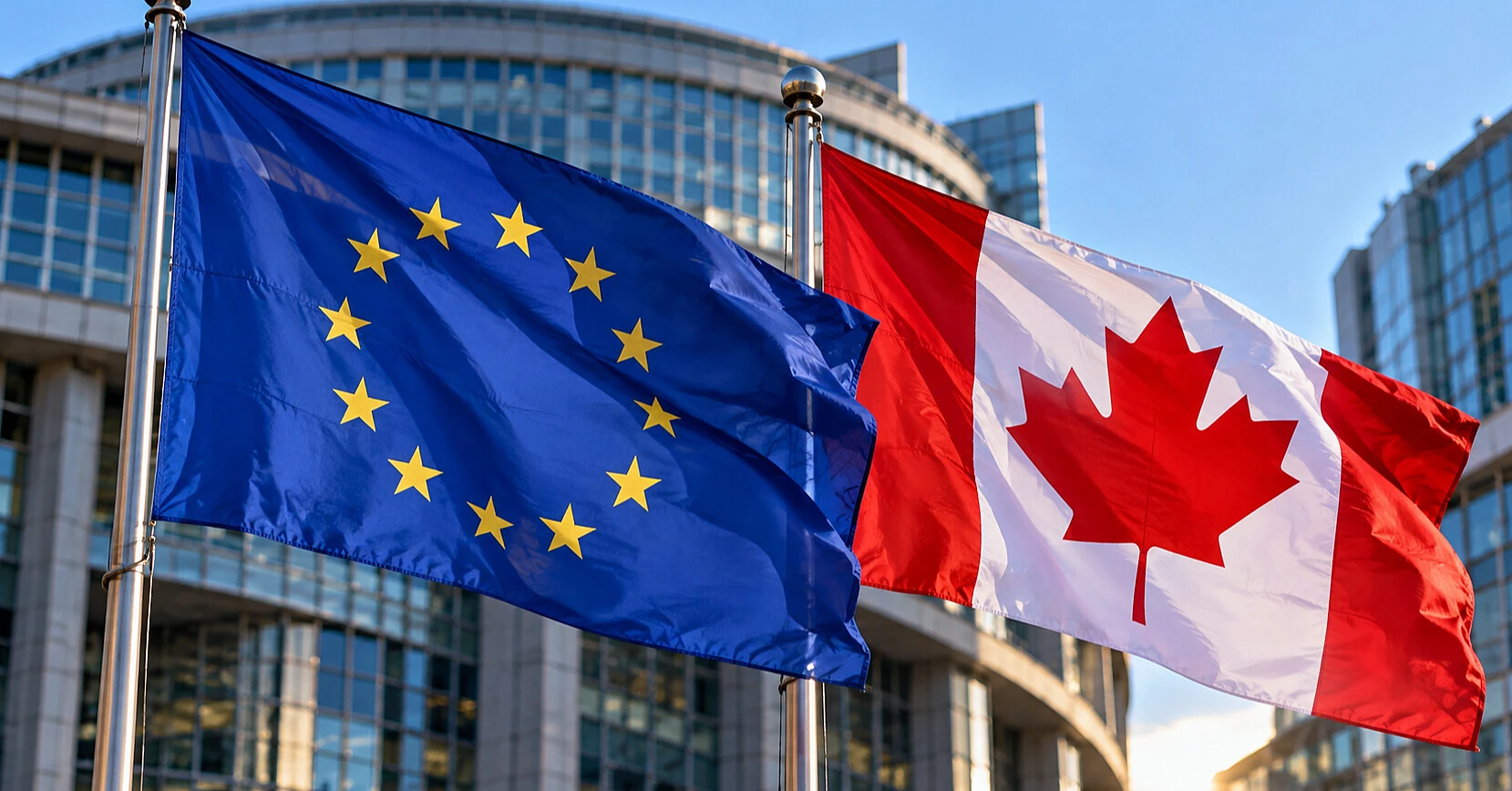
The European Union and Canada have announced the creation of the “Alliance for the Future” and agreed on a range of new initiatives in trade, investment, energy, defense, and technology. A separate agreement concerns Canada’s participation in the European credit program for Ukraine.
This was reported on October 30 in a joint EU–Canada declaration adopted following a two-day summit in Montreal.
The meeting was attended by Canadian Prime Minister Mark Carney, European Commission President Ursula von der Leyen, and European Council President António Costa.
The new alliance aims to create a shared space of economic prosperity and security. The parties intend to strengthen supply chains, reduce dependence on external suppliers of strategic raw materials and technologies, and expand cooperation in the defense industry.
According to the Canadian government, more than 20 new measures and initiatives were announced following the summit. Some of the agreements have already been formalized, while others have completed negotiations or begun preparation for implementation.
One of the outcomes of the meeting was Canada’s intention to join the EU’s €90 billion credit program for Ukraine. It is expected that this will allow Ukraine to purchase military equipment from Canadian manufacturers using funds from the European loan.
This does not mean Canada will provide an additional €90 billion. The amount represents the total volume of the previously planned EU credit program for Ukraine for 2026–2027. The specific terms of Ottawa’s participation have yet to be determined.
Canada and the EU also reaffirmed their intention to continue military, financial, energy, and humanitarian support for Ukraine. In the joint declaration, the parties agreed to intensify pressure on Russia and contribute to Ukraine’s post-war recovery.
In the economic sphere, the parties concluded negotiations on a digital trade agreement. The document should simplify cross-border data flows, increase regulatory predictability for businesses, and facilitate the provision of digital services in the Canadian and EU markets.
In addition, negotiations on an updated cooperation agreement between competition authorities were completed. It provides for closer cooperation in investigating antitrust violations by companies operating on both sides of the Atlantic.
Another practical result was the signing of a framework agreement between Canada and the European Investment Bank. The document creates a legal basis for the bank’s investments in Canadian projects, primarily related to the extraction and processing of critical minerals.
The parties also agreed to explore opportunities to increase supplies of Canadian liquefied natural gas to Europe. For now, this involves a joint study of the economic feasibility of such supplies, not new gas contracts.
In the technology sphere, Canada joined the European High-Performance Computing Joint Undertaking EuroHPC. This will expand cooperation opportunities in artificial intelligence, supercomputers, and scientific research.
Separately, the EU and Canada intend to consider the possibility of linking their instant payment systems. In the long run, this could make money transfers between Canadian and European banks faster and cheaper. However, technical solutions and launch timelines for such a mechanism have not yet been determined.
Despite expanded cooperation, the question of Canada’s special status in the European Union remains open. The joint declaration envisages the development of a model for closer association by the next summit in 2027. Canada has not yet received official status as an EU associate member.
Earlier, “Kurs Ukrainy” reported that Germany and several other EU states opposed granting Canada such status immediately, proposing to first agree on its content and legal conditions.
Thus, the summit ended with the launch of a new cooperation mechanism and specific economic agreements, while the formalization of a special format for Canada–EU relations was postponed to the next stage of negotiations.
