
On October 30, the conflict over the leadership of the Constitutional Tribunal in Poland escalated. A notice appeared on the institution's official website about the temporary suspension of its president, Bogdan Święczkowski, and deputy president, Bartłomiej Sochański. However, representatives of the previous leadership soon claimed the website had been illegally seized and refused to acknowledge the decision. Protesters gathered outside the court building in Warsaw, and police detained three people.
This was reported by the Polish Press Agency (PAP).
At around 6:00 p.m. local time, a document was published on the Constitutional Tribunal's website regarding the suspension of Święczkowski and Sochański from their duties for one month. According to information provided to journalists by tribunal judges, the corresponding order was issued by Anna Korwin-Piotrowska, who announced that she had assumed leadership of the institution as the judge with the longest tenure.
The stated basis for the decision is a provision of Polish law allowing judges to be temporarily suspended from their duties. The authors of the document claim that the previous leadership obstructed the convening of a general assembly of judges and prevented judges elected by the current parliament from hearing cases.
Korwin-Piotrowska also accused Święczkowski of blocking preparations for the Constitutional Tribunal's budget for 2027. She announced that a general assembly of judges would be convened on November 3.
However, the legality of this decision is disputed. On the Constitutional Tribunal's official page on the social network X, a statement appeared about the unlawful seizure of the institution's website. It asserted that Święczkowski and Sochański continue to hold their positions and that Korwin-Piotrowska has no authority as a tribunal judge.
Representatives of the previous leadership called the events an attempted coup d'état. However, there is no independent legal confirmation of such a characterization.
As noted by Puls Biznesu, constitutional lawyer Marcin Matczak also expressed doubts about the legal grounds for the suspension. In his opinion, provisions concerning ordinary courts cannot be automatically applied to the leadership of the Constitutional Tribunal, as the status of its judges is regulated separately.
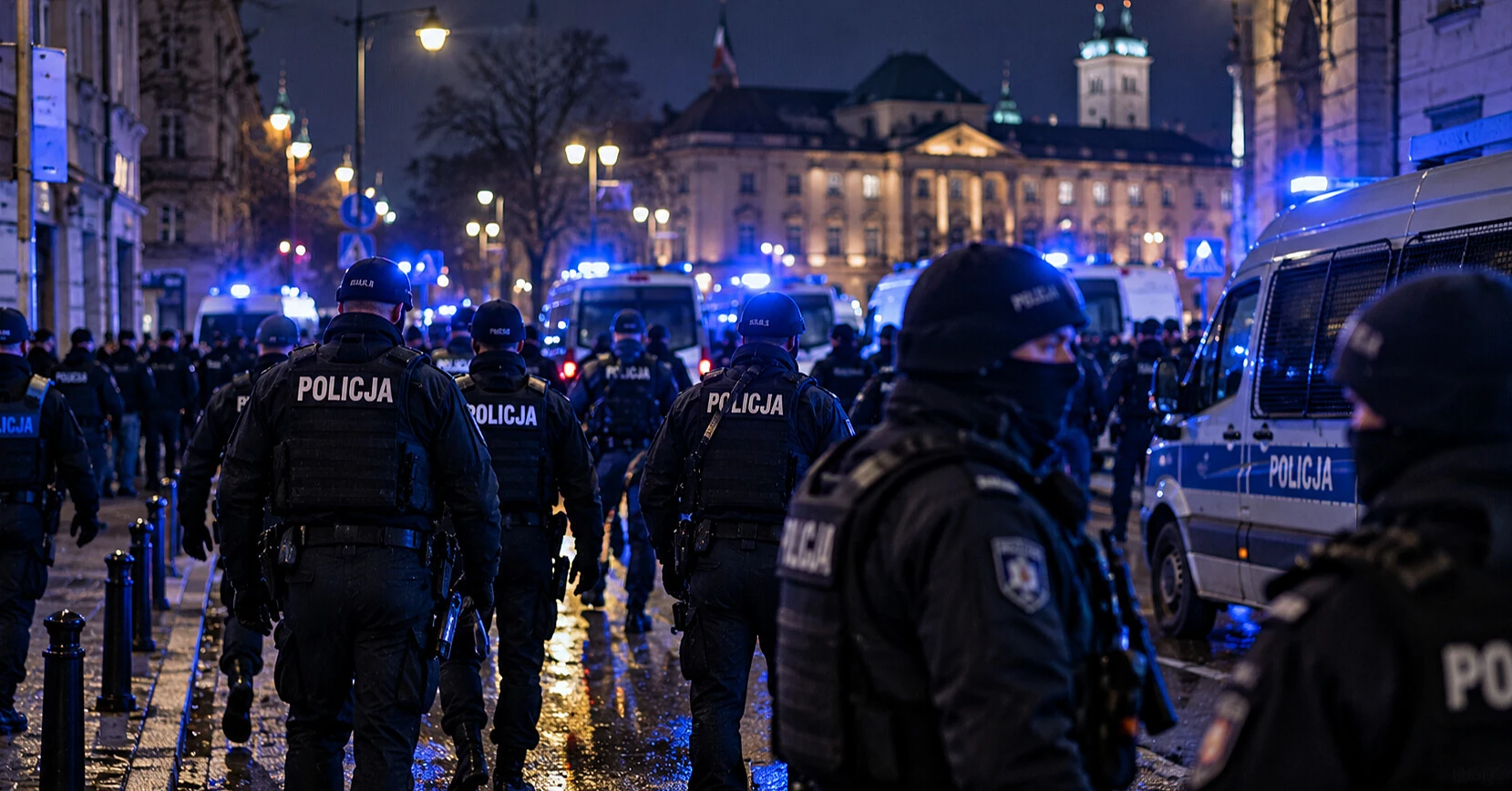
Amid the conflict, reinforced police units appeared outside the Constitutional Tribunal building. Law enforcement officials stated that they were ensuring security following a request from Korwin-Piotrowska, who warned of possible threats to the judges and staff of the institution.
Police emphasized that their officers are on the adjacent territory but are not taking any actions inside the court building.
Supporters of the opposition party "Law and Justice" gathered outside the tribunal. Among the participants were party leader Jarosław Kaczyński, former Prime Minister Mateusz Morawiecki, and Bogdan Święczkowski himself.
During the protests, three people climbed over the fence and entered the institution's grounds. They were detained. According to police, dangerous objects were also thrown at officers. Law enforcement tightened the cordon and restricted traffic near the building.
Polish President Karol Nawrocki reacted to the events. He interrupted a planned trip to Senegal and announced his return to Warsaw. The president explained his decision by the need to be in the country during a period of intensifying institutional conflict.
Prime Minister Donald Tusk, on the other hand, expressed support for decisive action to restore the rule of law. According to him, redressing the consequences of previous changes to the judicial system remains the state's duty.
An additional factor was the decision of Poland's Prosecutor General Waldemar Żurek to submit five motions to the Constitutional Tribunal for the lifting of judicial immunity. Four of them concern Święczkowski, and one concerns Sochański. The submission of such motions does not itself imply that the judges are guilty.
The conflict over the Constitutional Tribunal has been ongoing for several years. Since the change of government in Poland, the ruling coalition has been attempting to reform the functioning of judicial institutions that were restructured during the rule of the "Law and Justice" party. The opposition considers these actions political interference in the judiciary.
As of the evening of October 30, the question of the legality of the suspension of the Constitutional Tribunal's leadership remains disputed. Both sides continue to claim the right to lead the institution.
Based on materials from: PAP, Puls Biznesu, Polskie Radio.
