
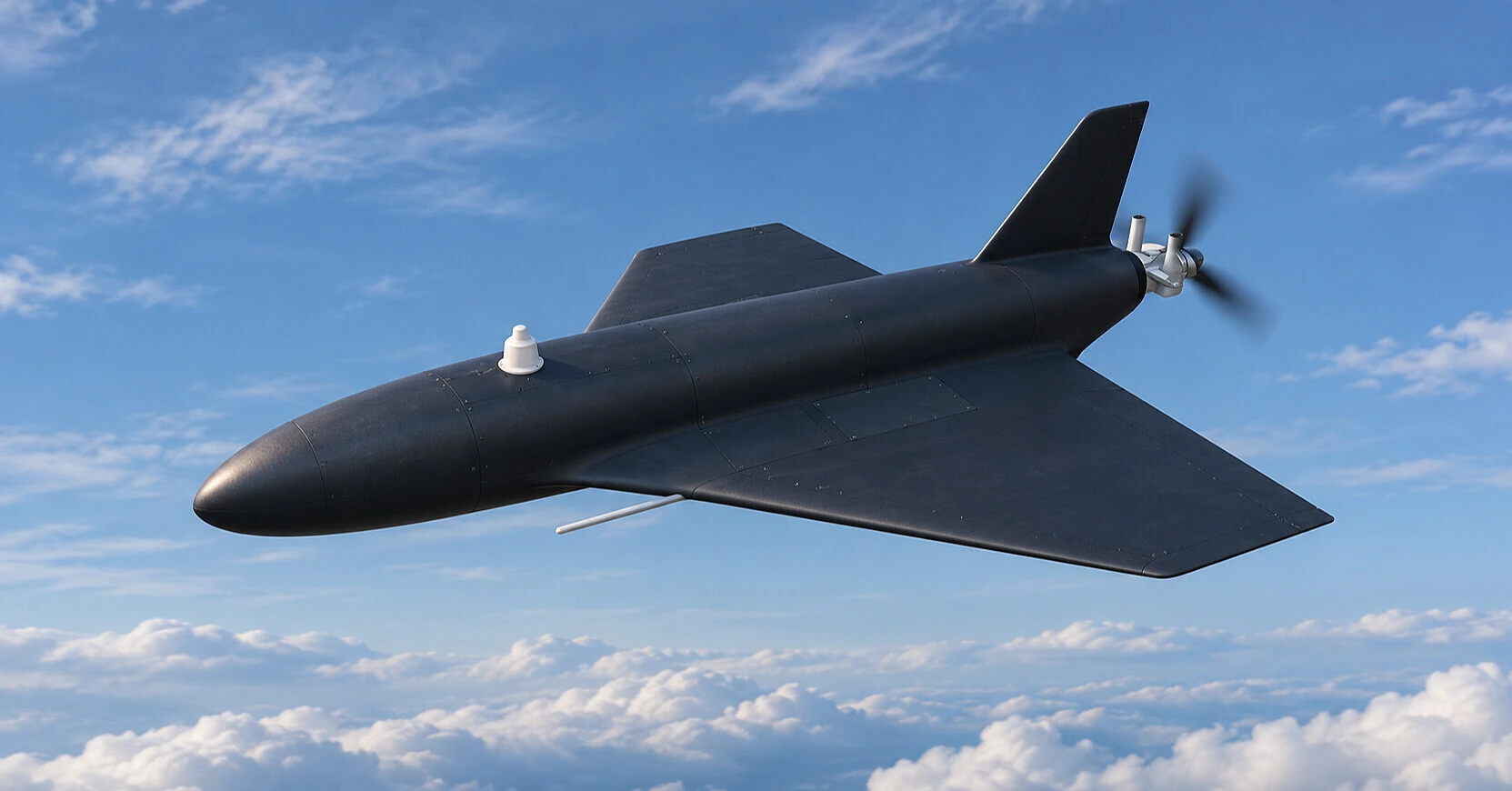
Russia has started using a larger modification of the 'Herber-2' drone, capable of covering a distance of up to 1200 km and carrying a warhead weighing up to 25 kg. The new aircraft received a more powerful engine, an enlarged fuel tank, and improved electronics.
This was reported on November 2 by the Main Intelligence Directorate of the Ministry of Defense of Ukraine, which published the results of drone research on the War&Sanctions portal.
According to intelligence, initially Russian 'Herbers' were used mainly as cheap decoys to overload Ukrainian air defense. Later, the Russians began to equip them with reconnaissance equipment and warheads, gradually bringing their capabilities closer to the more expensive strike drones of the 'Geran' family.
The new 'Herber-2' has a wingspan of 3 meters and a fuselage length of 2.6 meters. Thanks to the fuel tank increased to 63 liters, the flight range reaches 1200 km. The drone is equipped with a two-cylinder two-stroke engine, structurally related to the engine of 'Geran-2', production of which Russia localized in the special economic zone 'Alabuga'.
In the sample examined by Ukrainian intelligence, a high-explosive fragmentation incendiary warhead weighing 10 kg was installed, supplemented with containers with an incendiary mixture. At the same time, according to the characteristics declared by the Russian side, the maximum weight of the warhead can reach 25 kg.
The electronics of the drone also underwent significant changes. It was found to have an updated flight controller, a jamming-resistant satellite navigation system 'Kometa', data transmission equipment, and a new video processing system based on a Chinese microcomputer Coke Pi.
Some modifications are equipped with cameras designed, in particular, to detect interceptor drones. According to the GUR, there are also versions with additional optical equipment.
In the component base of the new 'Herber', most parts are of Chinese and American origin. Intelligence identified eight components from Chinese manufacturers and four from American ones. However, the presence of foreign electronics in itself does not indicate direct supply of parts by manufacturers to Russia.
GUR drew attention that the increase in flight range expands the potential geography of application of these drones beyond Ukraine. In particular, in mid-September 2026, a 'Herber-2' aircraft with a warhead was discovered on the Baltic coast of Poland.
On the War&Sanctions portal, intelligence published an interactive three-dimensional model of the new drone, its characteristics, and a list of detected electronic components. These materials are used to document the use of foreign technologies in Russian weapons and identify potential ways of sanction evasion.
Based on materials: GUR MO of Ukraine, War&Sanctions
