
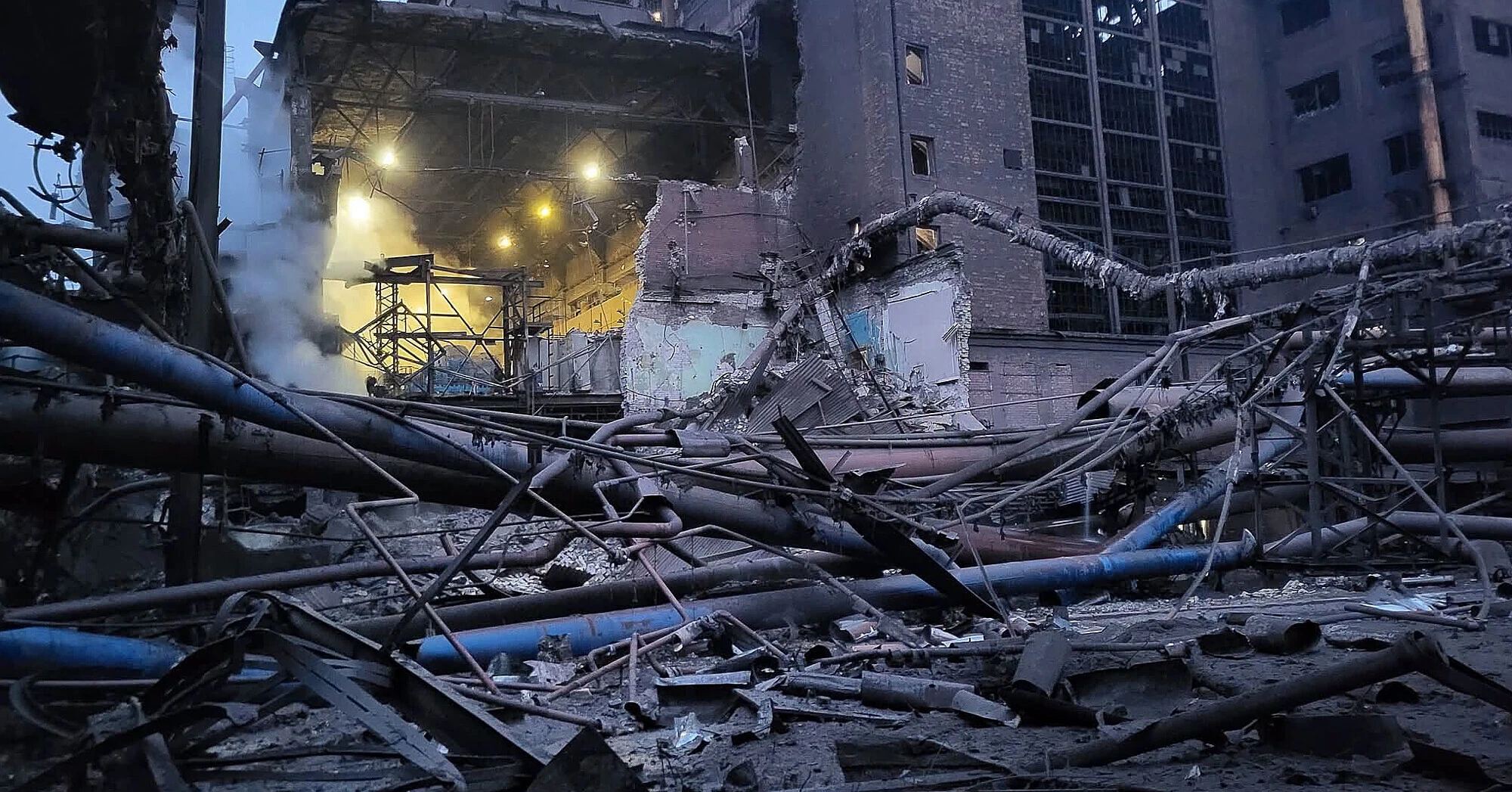
"Zaporizhstal" metallurgical plant, whose production complex was halted after Russian missile strikes in August 2026, ended nine months with significant losses. The enterprise, which last year operated profitably, recorded a deterioration in financial results amid the destruction of production capacity and energy infrastructure.
This is evidenced by the interim report of PJSC "Zaporizhstal" for the third quarter of 2026, published by the enterprise on October 30, as well as the company's financial statements.
For January-September 2026, "Zaporizhstal" received a net loss of 2.308 billion UAH. For the same period last year, the plant had a net profit of 1.887 billion UAH.
Directly in the third quarter, that is, from July to September, the enterprise's net loss amounted to 1.247 billion UAH. For comparison, in the first half of 2026, the plant accumulated 1.061 billion UAH in losses.
The enterprise's revenue for nine months decreased by 8.3% compared to the same period of 2025 - to 49.157 billion UAH.
At the same time, in the third quarter, revenue from contracts with customers amounted to 10.456 billion UAH, as reflected in the interim report of the enterprise.
Russian strikes led to production halt
In the report, the management of "Zaporizhstal" directly links the deterioration of liquidity and financial stability indicators to Russian attacks on the production site in August-September 2026.
According to the enterprise, missile strikes damaged certain objects of production and energy infrastructure, including blast furnace capacity. This negatively affected the production processes of the plant.
The enterprise suffered its first large-scale attack on August 11. After the shelling, the entire production complex had to be halted. Workers were engaged in clearing debris, eliminating the consequences of the strike, and assessing the possibilities for restoring damaged equipment.
Some technological processes were subsequently restored to the minimum necessary level to keep equipment in a safe condition and prevent technogenic risks.
However, the plant could not return to normal production mode. Further Russian shelling complicated the repair and restoration of damaged facilities.
During the third quarter, the enterprise suffered four ballistic attacks - August 11 and 27, September 12 and 17.
As a result of these strikes, production equipment, energy networks, and infrastructure necessary for the operation of the metallurgical complex were damaged.
In October Russia attacked the plant again
Already after the end of the reporting quarter, on October 17, Russian forces launched another massive strike on "Zaporizhstal".
According to the enterprise, this time six ballistic missiles were fired at the plant. They hit facilities of internal energy and logistics infrastructure, and also repeatedly damaged production sites of blast furnace production.
As a result of the October 17 attack, there were no fatalities or injuries: workers moved to shelters in time.
In total, from the beginning of August to October 17, 2026, Russian forces attacked "Zaporizhstal" with ballistic missiles five times. According to the plant's estimates, during this period 23 missiles were fired at its territory.
As a result of a series of strikes, eight employees of the enterprise were killed, and 31 metallurgists were injured.
At the time of the last attack, the plant had still not resumed production in normal mode. The main efforts of the staff were directed at eliminating the consequences of the shelling, repairs, and maintaining critical technological processes.
At the same time, the October strike occurred already after the end of the third quarter, so its consequences are not included in the financial results for January-September.
Financial risks for the enterprise
In the interim report, "Zaporizhstal" lists among the main risks further missile strikes, unstable power supply, rising energy costs, logistics complications, and restrictions on access to international markets.
The plant notes that the energy-intensive nature of metallurgical production makes it particularly vulnerable to power outages. Under conditions of significant energy supply restrictions, the enterprise can operate only with reduced production volumes.
Additional difficulties are created by restrictions on navigation in the Black Sea region, the need to use alternative transport routes, and trade restrictions on foreign markets.
Among regulatory risks, the company separately highlights the EU Carbon Border Adjustment Mechanism (CBAM) and new quotas for imports of certain steel products, which came into effect on July 1, 2026.
Due to war risks, the enterprise minimized investments and focused on critical facilities and repair of existing equipment. Total investment expenditures in the third quarter amounted to 120 million UAH.
The report notes that there are no plans to expand production capacity in 2026.
Despite the deterioration in financial performance, the management of "Zaporizhstal" assesses the enterprise as financially stable and solvent. At the same time, the company acknowledges that the further impact of war on its operating activities, assets, and ability to operate steadily cannot be reliably estimated.
The financial statements do not provide a separate calculation that would determine exactly which part of the net loss is directly caused by missile strikes and which by other production and economic factors.
"Zaporizhstal" is one of the largest metallurgical enterprises in Ukraine and a joint venture of the Metinvest group. According to the interim report, the average number of employees of the plant in the reporting period was 8,737 people.
Sources: PJSC "Zaporizhstal" (interim report for the third quarter of 2026), PJSC "Zaporizhstal" (financial statements for nine months of 2026), "Zaporizhstal" (notification of missile strikes and production halt)
