
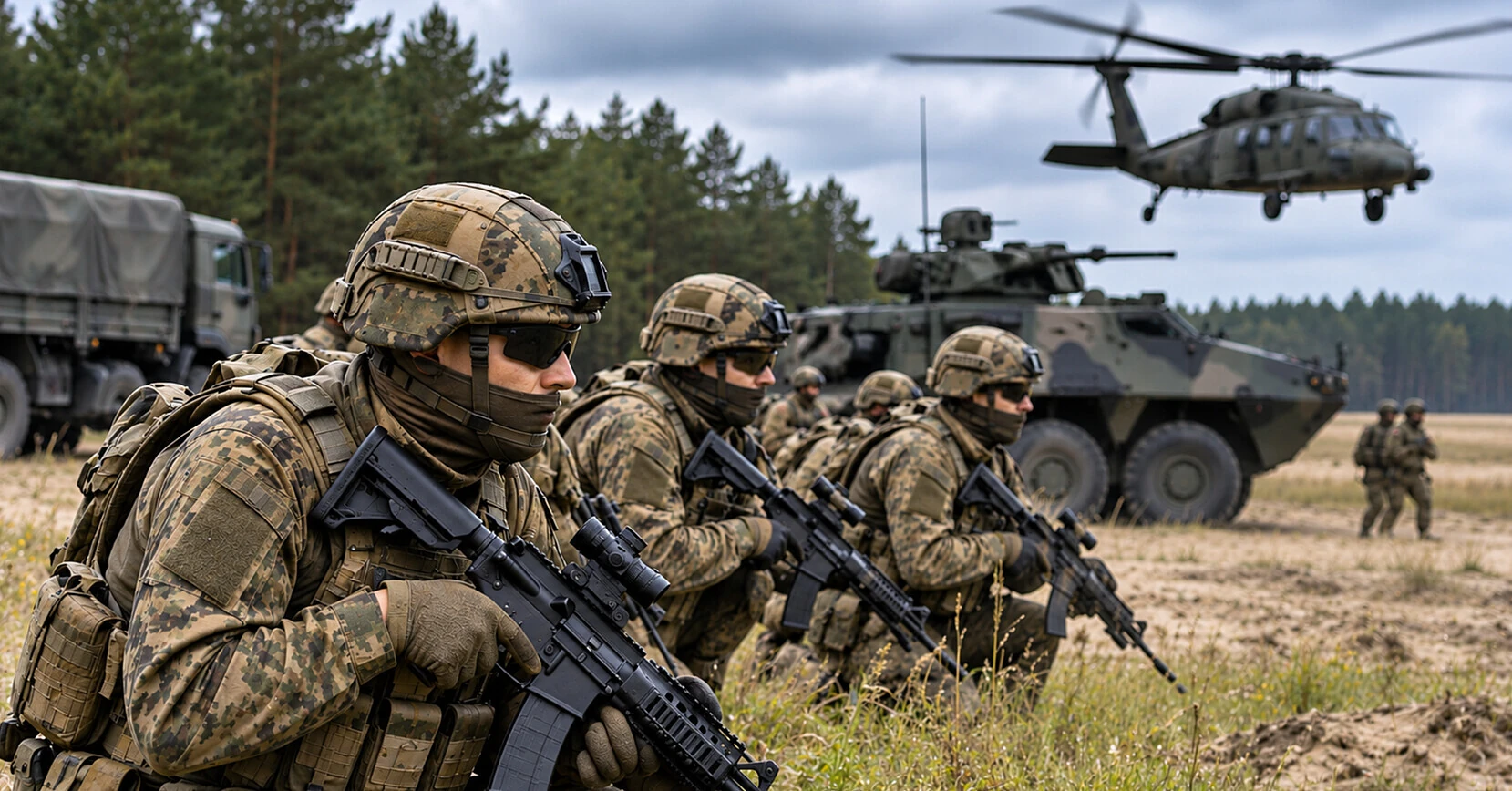
Poland is preparing to hold the first large-scale military exercises of the "coalition of the willing", during which European countries will test their readiness for a possible deployment of international forces in Ukraine after the cessation of hostilities. The maneuvers will involve about 2,800 military personnel from ten countries, including Ukrainian soldiers.
This was reported on November 2 by the French newspaper Le Monde, citing information about the preparation of the exercises.
The maneuvers, named Koalijca, are scheduled for November 9–22 in southeastern Poland. Their main task is to test the ability of the coalition countries to jointly organize an international mission in Ukraine in the event of a ceasefire agreement.
The bulk of the participants will be military personnel from France and the United Kingdom. The exercises will also involve representatives from Germany, Estonia, Lithuania, the Netherlands, Spain, Sweden, Belgium, and Poland.
According to Le Monde, the Polish side will provide about 500 troops. Warsaw intends to focus on logistical support for the international mission, as a significant portion of military aid to Ukraine already passes through Polish territory.
At the same time, Polish authorities have previously stated that they do not plan to send their own troops to Ukraine after the end of hostilities. Instead, the country is ready to provide transport, infrastructure, and organizational support to allies.
The exercises will focus primarily on the management of international forces, logistics, and interoperability between units from different countries. The military will test the functioning of command structures, compatibility of communication systems, and the ability to coordinate actions of a multinational contingent.
Special attention will be paid to countering drones. The French army plans to test a unit using autonomous air and ground systems.
Ukrainian military personnel will also participate in activities related to the preparation of the future international mission.
In addition to the ground maneuvers in Poland, aviation unit exercises are planned in Romania. They will involve combat, transport, and reconnaissance aircraft, as well as refueling tankers.
The maritime component of the operation will be practiced in a simulation format with the participation of Turkey. This is related to the security specifics of the Black Sea region and Ankara's role in controlling the passage of warships through the Bosporus and Dardanelles straits.
The preparation is carried out within the framework of the multinational force for Ukraine – Multinational Force Ukraine (MNF-U). Of the 36 countries in the "coalition of the willing", 24 have expressed readiness to participate in one form or another in the future international contingent.
As Le Monde notes, in the long term, the strength of such forces could reach 20,000 troops. However, the final composition, scope, and conditions of a possible deployment remain a subject of discussion among the allies.
It is expected that the international mission will perform two main tasks: deter Russia from resuming hostilities and assist in restoring the combat capability of the Ukrainian army, particularly through training of military personnel and equipment repair.
At the same time, the coalition does not consider the future contingent as forces for direct participation in combat operations or a classic peacekeeping mission deployed between Russian and Ukrainian troops.
According to the plan of the initiative's participants, the Ukrainian army should remain the main defense force of the country, while the international presence should provide additional security guarantees.
The United States is not directly participating in the exercises. NATO has been informed of their preparation, but the maneuvers are not conducted under the Alliance's command.
One of the unresolved issues remains Washington's participation in future security guarantees for Ukraine. European countries are counting on American support, but specific US commitments have not yet been defined.
There are also disagreements among coalition participants regarding the possible deployment of international forces. France supports the presence of ground units directly in Ukraine, the UK is considering options for more active air support, and Germany advocates for stationing part of the forces in neighboring countries.
Earlier, the Polish government reported that an agreement to hold the first exercises was reached in July 2026. At that time, Prime Minister Donald Tusk confirmed the country's readiness to receive British and French units.
In August, French President Emmanuel Macron also announced preparations for large-scale maneuvers in October and November. This was previously reported by "Kurs Ukrainy".
The new information from Le Monde clarifies the dates, number of participants, and content of the exercises. They will become the first large-scale practical test of the readiness of the international forces that European allies intend to form to ensure Ukraine's security after a possible end to the war.
Based on materials from: Le Monde, Government of Poland, Polskie Radio, Rzeczpospolita.
