
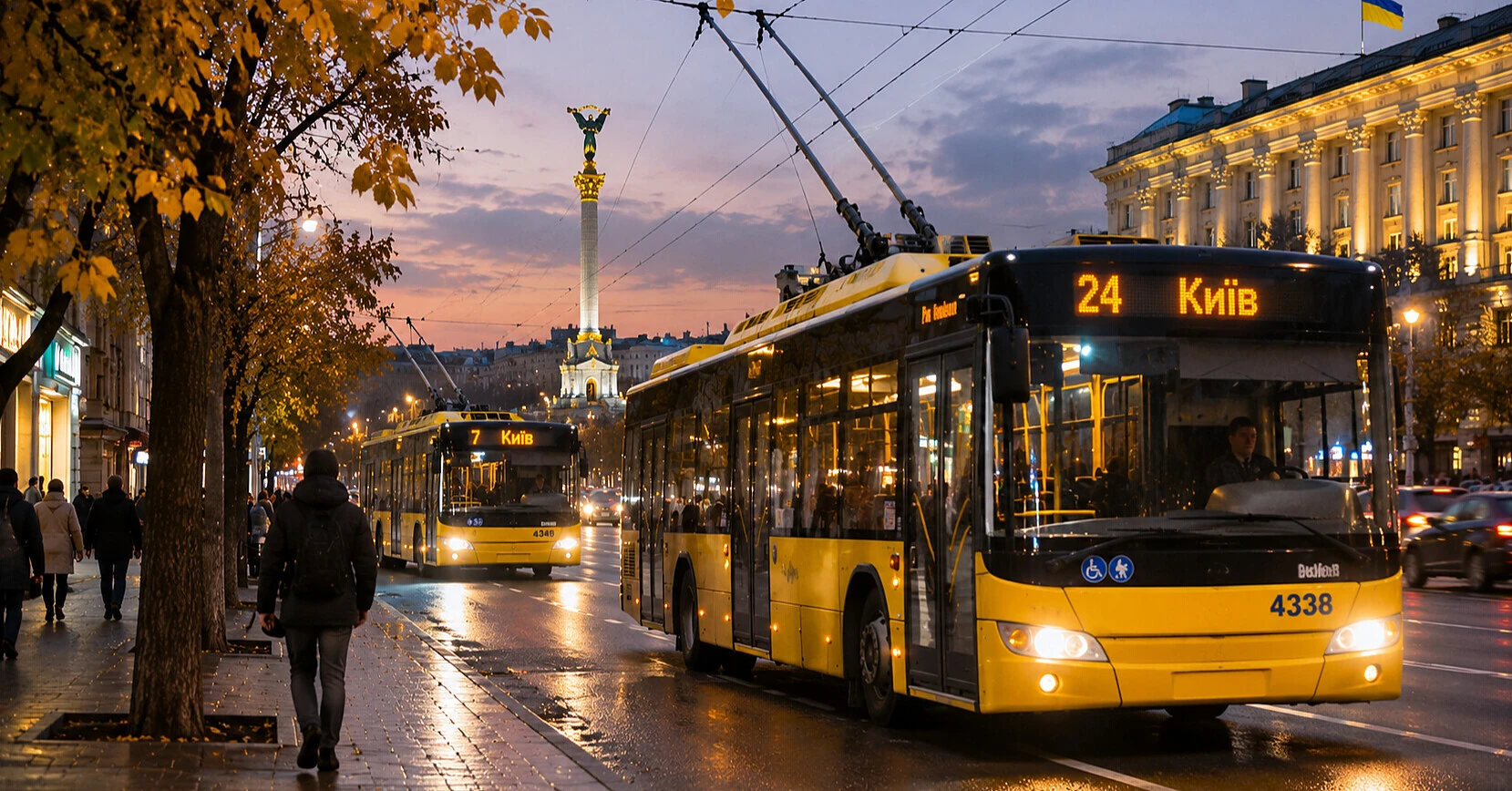
On the evening of November 3, all tram and trolleybus service in Kyiv was temporarily suspended due to the critical situation in Ukraine's power grid after Russian shelling. To transport passengers, city authorities will organize 40 duplicate bus routes, but warn they will not be able to fully replace ground electric transport.
This was reported by the Kyiv City State Administration (KCSA).
The restrictions affect tram and trolleybus routes on both banks of the Dnipro River. The reason for the shutdown is a critical shortage of electricity caused by damage to energy infrastructure.
The KCSA emphasized that the shutdown is temporary. Tram and trolleybus services will resume once the power grid stabilizes.
The Kyiv Metro continues to operate normally. However, city authorities warned that its further operation will also depend on the state of the power grid. Passengers will be informed about any changes in train schedules.
Which buses will run instead of trolleybuses
The municipal enterprise "Kyivpastrans" will organize bus service on 30 routes duplicating trolleybus lines.
Buses will be numbered according to the corresponding trolleybus route plus the designation "TR".
- No. 3TR — Zaliznychnyi Masyv — Palace of Sports;
- No. 4TR — Svobody Avenue — "Ploscha Ukrainskykh Heroiv" metro station;
- No. 6TR — Minskyi Masyv — Maidan Nezalezhnosti;
- No. 8TR — Smelianska Street — "Ploscha Ukrainskykh Heroiv" metro station;
- No. 11TR — National Museum of Folk Architecture and Life of Ukraine — Bahrynova Hora;
- No. 14TR — Botanical Garden — Central Railway Station;
- No. 17TR — Kosmonavtiv Square — "Ploscha Ukrainskykh Heroiv" metro station;
- No. 23TR — Mrii Street — "Lukianivska" metro station;
- No. 24TR — Pivnichna Street — Svobody Avenue;
- No. 26TR — Svobody Avenue — "Nyvky" metro station;
- No. 27TR — "Pochaina" metro station — "Kyiv-Volynskyi" railway station;
- No. 28TR — Svobody Avenue — "Lukianivska" metro station;
- No. 29TR — Darnytska Square — "Kurenivka" railway platform;
- No. 30TR — Myloslavska Street — Kadetskyi Hai Street;
- No. 31TR — Myloslavska Street — "Lukianivska" metro station;
- No. 32TR — Pivnichna Street — Soshenko Street;
- No. 33TR — Minskyi Masyv — Southern Railway Station;
- No. 35TR — Svobody Avenue — Kadetskyi Hai Street;
- No. 36TR — Pivnichna Street — Chornobylska Street;
- No. 37TR — Myloslavska Street — "Lisova" metro station;
- No. 38TR — "Vydubychi" metro station — National Museum of the History of Ukraine in the Second World War;
- No. 40TR — Kadetskyi Hai Street — Palace of Sports;
- No. 41TR — Tuluzka Street — "Sviatoshyn" metro station;
- No. 42TR — Olgycha Street — "Lybidska" metro station;
- No. 43TR — Kibbcenter — Darnytska Square;
- No. 44TR — Pivnichna Street — Stepana Bandery Avenue;
- No. 45TR — "Vystavkovyi Tsentr" metro station — "Vasylkivska" metro station;
- No. 47TR — Myloslavska Street — "Minska" metro station;
- No. 50KR — Myloslavska Street — Darnytska Square;
- No. 50TR — Myloslavska Street — "Lybidska" metro station.
Thus, bus service is planned to be maintained on key routes connecting residential areas with railway stations, metro stations, and the central part of Kyiv.
Which buses will replace trams
Ten additional bus routes are planned to replace tram service in Kyiv. They will operate on both the right and left banks of the capital.
- No. 1T — Mykhailivska Borshchahivka — "Starovokzalna" station;
- No. 3T — "Zhyulia Verna" station — "Starovokzalna" station;
- No. 12T — Pushcha-Vodytsia — Tarasa Shevchenka Square;
- No. 14T — Vidradnyi Avenue — Kontraktova Square;
- No. 16T — Kontraktova Square — "Heroiv Dnipra" metro station;
- No. 19T — Kontraktova Square — Tarasa Shevchenka Square;
- No. 22T — Voskresenskyi Avenue — ZZBK;
- No. 27T — Myloslavska Street — "Pozniaky" metro station;
- No. 28T — Myloslavska Street — "Lisova" metro station;
- No. 29T — "Boryspilska" metro station — "Lisova" metro station.
In particular, for passengers of the Borshchahivka light rail line, buses No. 1T and No. 3T will be provided. They will ensure connectivity between residential districts, the railway station, and adjacent transport hubs.
On the left bank, duplicate buses will serve routes between Troieshchyna, Darnytska Square, and the "Lisova", "Pozniaky", and "Boryspilska" metro stations.
Buses cannot fully replace electric transport
The KCSA warned that the duplicate buses will not be able to provide the same passenger capacity as trams and trolleybuses.
The number of buses on each route will be determined based on the available bus fleet, number of drivers, passenger flow intensity, and the current situation in the city.
This means that the actual frequency of the duplicate routes may differ from the usual schedules of trams and trolleybuses. Passengers should expect longer waiting times and reconsider their usual travel routes.
Some buses may experience increased load, especially on routes connecting large residential areas with the metro and railway stations.
The exact schedules of the duplicate buses will be published on the official website of KP "Kyivpastrans", city authorities promised.
Passengers can also get information about operational changes through the Telegram channel "Changes in Movement | Kyivpastrans".
Will the Kyiv Metro work?
Unlike ground electric transport, the metro continued to operate normally at the time of the KCSA's evening announcement.
The city administration noted that the further operation of the metro depends on the electricity supply situation. If the power grid requires additional restrictions, passengers will be warned through the official information resources of the "Kyivskyi Metropoliten" enterprise.
No complete metro shutdown was announced by the city authorities on the evening of November 3.
The metro remains an important element of Kyiv's transport system, as it provides connectivity between both banks of the Dnipro and allows passengers to transfer to bus routes.
Why did electric transport stop in Kyiv
The stoppage of trams and trolleybuses is one of the consequences of massive Russian attacks on Ukraine's energy infrastructure.
Earlier on November 3, the mayor of the capital, Vitali Klitschko, reported that as a result of the recent shelling, facilities in the Kyiv regional energy hub were damaged. In addition, Russian strikes affected generation and transmission equipment in other regions of the country.
Because of the damage, NPC "Ukrenergo" introduced emergency power outages in Kyiv and the region. Under such conditions, previously published hourly outage schedules do not apply.
The unstable power supply has already caused disruptions in the city's infrastructure. In particular, problems arose with water supply in the capital, as key "Kyivvodokanal" facilities suffered power outages.
During the day, power outages repeatedly affected public transport. On some sections, tram and trolleybus service was temporarily suspended and partially restored.
However, on the evening of November 3, restrictions were extended to the entire ground electric transport network in Kyiv. City authorities cited a critical situation in the national power grid as the reason.
"Ukrenergo" previously reported that the power grid is facing one of the largest Russian attacks. Energy workers continue restoration work, primarily providing electricity to critical infrastructure.
City authorities have not yet announced a specific date for the full restoration of tram and trolleybus services. The decision will depend on the stabilization of the energy system and the possibility of providing transport lines with the necessary electricity.
