

The McDonald's chain in Ukraine has begun testing a new procedure for restaurant operations during yellow-level air alarms. For now, the experiment has been introduced only in two locations - in Poltava and Chernihiv. They will be able to continue serving visitors during certain air alerts provided there is no direct threat to the specific location.
The company announced this on November 5 in Instagram Stories on its official page.
McDonald's explained that since September, Ukrainian legislation allows businesses to continue operations during yellow-level air alerts if they comply with established safety requirements.
The company adapted its operational processes to the new rules and introduced a real-time air threat monitoring system.
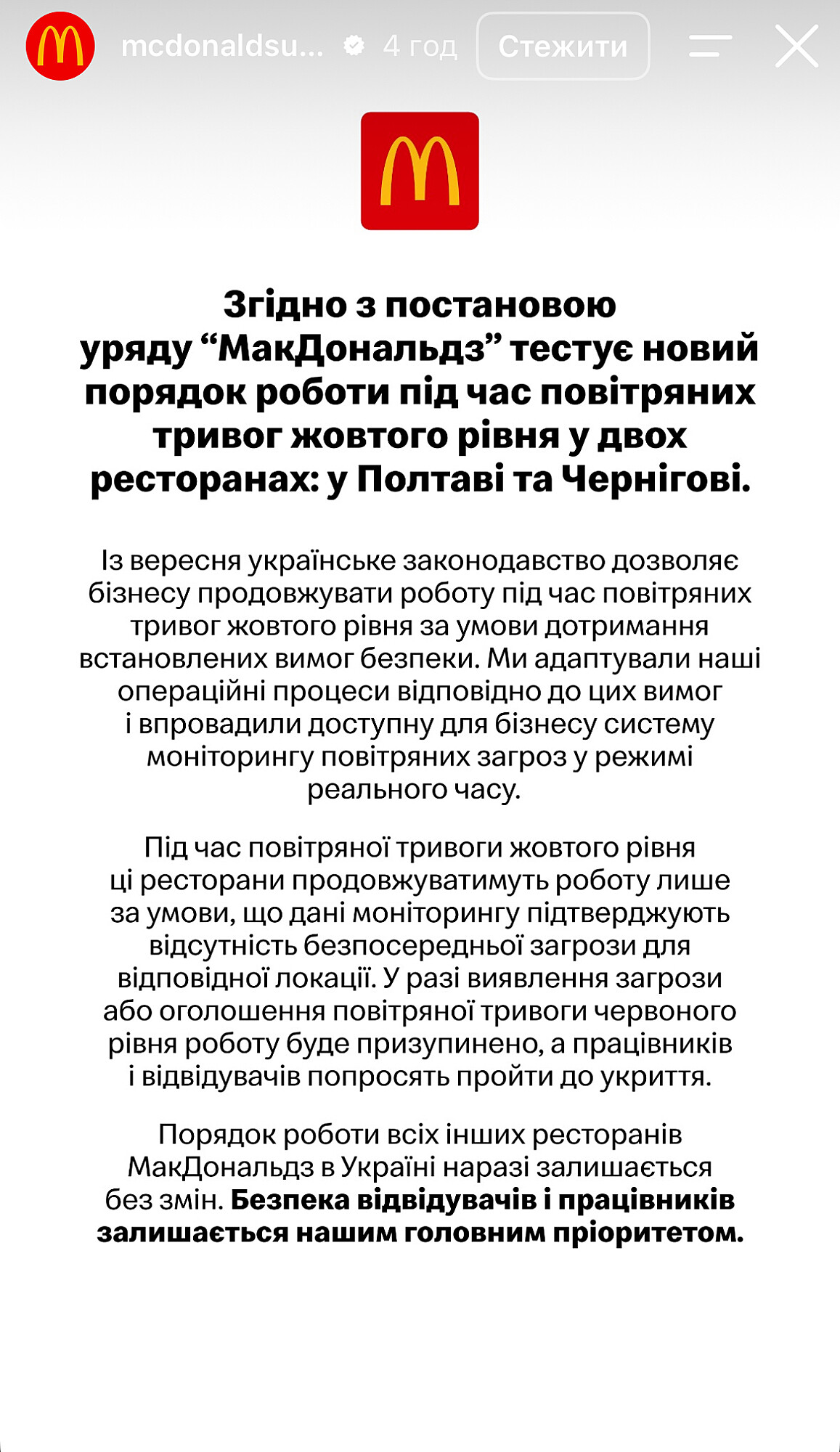
Restaurants in Poltava and Chernihiv will continue operating during a yellow alert only when monitoring data confirms the absence of a direct threat to the respective location.
If the system detects danger or a red-level air alert is announced, visitor service will be suspended. Employees and customers will be asked to proceed to shelter.
The company emphasized that the operating procedures of all other McDonald's restaurants in Ukraine remain unchanged for now.
New business rules during air alerts
The changes became possible after the Cabinet of Ministers adopted Resolution No. 1092 of September 4, 2026, which introduced a two-tier classification of air alerts by danger level.
Yellow level is designated for drone threats. Red level is announced for missile, missile-drone, or massive drone threats.
Under yellow level, enterprises are allowed to continue operations provided safety requirements are met. In particular, premises must have protective structures, temporary or permanent shelters, or appropriate safe spaces.
On September 15, the government adopted Resolution No. 1128, which clarified business requirements. The document, in particular, provided for the possibility of arranging safe spaces inside buildings according to defined protection criteria.
Additionally, enterprises are required to inform employees and visitors about the availability of shelters or safe spaces and ensure they are alerted to air alarms.
Government prepares postponement of shelter requirements
Under current rules, enterprises without shelters were given a three-month transitional period to arrange them - until December 4, 2026. During this time, they may continue operations during yellow-level threats by agreement with the workforce.
However, implementation of the new requirements caused difficulties for entrepreneurs, primarily small and medium-sized businesses. Some companies lack sufficient funds or technical capabilities to arrange their own protective structures.
On October 29, the Cabinet of Ministers announced preparation of additional amendments to Resolution No. 1092 providing for extension of the transitional period and more flexible shelter requirements.
According to the government, requirements are planned to be differentiated depending on the number of employees and visitors simultaneously present at the facility.
It is also proposed to allow enterprises to use shelters outside their own territory if they have sufficient capacity, or to arrange mobile protective structures.
Separately, the government expects that by March 4, 2027, military administrations will collect information on enterprises' compliance with safety requirements. Based on this data, the Cabinet will determine further steps.
Meanwhile, as of November 5, the new deadlines have not yet been finally approved. Therefore, the deadline set by the resolution - December 4, 2026 - remains in force. The announced postponement does not mean cancellation of mandatory safety measures.
Testing of the new regime at McDonald's became one of the examples of practical application of the September legislative changes. Whether the company will extend the new operating procedure to other restaurants in Ukraine is currently unknown.
Source materials: McDonald's Ukraine, Cabinet of Ministers of Ukraine, Ministry of Economy and Environment of Ukraine
