
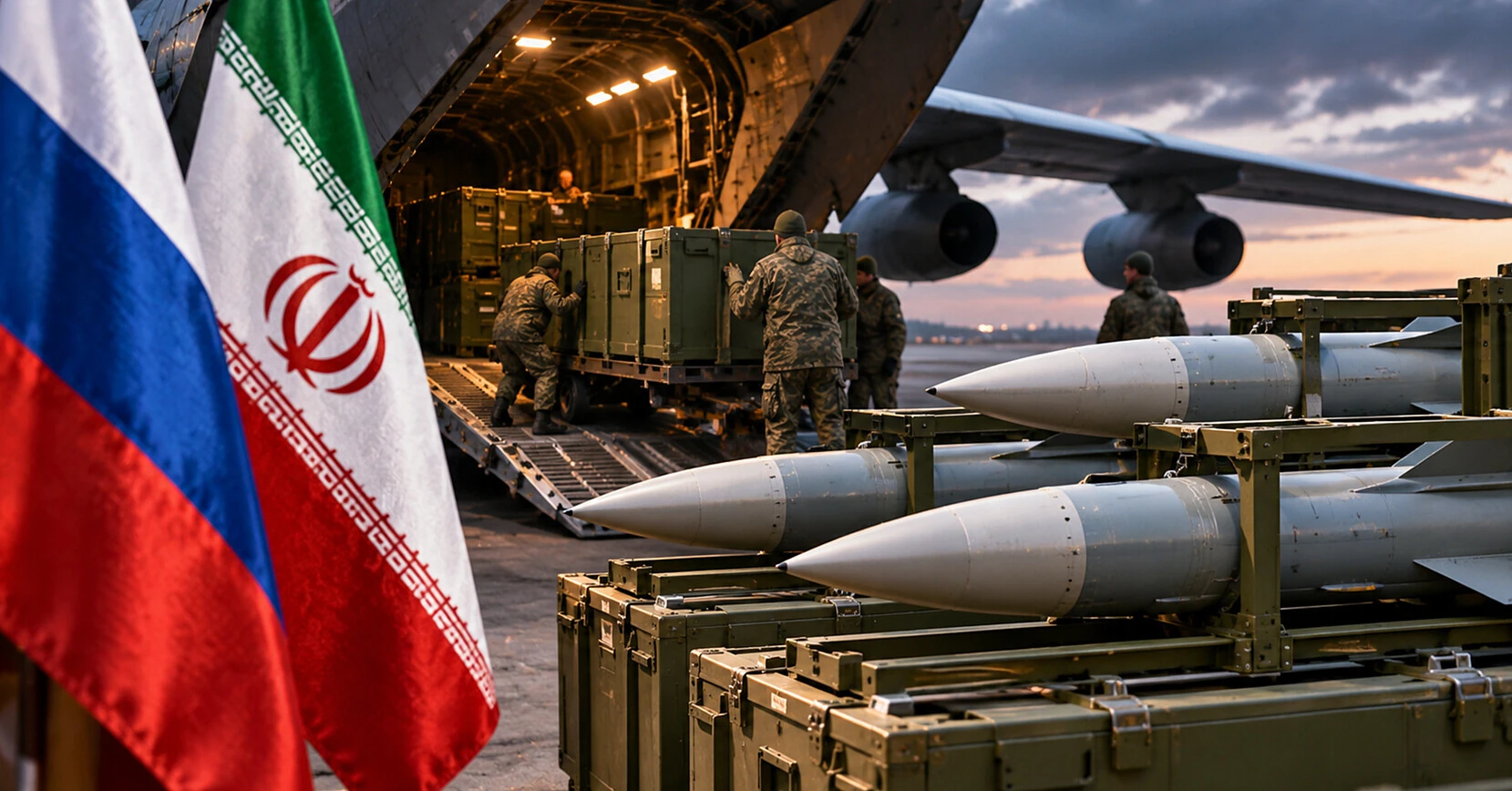
Russia has agreed to supply Iran with 90 launchers for precision-guided missiles that the Russian army actively uses in the war against Ukraine. The corresponding order was found in internal documents of a Russian defense enterprise.
This was reported on November 5 by Financial Times, which studied production documents for 2024–2025. The materials were provided to journalists by the Ukrainian private intelligence and analytical company Dallas Analytics.
According to the documents, Iran was to receive 90 APU-L launchers designed to launch Russian guided missiles LMUR, also known as “Product 305”.
FT obtained a letter from the Russian defense enterprise Vympel sent in May 2024 to the Machine-Building Design Bureau. In it, the manufacturer asked to speed up deliveries of components for two types of launchers — APU-L and APU-305.
The letter noted that delays could jeopardize the fulfillment of nine contracts. Seven customers were Russian, and two more represented foreign states.
One of the foreign buyers was China, which ordered 192 APU-305 launchers. The second customer, designated by code “K-10,” was to receive 90 APU-L launchers.
As journalists established, the Russian state arms exporter Rosoboronexport uses the designation “K-10” for Iran. This is confirmed by other internal documents, including contracts for the supply of Yak-130 combat training aircraft.
At the same time, the documents do not allow establishing whether the launchers were actually transferred to Tehran. Thus, the existence of an export order has been confirmed, but not its final execution.
Both types of launchers are intended for the use of the light multi-purpose guided missile LMUR. This is a precision weapon capable of hitting, among other things, moving targets.
The missile was first presented at the Russian military-technical forum “Army” in 2021. It entered service in 2022 and since then has been widely used by Russian troops against Ukraine.
The APU-L launchers are intended primarily for Mi-28 attack helicopters. Each launcher can carry two missiles. The range of the LMUR is about 14 kilometers.
Iran has previously concluded agreements on the purchase of Russian Mi-28 helicopters. In November 2023, Tehran announced the completion of the relevant arrangements, and in January 2026, images appeared that allegedly confirm the presence of one such helicopter in Iran.
The disclosed documents indicate the continuation of military-technical cooperation between Moscow and Tehran, despite the needs of the Russian army for weapons for the war against Ukraine.
Earlier, Financial Times reported on Russian assistance to Iran in developing technologies for supersonic cruise missiles, as well as on agreements on the supply of man-portable anti-aircraft missile systems.
In turn, Iran previously supplied Russia with Shahed attack drones and facilitated the organization of their production on Russian territory. Russian troops use these drones for attacks on Ukrainian cities and infrastructure.
Nicole Grajewski, an expert at the Carnegie Endowment for International Peace, noted that the discovered documents demonstrate Moscow’s willingness to continue supplying weapons to Iran, despite its own military needs and objections from Western countries.
At the same time, analysts emphasize that Russian military assistance to Tehran, although it expands its capabilities, has not yet led to a fundamental change in the situation in the Middle East.
Based on materials from: Financial Times, hromadske, Iran International.
