
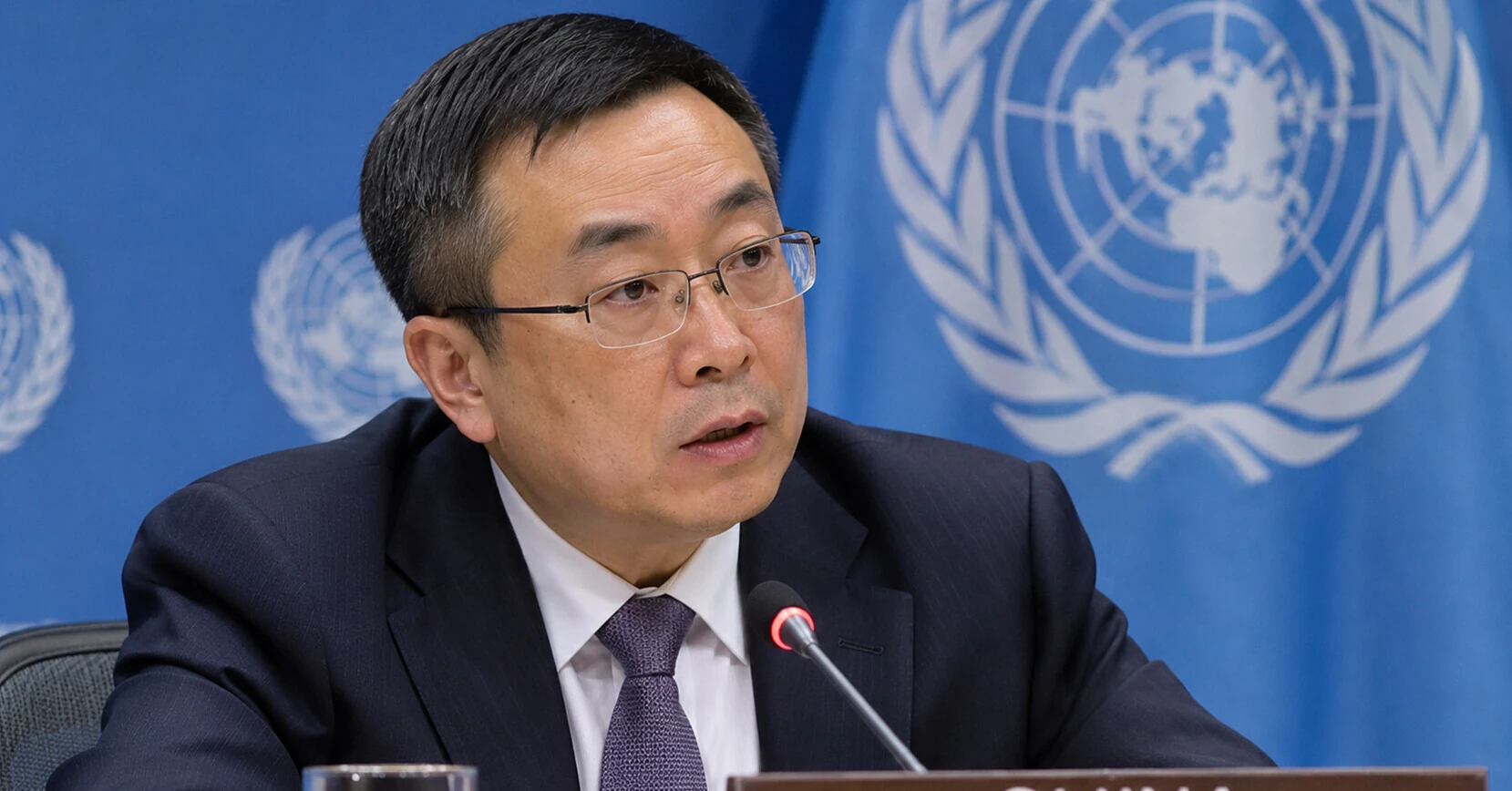
China supported diplomatic efforts to end Russia's war against Ukraine and called on the international community to facilitate the upcoming trilateral talks in Abu Dhabi. Beijing believes that the parties should take advantage of the current opportunity to reach a long-term peace agreement.
This was stated on November 9 by Deputy Permanent Representative of China to the UN Sun Lei during a UN Security Council meeting dedicated to the situation in Ukraine.
According to the Chinese diplomat, the negotiation process has entered an important phase, and recent diplomatic contacts between the parties to the conflict create prerequisites for further progress toward peace.
"The international community calls for peace, and voices in support of peace negotiations are growing louder. Recently, key parties have held a number of contacts, sending certain positive signals," — stated Sun Lei.
He emphasized that China supports efforts aimed at achieving peace and hopes for the continuation of the positive dynamics of the diplomatic process.
Special attention by the PRC representative was given to the upcoming talks between Ukraine, the US, and Russia, scheduled for November 10–11 in the capital of the United Arab Emirates.
Beijing called on the meeting participants to demonstrate political will, maintain constant dialogue, and gradually converge positions on key settlement issues.
"The interested parties should demonstrate political will, maintain communication, gradually build consensus, and work together to conclude a comprehensive, long-term, and binding peace agreement," — noted the diplomat.
According to him, the international community should contribute to creating favorable conditions for negotiations and play a constructive role in finding a political solution.
Sun Lei also outlined three main directions that, in China's view, need to be taken into account in the peace settlement process.
The first concerns compliance with international humanitarian law, protection of the civilian population, and reduction of the intensity of hostilities. China welcomed recent prisoner exchanges and local humanitarian arrangements that allowed for the evacuation of civilians and delivery of necessary aid.
The second direction, according to the diplomat, is continuation of negotiations and achievement of a sustainable political agreement.
The third direction is related to addressing the root causes of the war and forming a new regional security architecture. In Beijing's opinion, when preparing long-term arrangements, the security interests of all stakeholders must be taken into account.
The Chinese representative emphasized that Beijing continues to maintain diplomatic contacts with both Ukraine and Russia, and also uses its own diplomatic initiatives to facilitate the settlement.
"We maintain close contacts with all parties involved, in particular with Russia and Ukraine, and actively engage in shuttle diplomacy," — stated Sun Lei.
He assured that China is ready, together with the international community, to continue efforts for an early ceasefire, cessation of hostilities, and ensuring long-term stability in the region.
However, the Chinese diplomat did not announce Beijing's intention to directly participate in the talks on November 10–11 or present a new peace plan.
The meetings in Abu Dhabi will be held with US mediation. The American side will be represented by Steve Witkoff and Jared Kushner. The Ukrainian delegation will be headed by the Head of the Foreign Intelligence Service, Rustem Umerov.
In parallel with the trilateral talks, Ukraine plans to hold separate consultations with representatives of the United Kingdom, France, Germany, Italy, NATO, and the European Commission.
