
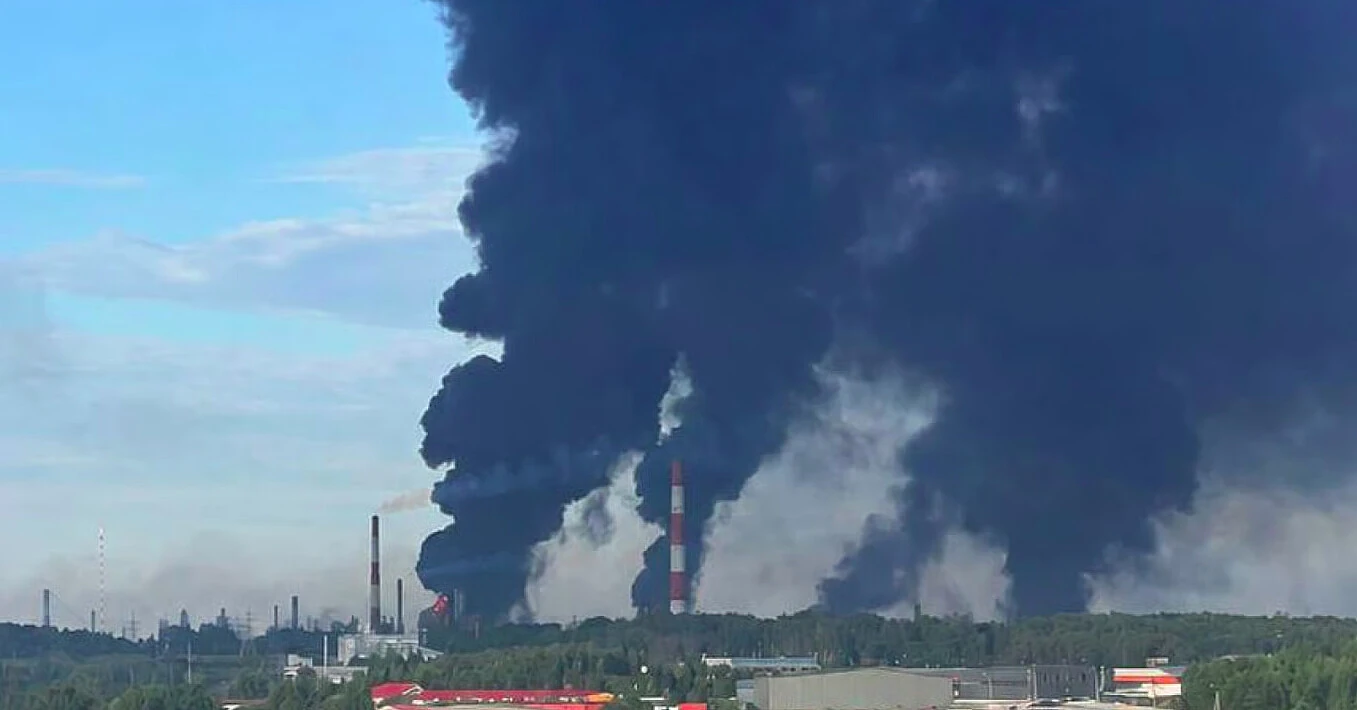
A new series of Ukrainian attacks on Russian oil refineries that began in late October has affected about 30% of Russia's refining capacity. Over the past week, drone strikes disrupted operations at nine of the country's largest refineries.
This was reported by Reuters on November 10, citing Reuters, with two sources in the Russian oil refining industry.
According to the agency's interlocutors, Ukraine has significantly intensified strikes on Russian oil refining enterprises since late October. Over the past week, the attacks led to disruptions of production processes and emergency situations at nine of the 35 large Russian refineries.
The combined design capacity of the enterprises affected by the attacks since late October is about 300 thousand tons of oil per day, or 2.2 million barrels. At the same time, the total primary refining capacity in Russia is estimated at approximately 930 thousand tons per day.
Thus, the strikes affected enterprises accounting for almost a third of Russian refining capacity. However, this does not mean that the actual volume of oil refining in the country has decreased by exactly 30%.
According to Reuters sources, at the end of October Russian refineries processed about 700 thousand tons of oil per day, which is equivalent to approximately 5 million barrels. After the resumption of Ukrainian attacks, the actual reduction in refining could have been up to 200 thousand tons per day.
Among the affected enterprises, the agency names refineries in Ryazan, Yaroslavl and the Volga region. In particular, strikes hit three large enterprises in central Russia.
One of the latest targets was the Kirishi refinery in Leningrad Oblast, considered the second largest in Russia. On the night of November 9, the facility was attacked by drones, after which a fire broke out on its territory.
The governor of Leningrad Oblast reported the strike on the facility and said that a woman was killed in the attack. The agency does not provide independent confirmation of all the aftermath.
Mass strikes on Russian refineries are exacerbating Moscow's problems with supplying the domestic fuel market. Reuters notes that Russia is already facing a shortage of petroleum products while continuing to supply diesel fuel to international markets under an export agreement with the administration of US President Donald Trump.
In late October, Russian enterprises began to restore refining volumes after a temporary reduction in the number of attacks. But the new wave of strikes again led to equipment shutdowns and disruptions in production.
The intensification of attacks came after the ceasefire on energy facilities in Ukraine and Russia announced by Trump failed to be implemented in practice.
Ukraine's President Volodymyr Zelensky last week confirmed that Ukrainian forces continue to strike Russia's oil sector facilities in response to Russian attacks on Ukraine's energy infrastructure.
The head of state said Russian troops continue to attack Ukraine's power plants, energy networks, heating and water supply systems. Zelensky stressed that Moscow rejected the de-escalation steps proposed by international partners.
In turn, Russian Foreign Minister Sergei Lavrov on November 10, in an article for the newspaper Kommersant, accused Ukraine of ignoring Trump's calls to stop strikes on Russian energy facilities.
The Reuters estimate of reduced oil refining is based on information from industry sources. There is no official confirmed data on the actual volume of idled capacity and recovery timelines yet.
