
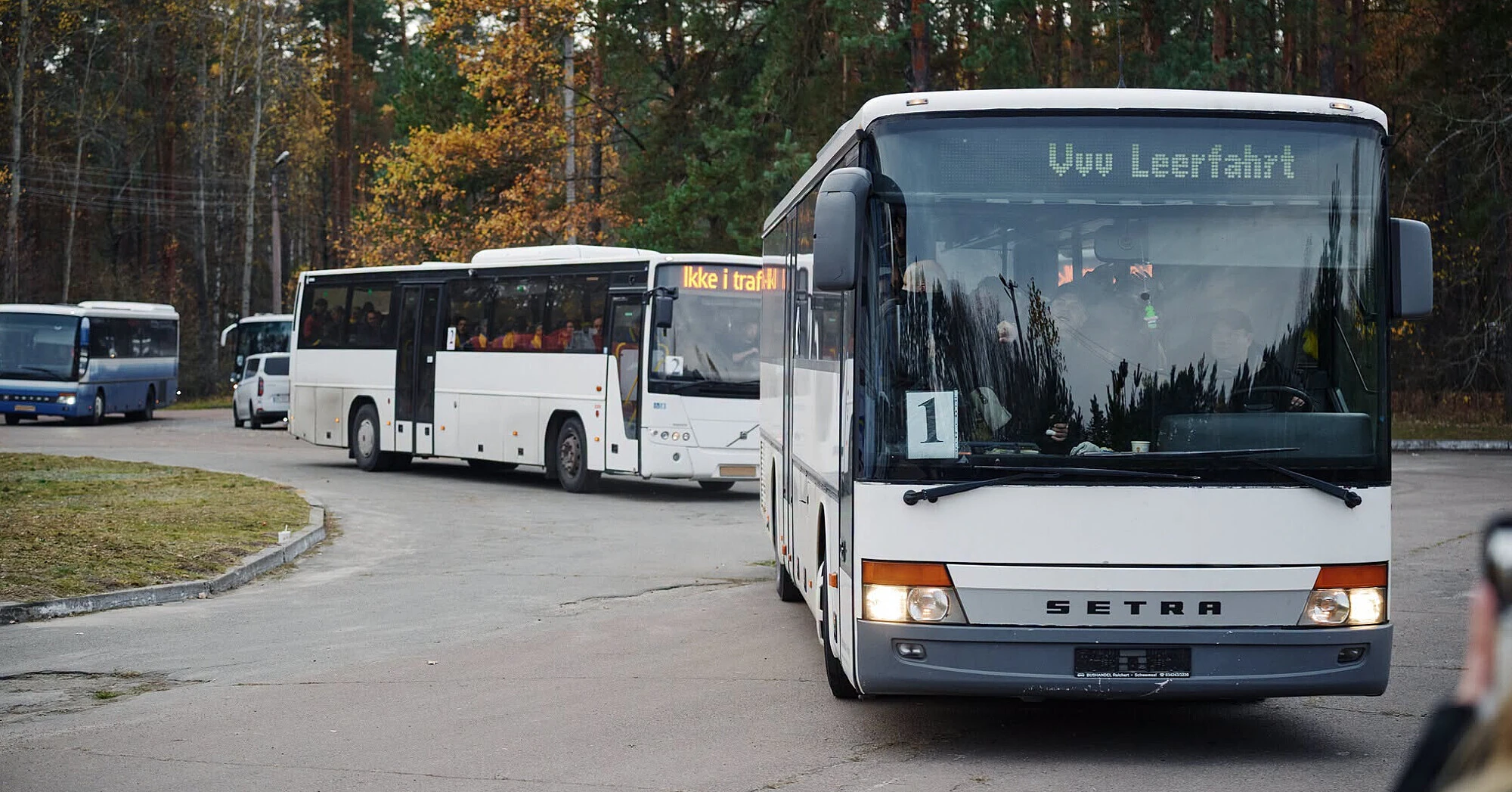
During the humanitarian evacuation from temporarily occupied Oleshky, some residents of neighboring settlements were unable to leave. People came out to the road, waiting for evacuation transport, but according to the head of the Kherson Regional Military Administration, Oleksandr Prokudin, the buses did not pick up some of those who wanted to leave.
Prokudin said this in an interview with Yevhen Buderatskyi, deputy editor-in-chief of "Ukrainska Pravda", for the "Damn Questions" podcast, published on November 10.
According to the head of the Regional Military Administration, residents of Nova Mayachka, Pidlisne and other settlements near Oleshky were among those waiting for evacuation. They came out to the highway on their own, hoping to get on the buses that transported people during the humanitarian operation.
"They went out to the highway, thinking they would be picked up. Nobody stopped. I was told that one person was finally taken from the road", - said Prokudin.
At the same time, earlier the Verkhovna Rada Commissioner for Human Rights Dmytro Lubinets told about another episode of the humanitarian mission. According to him, on the way back, the evacuation convoy saw people on both sides of the road who also wanted to leave the occupied territory.
"We stopped the convoy, went out to them and found out that they wanted to go specifically to Ukraine. So we took all those willing with us", - the ombudsman reported.
Lubinets clarified that such a stop was not provided for by previous agreements. However, the Russian Commissioner for Human Rights Yana Lantratova supported the proposal to pick up the people met along the way.
Thus, Prokudin reports about residents of neighboring villages who could not use the evacuation, while Lubinets describes a case when the convoy stopped and picked up those willing. From these statements it is impossible to establish whether they refer to different groups of people or sections of the route. The total number of residents of surrounding villages who wanted to leave but could not remains unknown.
Prokudin also said that the Russian occupation forces systematically restrict the movement of residents of the left bank. According to him, people cannot always leave their settlements even to receive medical care. The situation is especially difficult for those who do not have the necessary documents.
In addition, on the eve of the humanitarian operation, Russian military and FSB officers tried to persuade residents of Oleshky to leave in the direction of Russia. According to the head of the Regional Military Administration, some people were pressured to choose this direction.
At the same time, according to Prokudin, most people who used transport of the Russian side remained in the temporarily occupied territories of Kherson region or in Crimea. According to him, one family went to the Krasnodar Territory of the Russian Federation.
The head of the Regional Military Administration explained that initially they considered the possibility of evacuating residents of Oleshky directly to Kherson by water or air transport. However, the Russian side rejected such options. Additional obstacles were the mine danger on the Dnipro and the constant activity of attack drones.
According to Prokudin, some residents of the occupied territories were also afraid to leave because of the risk of Russian filtration, in particular if their relatives serve in the Armed Forces of Ukraine or work in Ukrainian state bodies.
He believes that carrying out further humanitarian missions without forced checks by the occupiers would allow evacuating more people who still remain on the left bank of the Kherson region.
Based on materials: Ukrainska Pravda, Dmytro Lubinets
