
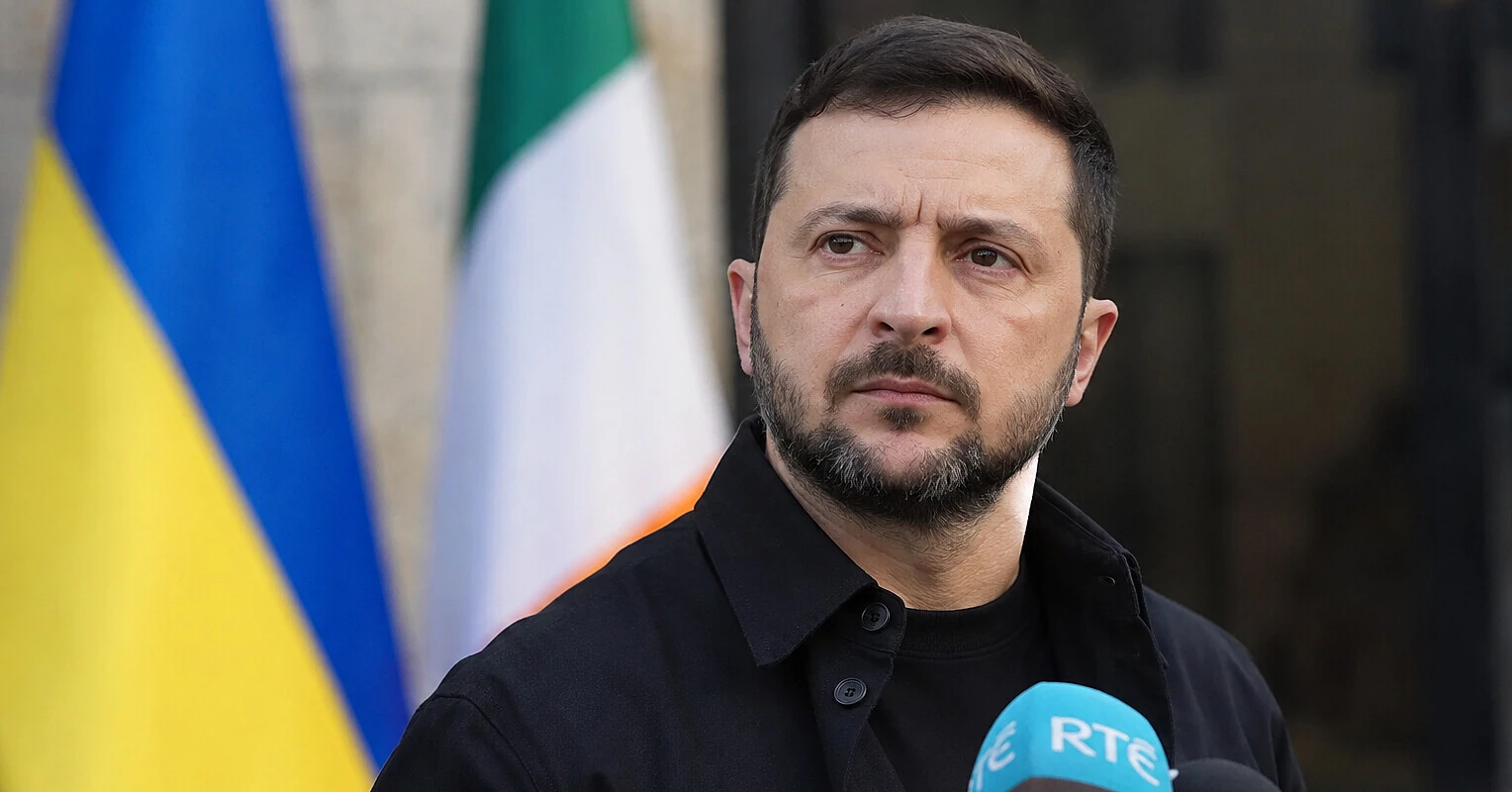
President of Ukraine Volodymyr Zelensky held a multilateral meeting in Dublin with leaders of European states and Ukraine's largest international partners. The sides discussed additional supplies of air defense missiles, restoration of energy infrastructure, construction of shelters, financing defense needs, and future security guarantees.
The head of state announced this on Thursday, November 12, following talks on the sidelines of the IX summit of the European Political Community in the capital of Ireland.
The meeting was organized by British Prime Minister Andy Burnham, to whom Zelensky expressed gratitude for coordinating international support for Ukraine.
The talks were attended by French President Emmanuel Macron, German Chancellor Friedrich Merz, Polish Prime Minister Donald Tusk, Italian Prime Minister Giorgia Meloni, Lithuanian President Gitanas Nausėda, and Canadian Prime Minister Mark Carney.
They were joined by NATO Secretary General Mark Rutte, President of the European Council António Costa, European Commission President Ursula von der Leyen, EU foreign policy chief Kaja Kallas, and other representatives of partner countries.
One of the main topics was providing Ukraine with additional missiles for air defense systems. Against the backdrop of ongoing Russian attacks, the Ukrainian side is counting on increased supplies of ammunition for intercepting missiles and drones.
Zelensky also raised this issue during a separate meeting with NATO Secretary General Mark Rutte. The President said he expects assistance in providing Ukraine with PAC-2 and PAC-3 missiles for Patriot systems.
The Ukrainian leader emphasized that the need for air defense means remains extremely high due to the intensity of Russian strikes on cities and energy facilities.
According to the data he cited, in the first week of November alone, Russian forces used 115 missiles of various types against Ukraine, as well as thousands of guided aerial bombs and strike drones.
The participants paid special attention to supporting Ukrainian energy sector before the winter period. The discussion focused on assistance in restoring damaged infrastructure, supplying necessary equipment, and enhancing energy supply resilience after Russian shelling.
Zelensky also discussed energy support in bilateral meetings in Dublin. In particular, Lithuanian President Gitanas Nausėda announced readiness to provide Ukraine with some of the necessary energy equipment.
The multilateral meeting also considered construction of new protective shelters for civilians.
The day before, on November 11, during talks with Irish Prime Minister Micheál Martin, Zelensky announced an agreement on Ireland's participation in the international Shelter Coalition.
This initiative aims to develop civil protection infrastructure, in particular the creation and modernization of protective structures for the population.
Another important area of talks was attracting additional funds through the PURL program. This mechanism allows partner states to finance purchases of American weapons and military equipment for Ukraine.
Within the framework of the program, Ukraine, together with the United States and NATO, determines priority military needs, after which partners allocate funds to form corresponding supply packages.
According to NATO's explanation, PURL primarily procures those types of American weapons that European manufacturers cannot quickly supply in the required quantities. These include air defense means and ammunition.
According to Zelensky, increasing contributions to this program remains one of the priorities of cooperation with allies. However, specific amounts of new financial commitments were not announced following the meeting in Dublin.
The leaders also discussed Ukraine's financial stability and the formation of security guarantees that should operate after a possible end to the war.
The issue of guarantees became particularly relevant against the backdrop of renewed trilateral talks between Ukraine, the United States, and Russia, which took place on November 10-11 in Abu Dhabi.
Ukraine insists that future agreements must include reliable mechanisms to protect against renewed Russian aggression. European states must be directly involved in discussing security conditions, as this concerns the future of the entire continent.
Following the meeting, Zelensky announced preparations for the next meeting of the "coalition of the willing". It is to take place next week in Berlin.
At the meeting, representatives of partner states intend to continue discussing military support for Ukraine and further coordination of security efforts.
Separately, the Ukrainian president highlighted the new package of British sanctions against the Russian oil sector, announced on November 12.
According to Zelensky, the United Kingdom became the first country to impose sanctions on all ten of Russia's largest oil producers.
The new measures affected, in particular, the oil and gas company Slavneft. Additional restrictions are also directed against other participants in the Russian energy sector and structures associated with energy resource exports.
"Another step towards limiting the resources with which Russia finances the war," Zelensky commented on London's decision.
The British government views further sanctions pressure as one of the tools for reducing Russian oil revenues against the backdrop of diplomatic negotiations to end the war.
The meeting of Ukraine's largest partners in Dublin took place on the day of talks between American representatives Steve Witkoff and Jared Kushner and Vladimir Putin in Moscow.
After consultations in the Russian capital, the American delegation headed to Dublin to discuss the results of the talks with Zelensky.
Following the previous round of consultations in Abu Dhabi, the sides announced preparations for a large-scale prisoner-of-war exchange. However, no significant publicly confirmed agreements on territorial issues and cessation of hostilities were reached.
Against this backdrop, Ukraine continues to seek from allies the preservation of military and financial support regardless of the course of the diplomatic process.
As of the evening of November 12, participants in the multilateral meeting in Dublin had not announced new agreed volumes of missile supplies, additional financial packages, or final agreements on security guarantees. Further discussion of these issues is planned within the framework of the next meeting of the "coalition of the willing".
Based on materials from: Volodymyr Zelensky, UK Government, Office of the President of Ukraine, NATO.
