
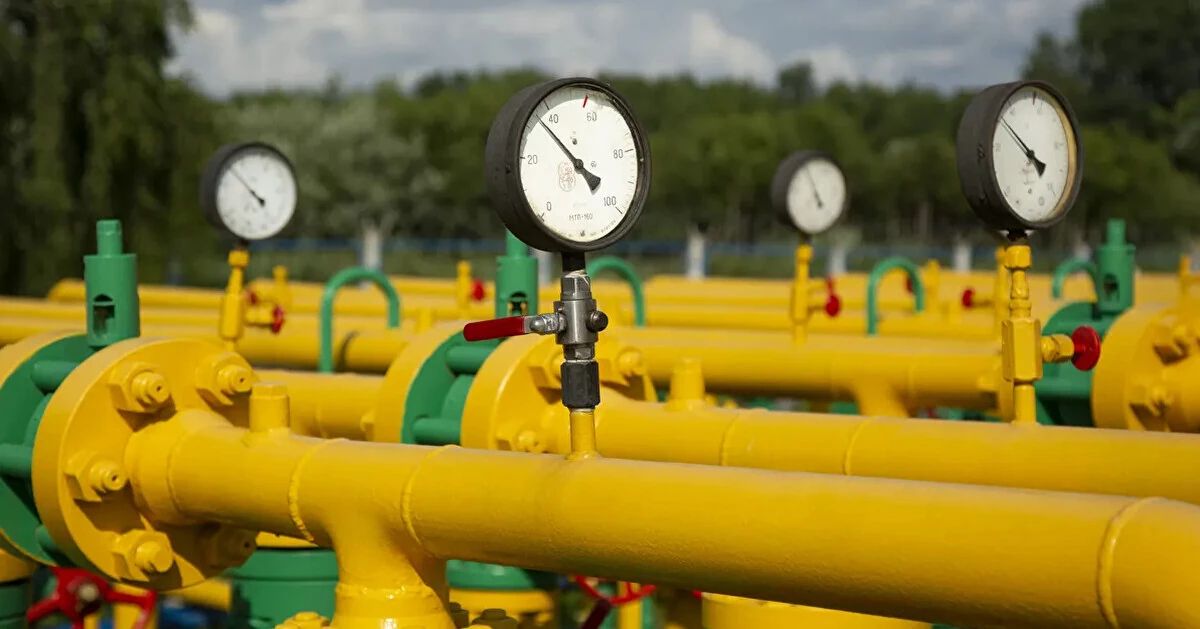
Ukraine has significantly accelerated natural gas withdrawals from underground storage. At the end of last week, it reached 47 million cubic meters per day, which is about 52% higher than the average for November over the last three years.
This was reported by former Minister of Energy of Ukraine Olha Buslavets in her weekly energy market review. According to her data, the average gas withdrawal in the corresponding month over the previous three years was about 31 million cubic meters per day.
Buslavets cited re-export of gas by Naftogaz Group, whose volume reaches 15 million cubic meters per day, as one of the main reasons for the increase in withdrawals. At the same time, exports of gas produced privately in Ukraine remain insignificant – about 0.3 million cubic meters per day towards Poland.
It is important to distinguish between re-export and sale of gas of Ukrainian production abroad. Re-export involves returning to the external market gas that was previously imported into Ukraine for storage, in particular under the "customs warehouse" regime.
As analysts of DiXi Group explained, a significant part of such operations may be carried out through a virtual gas substitution mechanism. This allows commercial re-export without mandatory physical movement of the entire corresponding volume from storage across the border.
In parallel, domestic demand for natural gas in Ukraine is growing. According to Buslavets' estimate, daily consumption increased to 70 million cubic meters due to the start of the heating season and more active use of gas generation in regions with electricity shortages.
Meanwhile, total gross natural gas production, according to her information, remains stable despite continued Russian attacks on energy infrastructure.
As of the end of last week, Ukrainian underground storage facilities contained 15.6 billion cubic meters of natural gas. That is 18%, or 2.4 billion cubic meters, more than in the same period last year.
Buslavets includes 4.6 billion cubic meters of so-called buffer gas in the total volume. This indicator must be separated from volumes that can be directly used for current consumption.
For comparison, at the beginning of the withdrawal season, which started on October 29, reserves were about 15.97 billion cubic meters. According to ExPro calculations, this was the highest starting indicator in the last three years.
The situation on the European gas market remains more complicated. According to Buslavets, gas reserves in European underground storage facilities decreased to 76.3 billion cubic meters, and the filling level is about 71%.
That is about 20% below the average for the last five years and 14% less than in the same period of 2025. Lower reserves increase the sensitivity of the European market to cold weather and possible supply disruptions.
Thus, despite the acceleration of gas withdrawal and growth in domestic consumption, Ukraine maintains larger reserves than last year. Further dynamics will depend on air temperature, operation of gas generation, volumes of re-export, and stability of its own production.
Based on materials from: Olha Buslavets, DiXi Group, ExPro
