

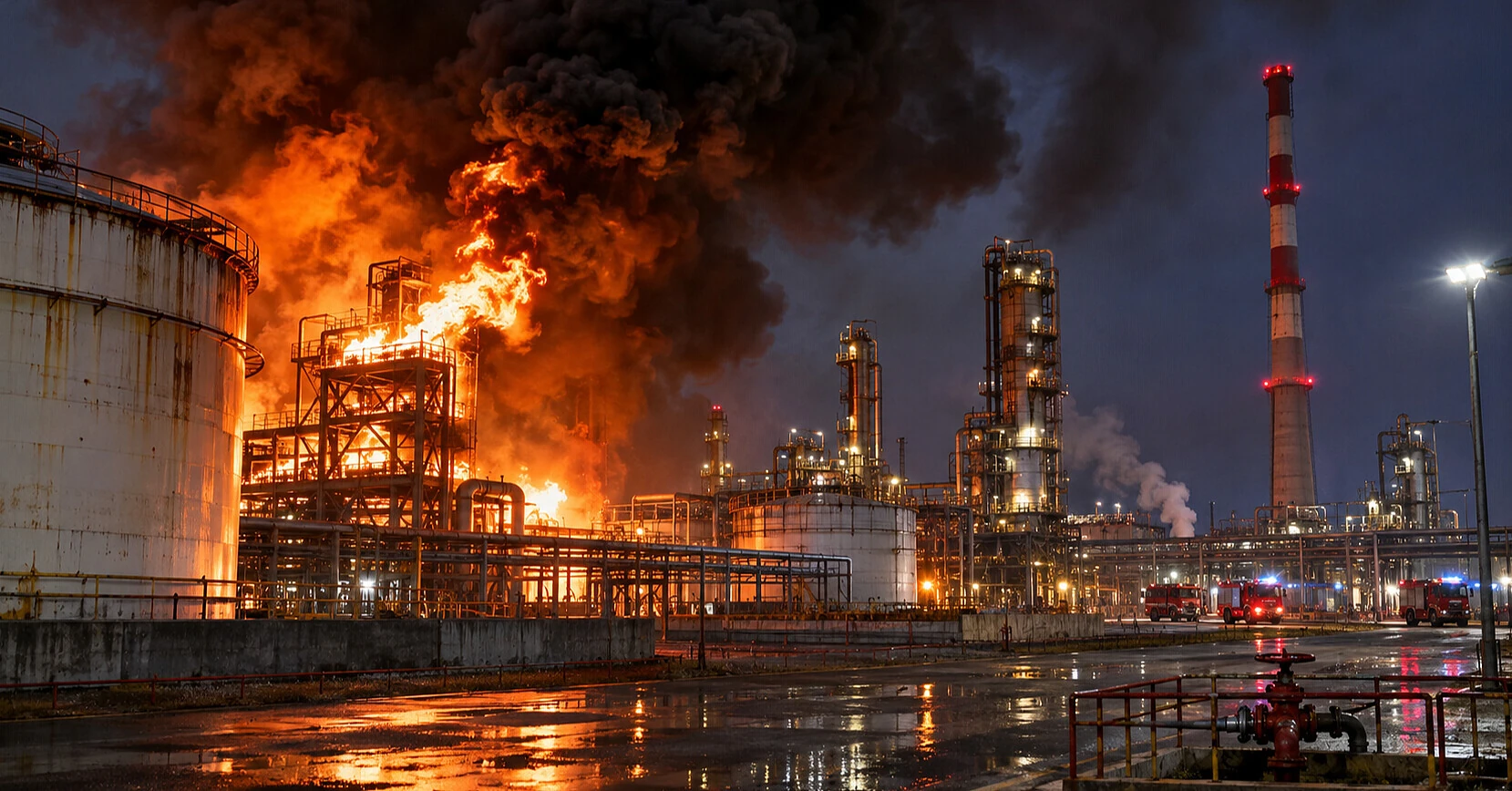
Ukrainian drone strikes have led to a sharp reduction in oil refining in Russia. Since late October, daily oil refining volumes at Russian refineries have fallen by about 45%. The attacks disrupted operations at nearly half of the industry's largest enterprises.
This was reported on November 18 by Reuters citing two sources in the refining industry.
According to estimates by the agency's sources, over the past three weeks, Ukrainian drones have disrupted or completely halted operations at 15 of Russia's 35 largest refineries. As recently as the middle of last week, only nine such enterprises were affected.
As a result of the almost daily attacks over the past 20 days, actual oil refining in Russia has decreased from more than 700,000 tons per day at the end of October to approximately 400,000 tons, or about 3 million barrels per day.
The combined design capacity of the enterprises affected by the strikes since the end of October reaches approximately 500,000 tons of oil per day. This corresponds to 54% of all Russian primary refining capacities, which are estimated at 930,000 tons daily.
At the same time, Reuters notes a significant difference between the current level of refining and the average monthly figure. Because enterprises reduced production gradually, the average daily refining in November is still above 500,000 tons. This is 5-10% less than in September and October. Thus, the 45% drop reflects the change in current daily volumes since the end of October, rather than the average result for the entire month.
Among the largest enterprises affected by the attacks, the sources name refineries in Ryazan, Yaroslavl, Kirishi in Leningrad Oblast, as well as in the Volga region.
A new wave of strikes began after a brief decline in the intensity of attacks in mid-October. US President Donald Trump announced an energy truce between Russia and Ukraine on October 11. However, neither Moscow nor Kyiv has officially confirmed reaching such an agreement, and strikes on energy facilities have not completely ceased.
For about two weeks, the intensity of Ukrainian attacks did decrease, but since the end of October, strikes on Russian refining enterprises have resumed with greater frequency.
The reduction in refining exacerbates Russia's problems with supplying the domestic market with fuel. In certain regions of the country, a shortage of petroleum products is already being observed, and strikes on port infrastructure further limit export capabilities.
According to Reuters' assessment, a further decline in production could also affect the international fuel market by reducing available volumes of petroleum products. In addition, the implementation of an agreement on supplies of Russian diesel fuel to the US could be at risk.
Earlier, on November 10, Reuters reported that Ukrainian attacks had affected about 30% of Russia's oil refining capacities. At that time, it was about nine large refineries whose operations had been disrupted. New estimates show a further expansion of the scale of damage and a significant drop in actual refining volumes.
Russia's Ministry of Energy did not respond to Reuters' request for comment on the state of the refining industry.