

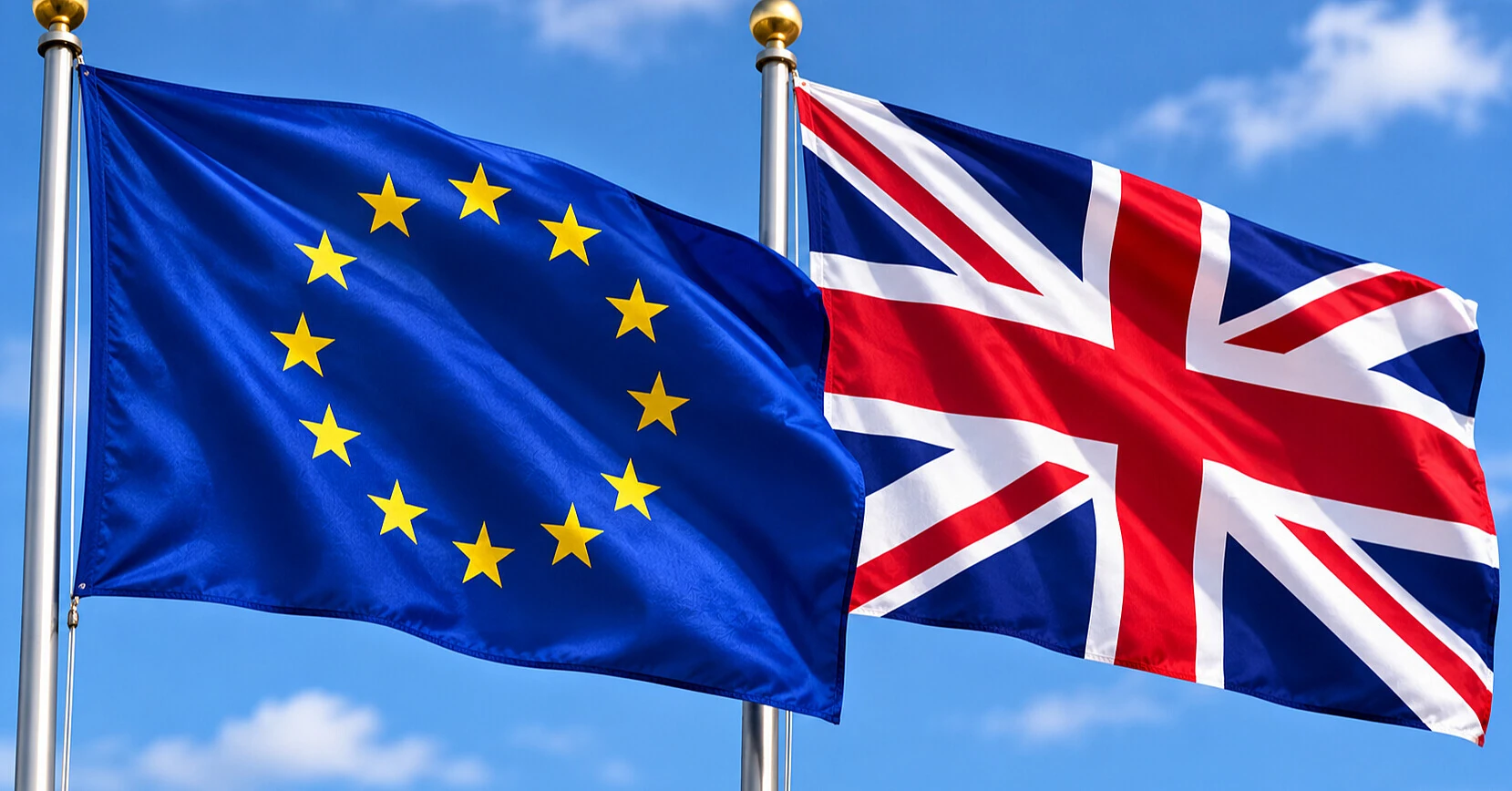
The European Union and the United Kingdom have completed negotiations on three agreements aimed at restoring economic ties after Brexit. They provide for simplified food trade, convergence of carbon markets, and new opportunities for young people to work and study abroad.
This is stated in a joint EU-UK statement following the summit held on November 20 in Brussels with the participation of the President of the European Council António Costa, European Commission President Ursula von der Leyen, and British Prime Minister Andy Burnham.
One of the main agreements was the simplification of trade in agricultural and food products. The parties agreed to create a common sanitary and phytosanitary space, thanks to which most goods of animal and plant origin will be able to cross the border without certificates and checks introduced after Brexit. For this, the UK must comply with relevant European standards. The new rules are planned to be introduced from March 1, 2028.
The second agreement concerns the linking of greenhouse gas emission trading systems. This will create conditions for the mutual exemption of certain British and European goods from carbon border payments. First of all, the changes may be important for the metallurgical and other energy-intensive industries. The parties plan to launch the mechanism in 2028, but the corresponding tax benefits will require separate legal procedures.
The third agreement provides for the creation of a youth mobility program called Youth Experience Scheme. It will allow up to 100,000 young people from each side to reside in the partner's territory for three years, including for work, study, volunteering, or travel. The program is not yet operational: the parties plan to legally implement it no later than 2028 and ensure that opportunities are accessible to participants no later than January 2030.
At the same time, the issue of tuition fees at universities remains unresolved. The EU seeks to facilitate financial conditions for European students in the UK, where after Brexit they mostly pay higher fees than local students. London and Brussels agreed to complete separate negotiations on tuition fees within six months.
Despite the agreements reached, the three main agreements still need to be legally formalized according to the procedures of both sides. Therefore, the abolition of trade checks, mutual carbon benefits, and the new mobility program have not yet entered into force.
In the joint statement, the sides also confirmed their intention to deepen cooperation in energy, defense, and security. In particular, the EU and the UK declared the continuation of support for Ukraine and coordination of measures against the Russian shadow fleet.
Based on materials from: Council of the European Union, Tagesschau, RTÉ