

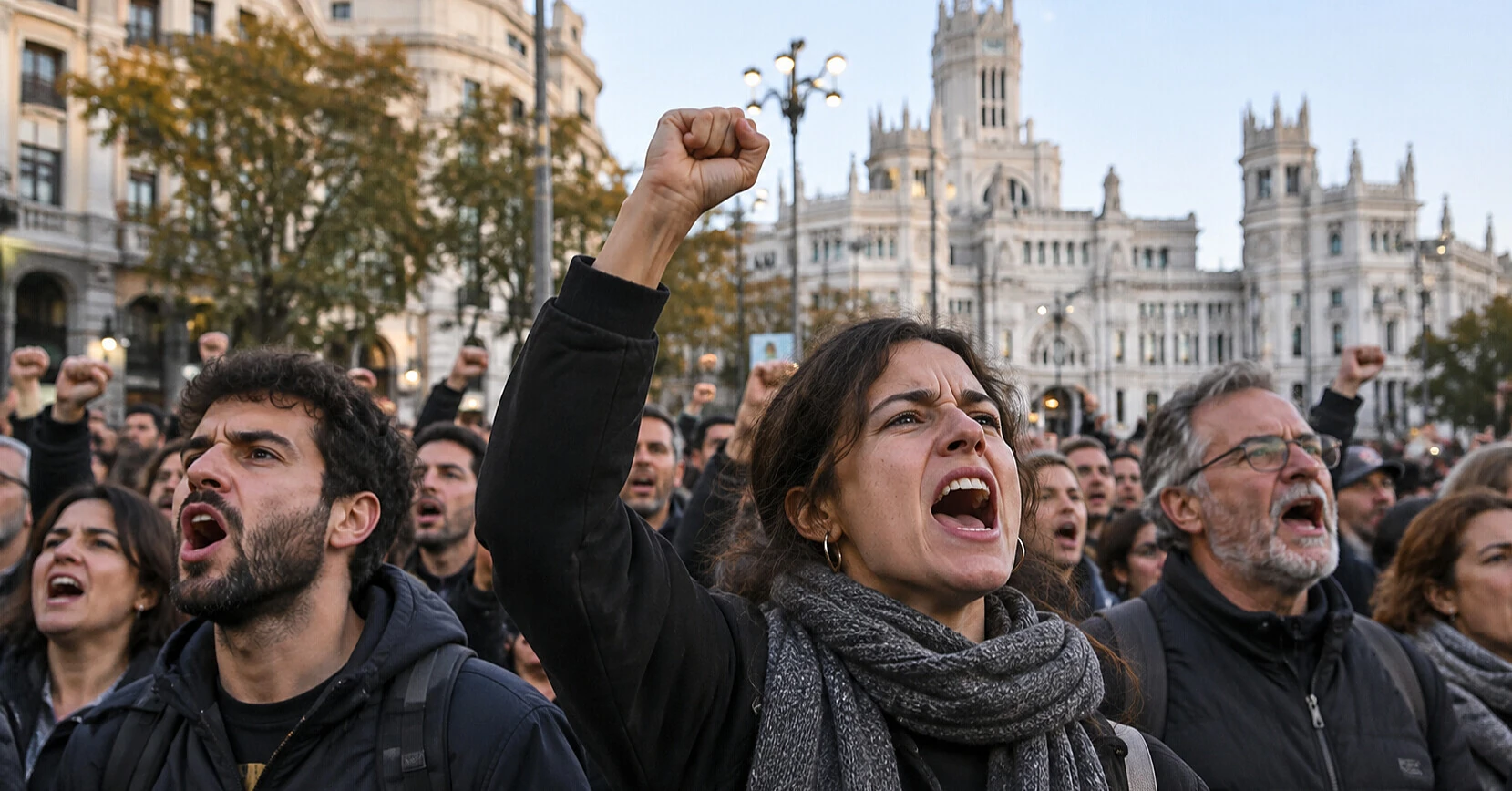
Tens of thousands of people took to the streets of Spanish cities on Wednesday, November 25, demanding that authorities strengthen protection of women from violence, ensure equal rights, and counter the spread of hatred. Mass demonstrations took place four days before Spain's general elections.
This was reported by the Spanish public broadcaster RTVE.
Despite cold and rainy weather, the actions, timed to the International Day for the Elimination of Violence against Women, covered almost all major cities of the country.
The organizers demanded improving the police risk assessment system for victims of abuse, strengthening control over perpetrators of violence, increasing the effectiveness of electronic surveillance, and ensuring sufficient funding for specialized courts.
Two separate demonstrations took place in Madrid
According to the agency EFE, the Spanish feminist movement has been holding separate events for the fourth consecutive year due to disagreements on legislation on transgender rights, prostitution, and regulation of sexual violence.
One of the demonstrations in the capital was organized by Foro de Madrid 25N and the Feminist Movement of Madrid. Its participants advocated for a ban on prostitution, pornography, and surrogate motherhood, as well as for the preservation of Spain's Ministry of Equality.
The event was attended by representatives of the government, the Spanish Socialist Workers' Party (PSOE), the People's Party (PP), and the spouse of Prime Minister Pedro Sánchez, Begoña Gómez.
The second demonstration, organized by the Comisión 8M movement, united demands to combat violence, racial discrimination, economic inequality, and the housing crisis.
Representatives of left-wing political forces present at the event demanded that 1 billion euros of state funds be directed to fight violence against women and guarantee income for victims.
Actions covered almost the entire country
In Barcelona, several thousand people took part in a demonstration by the Novembre Feminista movement. At the same time, a memorial action was held for women who died as a result of gender-based violence.
In Seville, protesters spoke out against the spread of hatred and denial of the problem of violence against women. In Valencia, participants demanded more effective measures from the authorities to eliminate gender inequality.
Manifestations also took place in Bilbao, San Sebastián, Vitoria, Pamplona, Vigo, and other cities. In Santander, organizers were forced to cancel the planned march due to adverse weather conditions.
Number of victims of gender-based violence increased
According to official data from the Spanish Ministry of Equality, since the beginning of 2026, 47 women have been killed by their partners or former partners. Since 2003, when the country began keeping relevant statistics, 1,388 such cases have been registered.
On the day of the demonstrations, the investigation into the murder of a 32-year-old woman in the city of Bullas in the autonomous community of Murcia was reported. If confirmed that the crime is related to gender-based violence by a partner or former partner, the number of deaths since the beginning of the year will rise to 48.
Demonstrations took place against the backdrop of the election campaign
This year, the events of November 25 coincided with the final stage of the election campaign. Spain's general elections are scheduled for Sunday, November 29.
As noted by RTVE, state policy in the field of equality and combating gender-based violence has become one of the subjects of disagreement among political parties.
The ruling Socialist Party advocates for the preservation and development of the existing system for protecting women, including measures against economic and digital violence. The People's Party declares its intention to continue implementing and evaluating the effectiveness of the state pact against gender-based violence.
The International Day for the Elimination of Violence against Women has been observed annually on November 25 by decision of the UN General Assembly adopted in 1999.