
Most Ukrainians support peace along the frontline, but reject ceding Donbas - poll
At the same time, 60% of respondents categorically reject transferring Ukraine-controlled areas of Donbas to Russia. The majority is willing to endure the war for as long as necessary.
Ceasing hostilities along the current frontline without international recognition of occupied territories as part of Russia is approved by 59% of Ukrainians. This scenario implies continued large-scale financing of Ukraine and arms supplies.
This is evidenced by the results of a survey by the Kyiv International Institute of Sociology (KIIS) conducted from July 20 to August 3, 2026.
How Ukrainians assess the situation on the frontline
An absolute majority of respondents - 77% - believe that Russia, although advancing, is doing so slowly and with heavy losses, while Ukraine is able to continue effective resistance.
A pessimistic assessment, according to which Russia has significant advances and Ukrainian resistance is supposedly hopeless, is shared by 12%. Another 11% could not decide.
In January 2026, the answers to this question were distributed similarly.
Scenario with troop withdrawal from Donbas
The first scenario proposed by sociologists involved withdrawing Ukrainian troops from the government-controlled areas of Donbas, including Kramatorsk and Sloviansk. These territories would come under Russian control, while the US and European countries would provide Ukraine with security guarantees.
Such an option is categorically unacceptable for 60% of respondents. 33% are willing to agree to it, with the majority describing this condition as difficult. Another 7% are undecided.
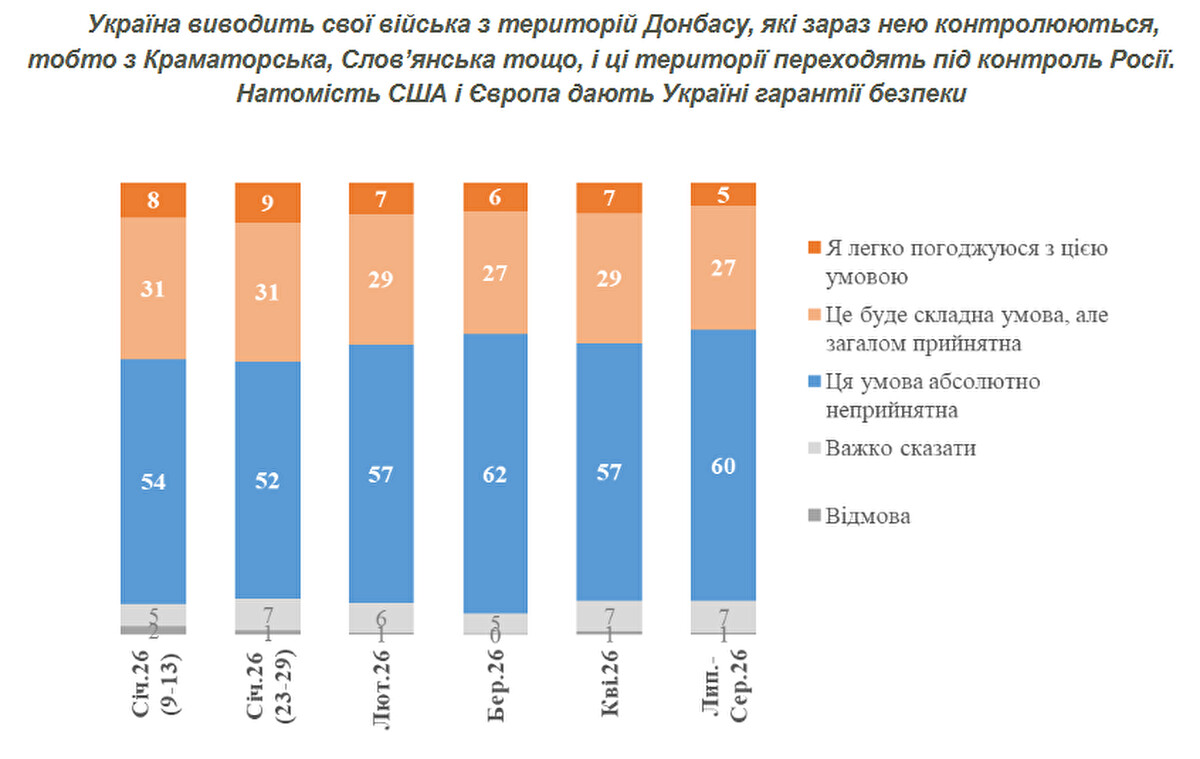
Compared to April, support for this scenario has decreased. Back then, 36% of respondents were ready to approve it, while 57% categorically rejected it.
In all regions, the majority opposes the withdrawal of Ukrainian troops:
- in the West, 37% are ready to approve the scenario, while 55% are categorically against it;
- in Kyiv, 26% and 69% respectively;
- in the Center and North, 32% and 62%;
- in the South, 33% and 57%;
- in the Lower Dnieper region, 32% and 60%;
- in the East, 29% and 59%.
In Kyiv, despite intense Russian strikes, the share of those willing to approve the troop withdrawal decreased from 34% in April to 26%. The share of those who categorically disagree rose from 62% to 69%.
Younger Ukrainians are more willing to consider such a scenario. Among people aged 18-29, 42% could agree to it, among respondents aged 30-44 - 39%, in the 45-59 group - 34%, and among people aged 60 and older - 22%.
At the same time, among the youngest respondents, support for this option decreased from 54% in April to 42%.
Ceasefire along the current frontline
The second scenario envisaged a ceasefire along the current frontline. Russia would maintain actual control over the occupied territories, but without international recognition of them as Russian.
Instead, Ukraine would receive substantial funding and large volumes of weapons, including missiles, air defense systems, aircraft, and tanks.
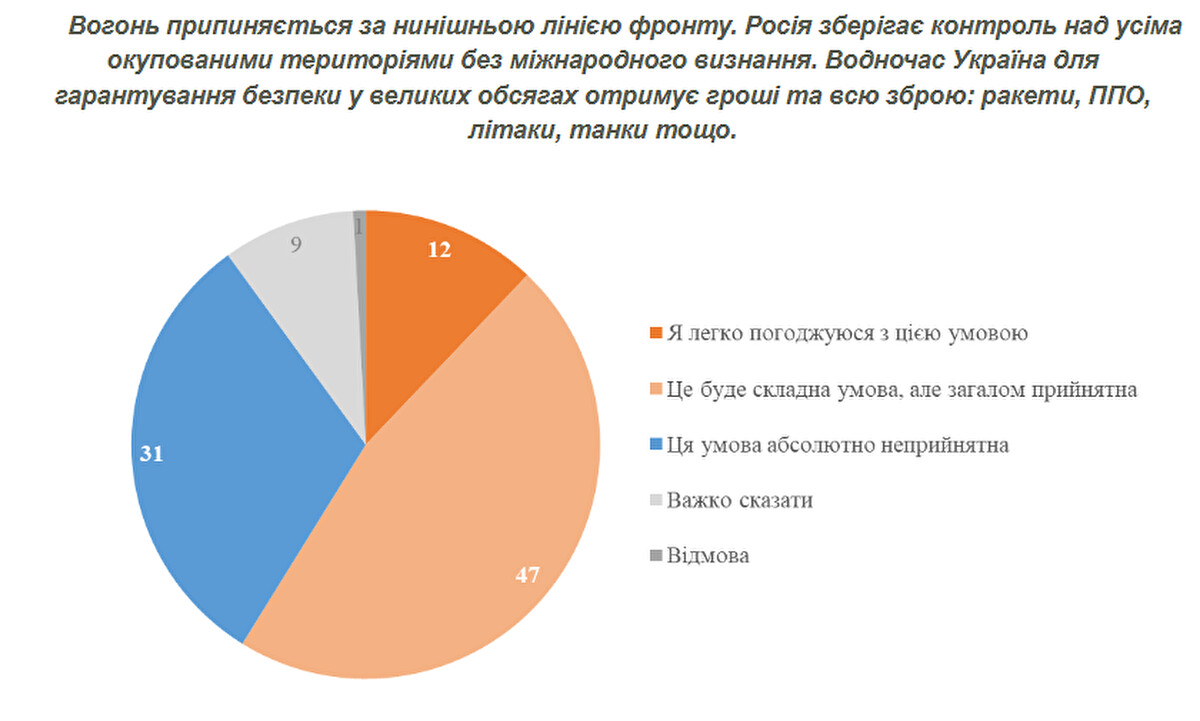
This option is ready to be approved by 59% of respondents, though mostly reluctantly. 31% are categorically against it.
In all regions, the share of those willing to agree to this scenario exceeds the share of opponents:
- in the West, 57% are ready to approve, 34% are categorically against;
- in Kyiv, 73% and 18% respectively;
- in the Center and North, 59% and 31%;
- in the South, 55% and 33%;
- in the Lower Dnieper region, 55% and 35%;
- in the East, 53% and 36%.
Among respondents aged 18 to 59, 62-64% are willing to approve this option. In the 60 and older age group, 49% support it, while 35% categorically reject it.
Thus, the survey shows a significant difference between the two scenarios. The majority of Ukrainians reject a voluntary withdrawal of troops from the government-controlled part of Donbas, but are willing to consider a ceasefire along the actual frontline - without a legal recognition of occupation and on condition of long-term military support.
When Ukrainians expect the war to end
21% of respondents expect the war to end by the end of 2026. Another 15% believe it could happen in the first half of 2027.
Instead, 45% predict the war will end in the second half of 2027 or later. Another 19% could not name possible timeframes.
KIIS noted that Ukrainians are mostly prepared for a long-term war.
How long Ukrainians are willing to endure the war
61% of respondents are willing to endure the war for as long as necessary. In January, this figure was 65%; in April, it dropped to 48%, but in July-August it almost returned to the previous level.
Another 20% of respondents said they are ready to endure the war from a few months to half a year. In April, 29% gave this answer.
In all regions, at least half of the respondents are willing to withstand the war as long as needed:
- in the West - 60%;
- in Kyiv - 69%;
- in the Center and North - 62%;
- in the South - 52%;
- in the Lower Dnieper region - 59%;
- in the East - 60%.
Compared to April, the indicator increased in all regions. The largest growth was recorded in the East - from 40% to 60%, as well as in the Center and North - from 46% to 62%.
In Kyiv, the share of those willing to endure the war for as long as needed increased from 61% to 69%.
In all age groups, the majority is also ready for prolonged resistance:
- among people aged 18-29 - 62%;
- among 30-44-year-olds - 55%;
- among 45-59-year-olds - 67%;
- among respondents aged 60 and over - 60%.
How the survey was conducted
The survey was conducted by telephone interviews among 974 adult citizens living in the government-controlled territory of Ukraine.
Residents of temporarily occupied territories and Ukrainians who moved abroad after February 24, 2022 were not included in the sample. However, internally displaced persons were among the respondents.
The formal statistical error for indicators close to 50% does not exceed 4.1%. KIIS notes that in wartime conditions, a systematic deviation may be added to it.
According to materials from: Kyiv International Institute of Sociology
