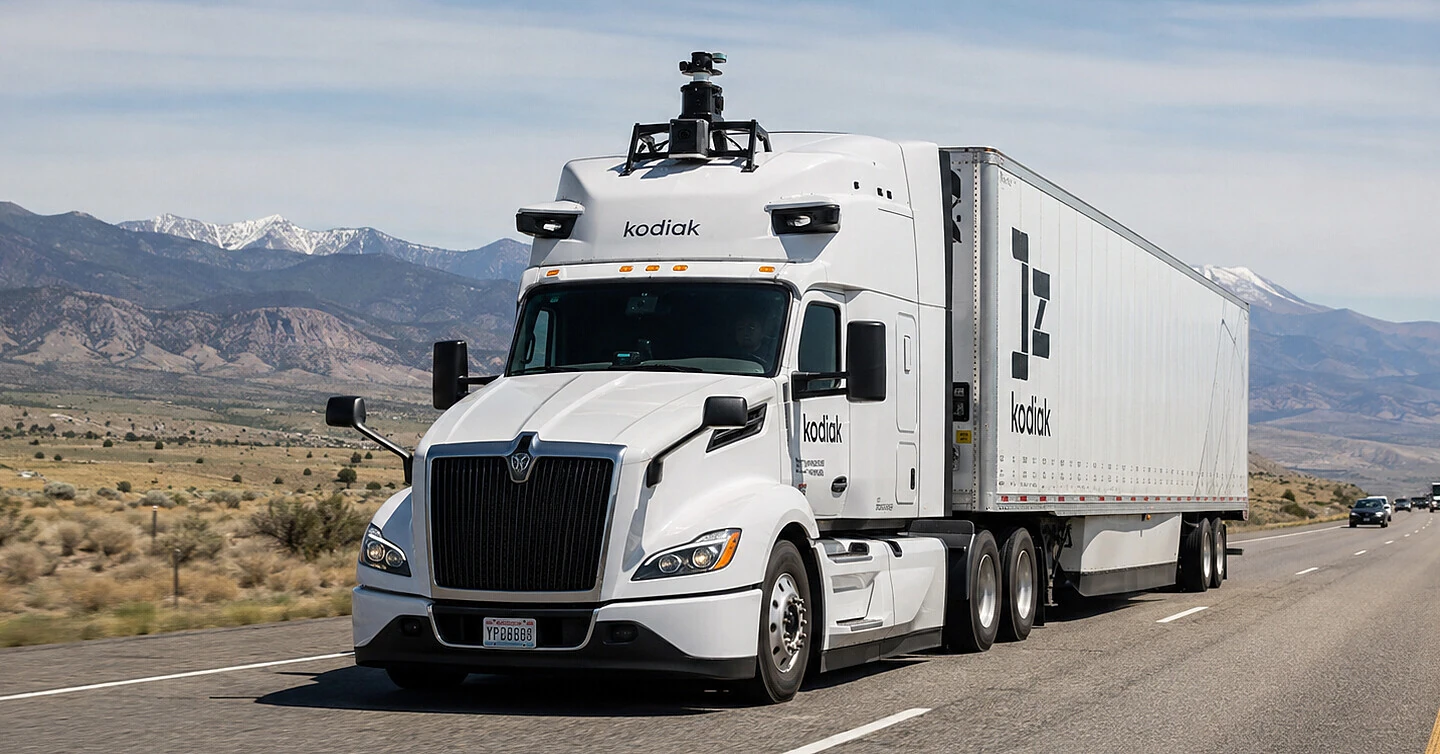
American companies Atlas Energy Solutions and Kodiak Robotics plan to expand their fleet of fully driverless trucks from the current 28 to 100 by mid-2027. The next stage will see them move from industrial routes onto public roads.
Currently, trucks with the Kodiak autonomous driving system are already operating without a driver in the cab in Texas and New Mexico. They are hauling sand to oil and gas sites in the Permian Basin. The companies have expanded operations to two locations about an hour-and-a-half drive apart.
According to the companies, by the end of March 2026, the fleet of 28 driverless trucks had completed about 7 thousand hauls, carrying more than 450 thousand tons of cargo, and accumulating more than 23.5 thousand hours of autonomous operation. In July, the vehicles set an internal record, performing 176 hauls in a single day.
Kodiak is also testing autonomous tractor-trailers with three trailers. The total weight of such a road train when loaded can exceed 135 tons. For now, similar vehicles are mostly used on specialized industrial routes, where road conditions are more predictable.
However, the companies are preparing to move to the next stage. Kodiak expects to begin fully driverless freight transport on freeways by late 2026, and Atlas plans to deploy trucks equipped with this system on public roads in 2027. The expansion to 100 trucks is scheduled for mid-next year.
For orientation, the trucks use cameras, radar and lidar. The developer says the autonomous system continuously monitors the vehicle's condition and traffic situation. In dangerous weather, or during a technical malfunction or other critical situation, the truck is meant to reduce speed and automatically stop in a safe place.
The fleet operation is also controlled by a remote command center. Its staff can provide remote support, but in fully autonomous operation there is no actual driver in the cab.
The shift of driverless heavy trucks onto regular freeways will be an important test for autonomous transport. Aside from potential savings and increased transport efficiency, the technology raises questions about safety, crash response, cybersecurity and the future of the truck driver's profession.
Based on: Fox News