
Polyakova speaks out about 'unfree Ukraine' and busification — the scandal became bigger than the singer herself
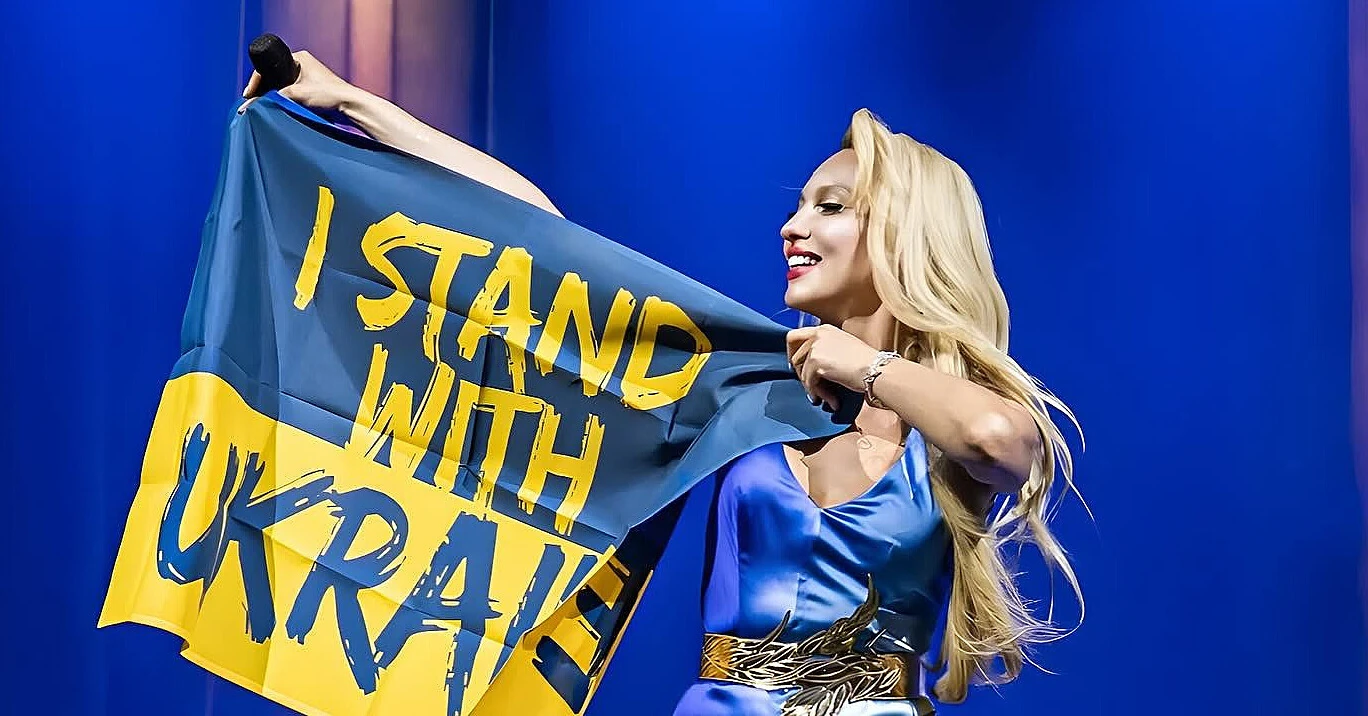
Olya Polyakova has sparked a new scandal after an interview with Ramina Eshakzai, in which she spoke about Ukrainians' fear of publicly expressing their opinions, harsh mobilization, and restrictions on freedom during the war.
The singer called Ukraine an 'unfree' country and compared the atmosphere of constant fear of public harassment to a concentration camp. Separately, she sharply spoke out against the so-called busification — cases where men are forcibly detained on the street and taken to territorial recruitment centers.
The reaction was predictably polarizing. Some saw in Polyakova's words what many have long been saying in kitchens and on social media. Others accused her of using talking points actively exploited by Russian propaganda.
The word 'concentration camp' is too much, the busification problem is not
Comparing today's Ukraine to a concentration camp looks excessive and historically incorrect. Ukraine remains a country with public debate, independent media, an opposition, and the ability to publicly criticize the authorities — in fact, the sheer scale of discussion of Polyakova's words demonstrates this.
But from the unfortunate comparison it does not follow that the issues she raised are made up.
Ukrainian Ombudsman Dmytro Lubinets reported in February that the number of complaints due to the actions of individual employees of territorial recruitment centers increased from 18 in 2022 to 6,127 in 2025. During inspections, unlawful restriction of liberty, use of physical force, and other forms of coercion were recorded.
In 2026, the Ombudsman's Office also reported on very serious cases. In the Uzhhorod Territorial Recruitment Center, people, according to the inspection, were handcuffed to a staircase. Several employees were subsequently notified of suspicion of exceeding their authority and unlawful deprivation of liberty.
Therefore, it is no longer possible to reduce the entire conversation about busification to 'Russian propaganda.' The problem is officially recognized by the Ukrainian state institution responsible for protecting human rights.
Another thing is that from real violations one cannot conclude that any action by a recruitment center is a kidnapping. There is a fundamental difference between lawful mobilization and unlawful violence.
Men are indeed restricted in their right to leave Ukraine
Another source of the feeling of unfreedom is the border closed to a significant part of men.
Since the beginning of the full-scale war, broad restrictions on men leaving the country have been in effect. From August 2025, the rules were relaxed: men aged 18 to 22 inclusive again received the opportunity to freely leave the country.
For most men aged 23 to 60, the restrictions remain, although legislation provides numerous exceptions.
For modern Europe, this is a very harsh measure. But historically, Ukraine is far from the first country that during war restricted the exit of citizens to preserve mobilization resources.
Who else did not let men leave during war
One of the closest modern examples is Armenia during the Nagorno-Karabakh war in 2020. After the introduction of martial law, male citizens of Armenia aged 18 to 55 could not freely leave the country. The restrictions applied also to holders of second citizenship.
Similar rules existed in Armenia during the previous phase of the Karabakh conflict in the 1990s: men of conscription age could be denied exit from the country without confirmation of completion of military service.
An even more famous example is Great Britain during World War II. There, a system of exit permits was in effect. Overseas travel by Britons was strictly controlled, and people of conscription age were issued permission only after verification that the trip was not being used to evade military service.
Moreover, the British system was even broader than the Ukrainian one in one respect: restrictions applied not only to men. In 1940, the authorities stated that Britons aged 16 to 60 in general were not allowed private trips abroad without a compelling reason.
A harsher example appeared immediately before Russia's full-scale invasion of Ukraine. In February 2022, the Russian-controlled authorities of the so-called DPR and LPR announced general mobilization and prohibited men aged 18 to 55 from leaving those territories.
Interestingly, Russia itself after the start of the full-scale war did not introduce such a general ban for all men. After the announcement of mobilization in 2022, hundreds of thousands of Russians were able to leave abroad. However, in 2023 Russian legislation changed: after a conscription notice appears in the electronic register, a specific person liable for military service is automatically prohibited from leaving the country until reporting to the military enlistment office.
So the Ukrainian model is not unique. But it is also difficult to call a ban on exit for virtually an entire age category of men a common practice of modern democratic states.
Why Polyakova's words hit a nerve
In my view, this is where the reason for such resonance lies.
The word 'concentration camp' itself was poorly chosen by Polyakova. It simplifies the conversation and allows arguing about the comparison instead of discussing real problems.
But it would be much more dangerous to declare the questions themselves inadmissible: can a state at war restrict a person's freedom without a clear procedure, where does lawful mobilization end and violence begin, how long can a ban on exit remain in effect, and can a citizen criticize what is happening without automatically receiving the label of traitor.
War inevitably restricts some rights. This has happened in many countries and in different eras. But the point of a democratic state is precisely that emergency powers do not turn into an official's right to do anything at all with a person.
And Ukraine must hold itself to a higher standard in this matter precisely because it is at war with Russia. The difference between the two countries should manifest not only in slogans but also in the state's attitude toward its own citizens.
Therefore, the scandal around Polyakova is interesting not so much for the singer herself. It shows that the conversation about mobilization, closed borders, and the permissible limits of state coercion has long gone beyond the frames of political Telegram channels and become part of mass public discourse.
