

Germany Allows Ukrainians to Exchange Driving Licences Without Exams: What Changes on August 18 and Important Nuances
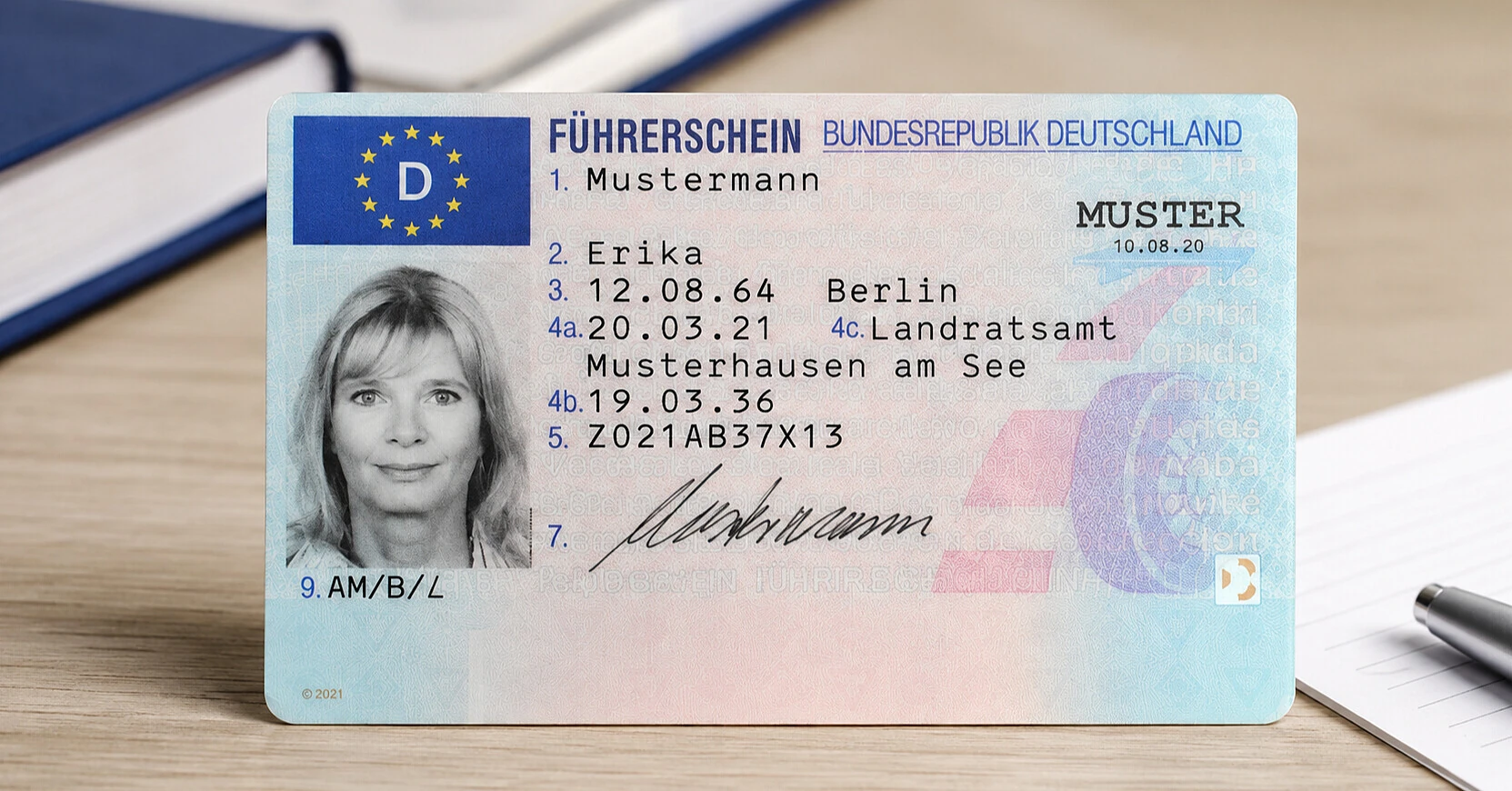
Ukraine has been added to Annex 11 (Anlage 11) of Germany’s Driving Licence Regulation. For most Ukrainian drivers, this creates a fundamentally different route to a German licence: in standard cases, they will no longer need to attend a German driving school or pass the German theory and practical driving tests. The reform, however, comes with important nuances — from switching from Section 24 temporary protection to an EU Blue Card, to expired licences, the Diia app, C/CE categories, and applications that are already in progress.
Starting August 18, 2026, Ukrainian driving licences can be exchanged for German ones under a simplified procedure. The relevant ordinance was published in the Bundesgesetzblatt on August 17.
Ukraine has been added to Anlage 11 of the Fahrerlaubnis-Verordnung (FeV), the list of countries whose driving licences Germany may exchange under special rules. For Ukrainian categories A1, A, B, BE, C1, C1E, C, CE, D1, D1E, D and DE, the entries for both the theory and practical tests are now nein — meaning that, as a rule, neither test is required.
For exchange purposes, the Ukrainian A1 category corresponds to the German AM category. Separate conditions continue to apply to truck and bus categories.
The key point: this is not a temporary benefit only for refugees
One of the most common misconceptions is that the new rules apply only to Ukrainians with temporary protection under Section 24 of the German Residence Act (§24 AufenthG).
They do not. The simplified Umschreibung under Anlage 11 is tied primarily to the country that issued the driving licence and to the relevant licence category. Ukrainians with a work residence permit, an EU Blue Card, a Niederlassungserlaubnis or other residence statuses can therefore also use the new procedure.
The key German requirement is having an ordinary residence — ordentlicher Wohnsitz — in Germany. Under the FeV, this generally means the country where a person normally lives for at least 185 days per year because of personal or professional ties.
In the official explanatory memorandum, the German government expressly notes that the simplified procedure will also benefit Ukrainians who move to Germany through ordinary migration channels unrelated to the war.
People under Section 24 do not need to exchange their licence urgently
The new rule does not mean that Ukrainian licences were invalid in Germany before August 18.
A separate EU mechanism already governs the recognition of Ukrainian driving licences for people benefiting from temporary protection. As long as a person remains covered by that regime, a valid Ukrainian licence continues to be recognised without the normal German testing process.
Temporary protection for Ukrainians in the EU has been extended until March 4, 2028. A person covered by Section 24 therefore does not need to rush to a Führerscheinstelle on August 18 simply in order to keep driving.
The real significance of the reform is different: Ukrainians now have a route from temporary recognition of a foreign document to a full German driving licence without having to take the German theory and practical tests.
This is particularly important for people who intend to remain in Germany long term or switch from Section 24 to a work permit, an EU Blue Card or another residence status.
What happens when someone switches from Section 24 to an EU Blue Card or Section 18
A common piece of advice on Ukrainian forums is that changing residence status automatically starts a new six-month period during which a person may continue driving on a Ukrainian licence.
That should not be relied on.
The ordinary rule in Section 29 FeV counts the six-month period from the point when the person established their ordinary residence in Germany — not from the date on which a new residence permit card was issued.
In other words, someone who has lived in Germany for several years under Section 24 does not become a “new arrival” for driving-licence law simply because they receive an EU Blue Card.
This is precisely why Ukraine’s inclusion in Anlage 11 removes a potentially serious problem: after switching to another residence status, the person can obtain a German licence without going through the full German testing process.
What is now required to exchange an ordinary Category B licence
At the federal level, Section 31 FeV exempts eligible licence holders from Anlage 11 countries from several standard requirements.
For an ordinary Ukrainian Category B licence, the standard exchange should no longer require attendance at a German driving school, a German theory test, a practical driving test, a first-aid course (Erste-Hilfe-Kurs) or the standard eyesight test (Sehtest) normally required for car-licence applicants.
The exchange therefore becomes primarily an administrative process.
That does not mean no paperwork is required. Applicants will normally need proof of identity, proof of residence in Germany, a biometric photograph and the original Ukrainian driving licence. The competent Führerscheinstelle may request additional documents in order to verify the foreign licence.
Translation is a separate issue. Federal law does not establish a universal rule requiring every Ukrainian licence to be translated throughout Germany after August 18. Some local authorities, however, require translations of foreign licences. Applicants should therefore check the document list published by their own Fahrerlaubnisbehörde before applying.
Can the authority still require an exam?
Not in the standard case.
Section 31 FeV does, however, allow the authority to order a test of knowledge or driving ability in an exceptional individual case where concrete facts give reason to doubt whether the applicant still has the necessary knowledge or skills.
That does not give an official a general right to require an exam from any Ukrainian applicant. It is an exception for specific cases.
What should people do if they already started the old conversion process?
This is one of the most pressing questions following publication of the reform. Many Ukrainians have already enrolled in a Fahrschule, received a Prüfauftrag, passed the German theory test or are waiting for a practical exam.
The ordinance contains no special transitional provision specifically for these cases.
German case law on Umschreibung, however, provides an important indication: when an applicant seeks the issuance of a driving licence, the legal situation in force at the time the authority makes its decision is relevant.
Accordingly, if an application is still pending after the new rules take effect, there are strong grounds for contacting the Führerscheinstelle and asking for the case to continue under the new Anlage 11 rules without any remaining exams.
What cannot be promised automatically is the cancellation of an already scheduled exam or reimbursement of all money already paid. Payments to a driving school, TÜV or DEKRA may depend on which services have already been provided and on the terms of the relevant contract.
Can someone simply travel to Ukraine, obtain a licence there and then exchange it in Germany?
No. The new system does not create such a loophole.
If a person already has their ordentlicher Wohnsitz in Germany and then obtains a driving licence in a non-EU country, German law may in certain circumstances refuse to recognise that licence for driving in Germany.
The Federal Administrative Court (Bundesverwaltungsgericht) has already confirmed that problems with the residence principle can also prevent a later simplified Umschreibung.
The strategy “I have lived in Germany for years, I will go to Ukraine, get a licence there, come back and exchange it without exams” is therefore legally highly risky.
What about expired Ukrainian licences?
This is more complicated than the situation with a normal valid plastic licence.
Ukraine has extended the ability to use certain driving licences whose validity expired during martial law. A separate EU mechanism also provides for the recognition of documents whose validity has been extended by Ukraine, subject to the applicable conditions.
The common assumption that “the date printed on the card has passed, so the licence is automatically invalid” is therefore too simplistic.
But two separate issues must be distinguished: recognition of the right to drive under the special EU regime, and permanent exchange for a German licence under Section 31 FeV.
For an Umschreibung, the German authority must be satisfied that the foreign Fahrerlaubnis exists and remains valid. Holders of first Ukrainian licences issued for two years whose printed validity has expired should therefore expect additional verification through the Ukrainian authorities.
At this stage, it would be unsafe to guarantee that every such document will automatically be exchanged without further proof.
Can the licence be exchanged if the plastic card is lost but the document is available in Diia?
For driving under the temporary-protection regime, Germany recognises a Ukrainian digital driving licence where the entitlement to drive can be confirmed through the Ukrainian authorities.
A permanent Umschreibung is a different procedure. Section 31 FeV is based on proof of the foreign Fahrerlaubnis by means of the national driving licence.
Recognition of Diia for driving purposes therefore does not automatically mean that Diia alone will be sufficient in every case for a permanent German exchange.
If the physical card has been lost or stolen, the Federal Ministry for Transport recommends contacting the local Fahrerlaubnisbehörde. Different regions already describe their own procedures for checking the Ukrainian register and issuing replacement documentation.
What does code 99.01 mean?
The ordinance does introduce European code 99.01 for a special licence that can serve as a replacement for a lost or stolen Ukrainian driving licence for the duration of temporary protection.
It would nevertheless be premature to interpret this as the launch of a single nationwide German replacement-licence scheme.
In the official explanatory memorandum, the Federal Ministry for Transport states expressly that Germany did not make use of the option under the relevant EU regulation to issue such German documents on a broad basis. The code is being incorporated into the German system in part because it is a common European code.
At the same time, some local Fahrerlaubnisbehörden describe their own procedures for lost Ukrainian licences. Anyone without the original physical card should therefore clarify the procedure with the authority responsible for their place of residence.
What changes for trucks and buses?
Ukrainian categories C1, C1E, C, CE, D1, D1E, D and DE are also included in Anlage 11 with no standard theory or practical exam.
However, medical fitness and eyesight requirements under Anlage 5 and Anlage 6 FeV continue to apply to these categories.
There is also an unusual exception: if a Ukrainian C or D category was issued without a prior Category B entitlement, Germany will not issue Category B without exams in that situation. Theory and practical tests will be required for B, because in the German system C and D cannot be issued without B.
Exchanging C/CE does not automatically allow someone to work as a professional truck driver
This is one of the most important points for professional drivers.
In Germany, a Fahrerlaubnis and a Berufskraftfahrerqualifikation are separate legal matters. Even after receiving German C or CE categories, a driver does not automatically become entitled to perform commercial transport work for which professional-driver qualification is required.
A Fahrerqualifizierungsnachweis and proof of qualification commonly associated with code 95 may still be required separately.
The same reform also expands the list of languages in which the accelerated professional-driver qualification exam can be taken. The final framework provides for German plus nine foreign languages, including Ukrainian, Russian and English.
The ordinary theory test for the driving licence itself is a separate matter. Ukrainian will become available for that exam from April 1, 2027. Russian is already on the list of available languages.
Will the Ukrainian licence be taken away after the exchange?
In the normal procedure, yes.
Section 31 FeV provides that the German licence is issued in exchange for the foreign licence. The Ukrainian physical card is surrendered to the Führerscheinstelle. Depending on the procedure, it may be returned to the issuing authority or retained by the German authority.
An Umschreibung is therefore not a way to obtain a second independent licence while continuing to keep and use the Ukrainian physical licence at the same time.
Will the Ukrainian driving record be reset?
Not completely. An experienced Ukrainian driver does not automatically become a new German Fahranfänger with a fresh two-year probationary period simply because of the exchange.
There is, however, an awkward technical issue. When a third-country licence is exchanged, the German licence may show the German exchange date as the category issuance date rather than the original Ukrainian date.
The Bundesrat has already drawn the federal government’s attention to this problem. One consequence is that a special two-year period relevant to Category B drivers of certain alternatively powered vehicles weighing up to 4.25 tonnes can begin again from the new German date. The Bundesrat has asked the federal government to address this issue.
This does not amount to a general legal “reset” of driving experience. The probationary period, the date printed on the licence, and requirements imposed by employers, rental companies and insurers are separate issues.
An insurance no-claims class (SF-Klasse) is also not simply a copy of the driving-licence issue date. Whether Ukrainian claims-free driving history is recognised depends on the insurer’s own rules and on the evidence the customer can provide.
How much will the exchange cost?
In the regulatory impact calculations, the federal government uses an administrative fee of €37.50 for an Umschreibung without exams.
Actual out-of-pocket costs may be higher because of the photograph, a possible translation and, for heavy-vehicle categories, medical and eyesight examinations.
Applicants should check the precise document requirements and current fees on the website of the Fahrerlaubnisbehörde responsible for their city or district.
The reform could affect hundreds of thousands of Ukrainians
In its impact assessment, the government worked from a figure of roughly 1.23 million Ukrainians living in Germany. After taking age and the estimated share of driving-licence holders into account, it put the maximum potential group at around 600,000 people.
For modelling purposes, the authorities assumed that approximately 350,000 Ukrainians might obtain German licences.
This is not a forecast of the actual number of applications. It is a regulatory-impact model. Under that model, eliminating the exams saves around 1.05 million hours of time and approximately €75.3 million in costs.
What should a Ukrainian driver do after August 18?
If the Ukrainian licence is valid and the person remains under temporary protection, there is no need to exchange it urgently merely because the new rule has taken effect.
If, however, the person intends to remain in Germany long term, is switching to an EU Blue Card or work residence permit, or simply wants a full German driving licence, the new Anlage 11 framework makes the process significantly easier.
The first step is to visit the website of the relevant Fahrerlaubnisbehörde and check the section on Umschreibung einer ausländischen Fahrerlaubnis. From August 18, the procedure for Ukraine should reflect the new Anlage 11 entry.
Anyone who has already started the old testing process should contact the authority before the next exam and ask whether the pending case can be transferred to the new procedure.
Holders of lost, digital-only or formally expired licences should be particularly cautious about relying on general advice from social media. These are the three situations in which verification through the Ukrainian register and an individual decision by the Fahrerlaubnisbehörde may be necessary.
The most important change on August 18 is not merely the removal of exams. Germany has effectively moved Ukrainian driving licences from a temporary wartime recognition regime into its permanent system for simplified exchange of foreign licences. For hundreds of thousands of Ukrainians who intend to continue living and working in Germany, this removes one of the most costly and time-consuming administrative barriers.
Sources: Bundesgesetzblatt, Fahrerlaubnis-Verordnung, Bundesrat, Bundesministerium für Verkehr, Bundesverwaltungsgericht, Regulation (EU) 2022/1280, Council Implementing Decision (EU) 2026/1912.