

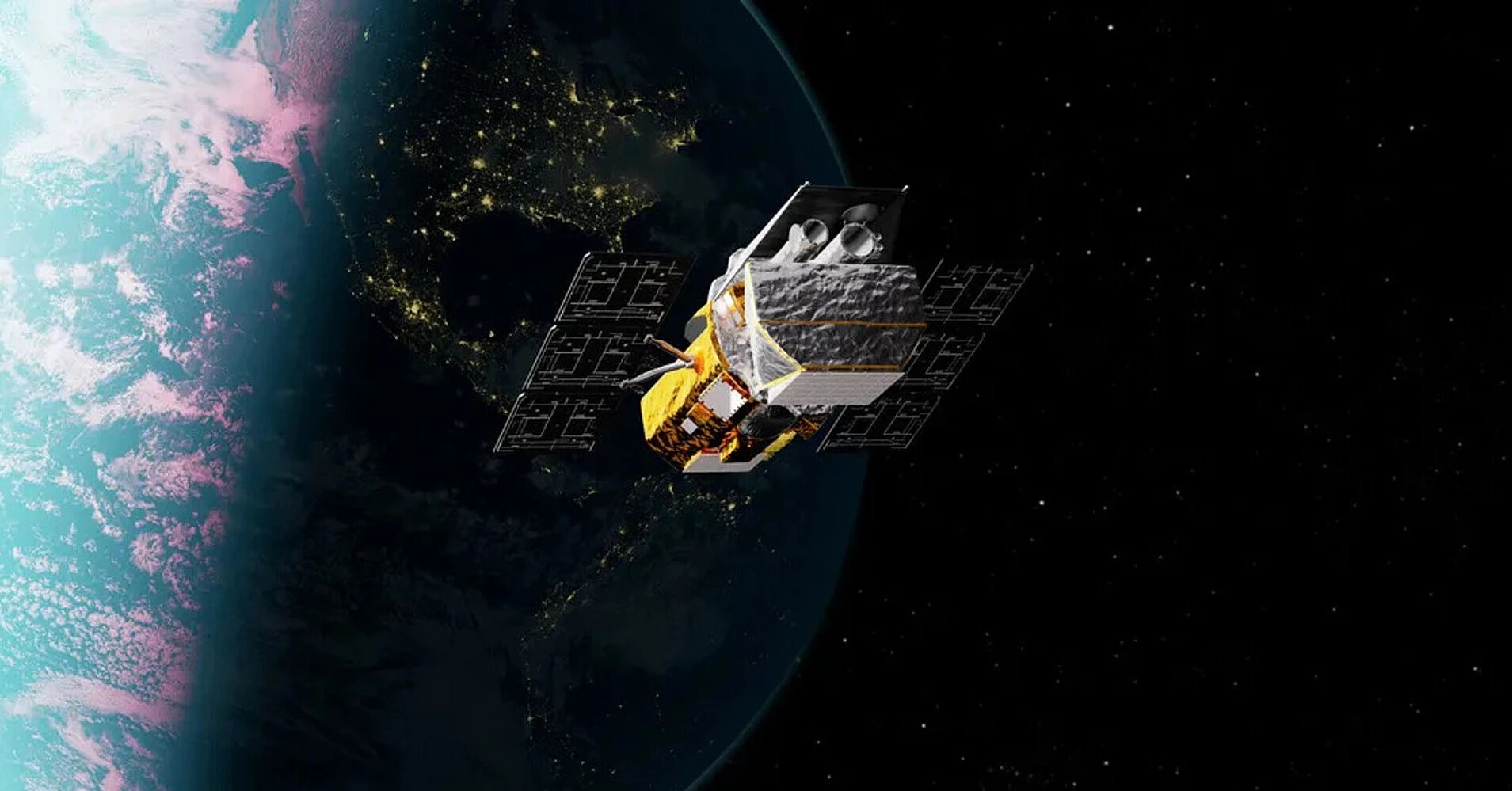
NASA and the American company Katalyst Space have abandoned the attempt to raise the orbit of the Neil Gehrels Swift Observatory space telescope following technical problems with the LINK spacecraft, which was specifically designed for its rescue. Thus, a unique operation that was supposed to extend the work of Swift for several more years has ended in failure.
The robotic LINK spacecraft was launched on July 3 aboard a Northrop Grumman Pegasus XL rocket. It was supposed to approach Swift, inspect the telescope, capture it using robotic mechanisms, and then gradually raise it to a higher and more stable orbit over several months.
However, soon after system checkout began, LINK encountered serious attitude control problems. In late July, NASA reported that two of the three reaction wheels in the spacecraft's attitude control system had stopped working. In addition, functionality of the gas thruster system was partially lost.
Due to the failures, LINK began to spin uncontrollably about several axes at a rate of about nine degrees per second. This led, among other things, to communication interruptions with the spacecraft and prevented further preparation for approach to Swift.
Engineers Tried to Recover LINK for Several Weeks
The Katalyst team did not give up the operation immediately. Using the electric motor, engineers managed first to reduce LINK's spin rate to under four degrees per second, and by early August to about 1.47 degrees per second.
Specialists also prepared a software update and a new attitude control system designed to work with the remaining operable equipment. As early as July 31, NASA stated that it was considering alternative ways to continue the mission with Katalyst, and the approach of LINK to Swift was postponed to late August.
In the end, the technical condition of the rescue spacecraft did not allow a safe transition to the main phase—approach, capture, and orbit raising of the telescope. The attempt to further rescue Swift was decided to be discontinued.
Swift Is Gradually Losing Altitude
Swift itself remains operational, but its orbit is gradually decaying. The telescope has no propulsion system of its own capable of returning it to a higher orbit. The process has accelerated in recent years due to high solar activity: heating of the upper layers of the Earth's atmosphere increases its density at satellite flight altitudes and strengthens aerodynamic drag.
Back in February, NASA temporarily restricted most of Swift's scientific observations. The spacecraft was placed in an attitude to reduce atmospheric drag and maximize altitude preservation while awaiting LINK.
According to NASA's calculations, for a successful rescue operation, Swift ideally needed to be kept above roughly 300 km. The agency had previously warned that without orbit raising, the observatory could enter the dense layers of the atmosphere later in 2026. The exact date depends on solar activity, atmospheric conditions, and the rate of further orbital decay.
$30 Million Was Allocated for the Telescope Rescue
NASA signed a contract with Katalyst Space in September 2025. The project cost was $30 million, and the company was given less than a year to build, test, and launch the specialized spacecraft.
The mission was unusual not only because of the extremely compressed schedule. Swift was not originally designed for in-space servicing: it has no dedicated docking port or grapple fixture for a servicing spacecraft. Had it succeeded, LINK would have become the first commercial robotic spacecraft to autonomously capture an operational NASA satellite that was not designed for such operations.
Swift was launched in November 2004. Its primary task was detecting gamma-ray bursts—extremely powerful and short-lived cosmic events. The observatory can quickly determine the source of such a signal and transmit the information to other telescopes that then conduct follow-up observations. Over more than two decades, Swift has also been used to study stellar explosions, black holes, active galaxies, and other rapidly changing objects.
The abandonment of the LINK operation does not mean the immediate cessation of Swift operations. The telescope will remain in orbit as long as its altitude allows safe operation of the spacecraft. However, without external orbit raising, the possibility of significantly extending its service life has now been greatly reduced.
Based on materials from: NASA, Folha de S.Paulo