
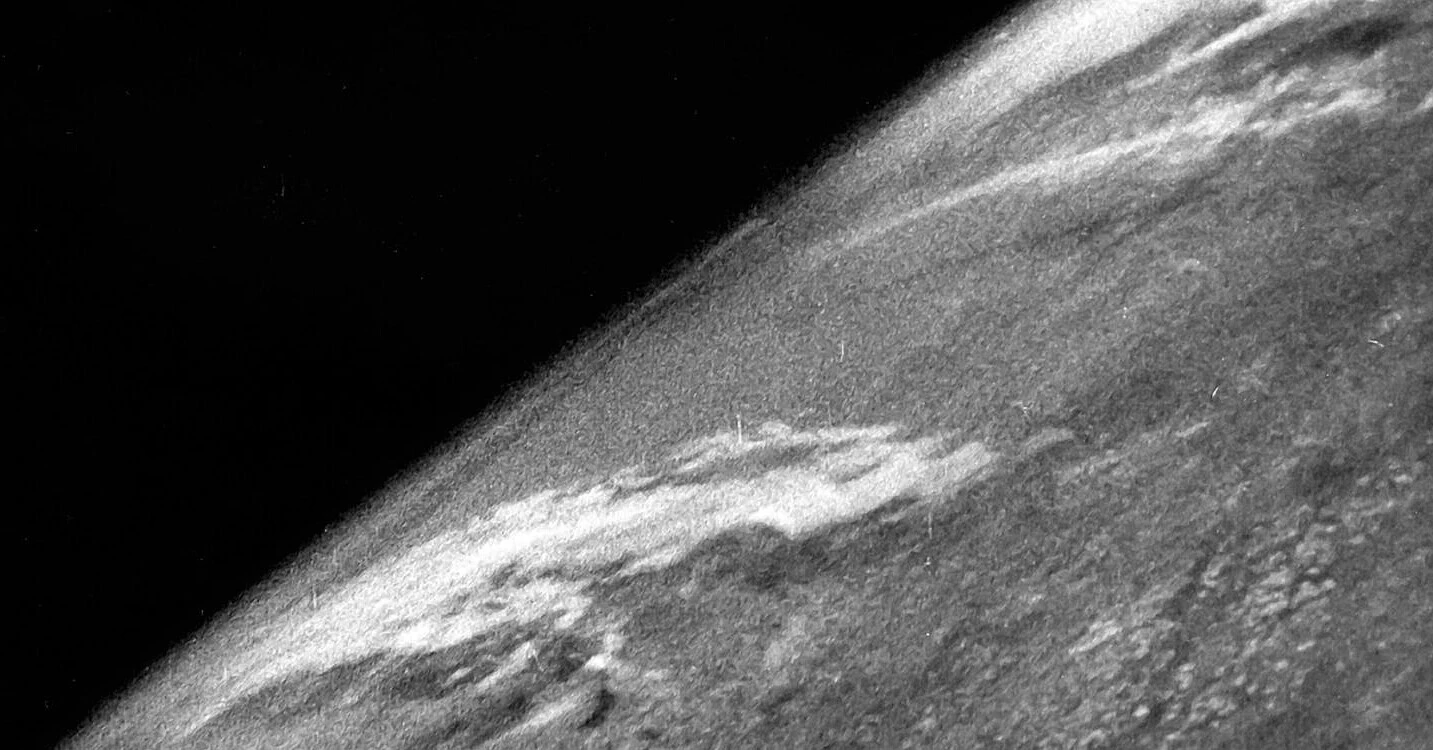
On October 24, 1946, humanity first saw Earth in a photograph taken from space. The image was grainy and black-and-white, and the rocket that carried the camera soon crashed. But most remarkably, the historic footage was preserved thanks to a small steel cassette that survived a fall at a speed of about 550 km/h.
Today marks exactly 80 years since the first space photo of our planet. It was taken using a captured German V-2 rocket, which Nazi Germany had recently used to strike cities.
The photograph shows the curved horizon of Earth, clouds, and the darkness of space. No familiar blue sphere—only a portion of the planet's surface captured from an altitude of about 105 kilometers.
But it was this frame that marked the beginning of a new era of observing Earth.
How a Nazi rocket became a space camera
The historic launch took place at the White Sands Missile Range in New Mexico. It was almost 15 years before Yuri Gagarin's flight and another 11 years until the launch of the first artificial Earth satellite.
After World War II, American specialists obtained German V-2 ballistic missiles. They began using them to study the upper atmosphere, replacing warheads with scientific instruments.
On October 24, 1946, a 35-millimeter movie camera developed by engineer Clyde Holliday was installed in the nose cone of V-2 rocket No. 13.
The camera automatically took a new frame every one and a half seconds. As the rocket climbed, an ever-wider panorama of Earth opened before the lens.
The rocket reached an altitude of about 105 kilometers—just above the Kármán line, often used as a conventional boundary of space.
It was during this flight that the first photographs of Earth from space were taken, NASA confirms.
The crash destroyed the camera, but not the photographs
The 1946 space photography had one serious problem: the rocket was not designed to return safely to Earth.
After reaching maximum altitude, the V-2 began to fall and a few minutes later struck the ground at more than 540 km/h.
The camera was destroyed. It seemed that along with it, all the images obtained should have vanished.
However, the engineers had protected the film: it was placed in a sturdy steel cassette. It was this cassette that survived the impact.
As Smithsonian Air & Space Magazine reports, one member of the search team was 19-year-old serviceman Fred Rulli.
Decades later, he recalled how the researchers rejoiced when they found the undamaged cassette. But the true excitement came later, when the film was developed and the photographs were first shown on a screen.
Scientists saw what no one had seen before: Earth, photographed from outer space.
Why the first space photo doesn't look like modern ones
Today, photographs of Earth from space are associated with blue oceans, white clouds, and clearly visible continents.
But the 1946 image does not show the whole planet. The reason is simple: the camera was only 105 kilometers above the surface—too close for Earth to fit entirely in the frame.
However, the curvature of the horizon is clearly visible, and above it is dark outer space.
Before that, the highest photographs of Earth's surface were taken in 1935 from the Explorer II stratospheric balloon, which rose to about 22 kilometers.
The V-2 rocket made it possible to photograph from almost five times higher.
At the same time, the 1946 image was not the first proof of Earth's spherical shape: scientists had known this long before the photograph appeared.
Its significance lay elsewhere—for the first time, people had the opportunity to see their home planet from an altitude previously inaccessible to cameras.
From the first black-and-white image to the famous “Blue Marble”
After the 1946 experiment, space photography began to develop rapidly.
On August 14, 1959, the American satellite Explorer 6 transmitted the first image of Earth from orbit. It was very crude, but became an important step toward regular observation of the planet.
On May 30, 1966, the Soviet communications satellite Molniya-1-3 took the first photograph in which Earth was visible as a whole—as a full disk. However, the image quality remained low.
But on December 7, 1972, the crew of the American spacecraft Apollo 17 took a photograph that became one of the most recognizable images in history.
In the shot, named “Blue Marble,” Earth appears as a bright blue planet with white clouds. It was taken on the astronauts' way to the Moon, 26 years after the V-2 flight.
The famous photo can be viewed in NASA's archive.
Today, satellites transmit a huge number of images of Earth daily. With their help, scientists monitor hurricanes, forest fires, the state of oceans, glaciers, and climate change.
But the history of space photography began not with a modern satellite or even with a human spaceflight.
It began with a camera on a former military rocket that crashed in the New Mexico desert. Only the film survived—and thanks to it, we can see how Earth first appeared before a lens from space 80 years ago.
The original historic image is available on Wikimedia Commons.
Sources: NASA, Smithsonian Air & Space Magazine, NASA Science.

