
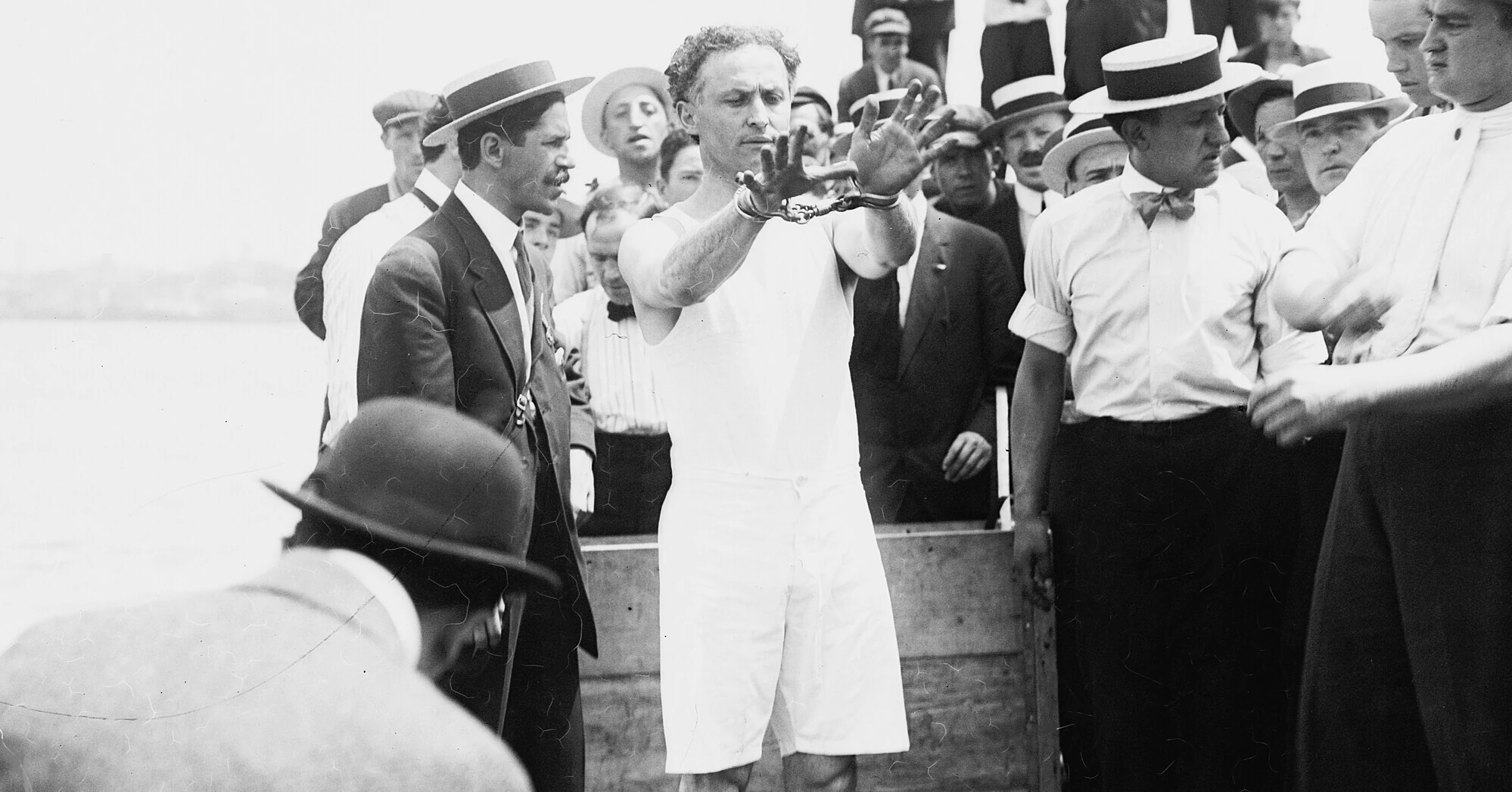
The famous illusionist died on October 31, 1926. The story of his final days is usually reduced to an unexpected blow to the stomach, but a biographer draws attention to other circumstances: delayed medical treatment, performing with a high fever, and an insurance policy under which the widow received a double payout.
Harry Houdini freed himself from handcuffs, chains and straitjackets, escaped from closed containers filled with water. What proved fatal to him was illness: the performer died of peritonitis associated with a ruptured appendix. He was 52 years old.
October 31, 2026 marks exactly one hundred years since his death. For this date, the Library of Congress published a material about the illusionist's final days and the collection of approximately 4000 books that he bequeathed to the library. Central to the account is the question of how well the well-known version of his death corresponds to reality.
The punch backstage really happened
According to the popular story, a student came backstage and wanted to test whether Houdini really could withstand a strong blow to the stomach. He struck the performer before he could brace himself. What usually follows is a brief explanation: the punch caused the rupture of the appendix, and nine days later the illusionist died.
It is precisely this sequence that raises questions. The Library of Congress refers to the 2020 biography "Houdini" by Adam Begley. The author does not deny the blow itself, but points out that a ruptured appendix from blunt trauma is an extremely rare occurrence.
Begley allows that the punch might have aggravated an existing condition. However, he believes that the rupture occurred later. Therefore, the claim "Houdini died from a student's blow" presents a debatable version as an established fact. There are especially no grounds to regard this episode as proven murder.
Pain and fever did not stop performances
In Begley's account, the artist's own behavior played an important role. Houdini experienced intense pain and suffered from a high fever, but postponed seeking medical attention so as not to cancel performances. According to the biographer, when he finally saw a doctor, he did not follow the recommendations given.
These circumstances shift the emphasis of the story. A person whose acts were built on demonstrating the incredible capabilities of the body continued to appear before the public with symptoms of a serious illness.
At the same time, the biographer's conclusions do not replace a medical investigation. After a century, it is impossible to confidently reconstruct each stage of the illness and determine exactly what role the injury played.
Why the punch version mattered financially
Explaining the death as an accident affected the amount of the insurance payout. As Begley writes, Houdini's policy provided for 25,000 dollars, and in the event of accidental death the sum was doubled—to 50,000.
As the biographer tells it, the illusionist's widow Bess hired a lawyer. The insurance company accepted the version of death resulting from the blow and paid the double amount.
Begley views the insurance conditions as a possible explanation for why Bess persistently supported this version. This is the biographer's interpretation, not proof of deception on the part of the widow. But the financial detail helps understand why the circumstances of the blow mattered beyond newspaper headlines.
The man who created illusions exposed others'
Even during his lifetime, Houdini fought against spiritualists who claimed they could communicate with the dead. After his mother's death in 1913, he was particularly active in exposing such claims. In particular, he created double exposure photographs, showing how one could produce an image with a fake "spirit."
His interest in mysteries left a very tangible legacy. In the collection he bequeathed to the Library of Congress there are around 4000 books on illusionism, witchcraft, demonology, spiritualism and psychic phenomena. The earliest editions date from 1489. Also preserved are personal albums of clippings and other materials.
Today the collection is accessible to researchers in the Rare Book and Special Collections Division. A hundred years after Houdini's death, it allows study of what he devoted his life to: the boundary between a convincing performance and what really happened.
