
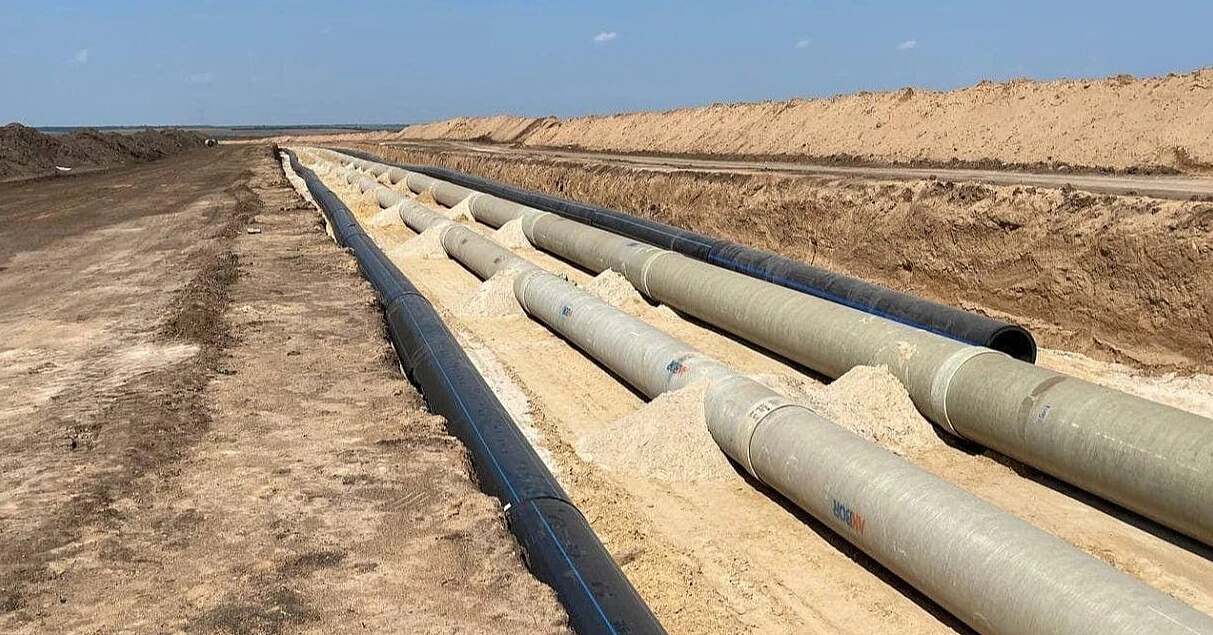
The National Police are investigating possible abuses during the construction of a main water pipeline from the Inhulets River to the Pivdenne Reservoir, which is intended to supply water to Kryvyi Rih. According to expert research, certain design decisions could have led to unnecessary state expenditures of about UAH 2.8 billion.
On November 9, this was reported by "Nashi Groshi", which studied the materials of the criminal proceedings and expert opinions.
The construction of the water pipeline began in 2023 after the destruction of the Kakhovka Hydroelectric Power Station by Russian troops. At that time, the Service for Restoration and Infrastructure Development in Dnipropetrovsk Oblast concluded three contracts for the construction of main water pipelines without open tenders, with a total cost of UAH 12.62 billion.
The contract for the construction of the water pipeline for Kryvyi Rih, with an initial cost of UAH 5.32 billion, was awarded to Avtomahistral-Pivden LLC. The work was ordered on a "design and build" basis, where the contractor is responsible for both the development of design documentation and the execution of construction.
According to the investigation, the construction of a third pumping station and the laying of four parallel pipelines instead of two could have been included in the project without sufficient justification.
To verify these decisions, law enforcement officers ordered an alternative project from the state enterprise "Ukpivdendniprovodhosp". It envisaged laying two pipelines with a diameter of 1300 mm instead of four with a diameter of 1000-1200 mm.
The cost of the actually implemented design solution for the pipelines was UAH 4.47 billion, while the alternative option was UAH 2.13 billion. The difference between the two projects exceeds UAH 2.34 billion.
Another UAH 442.2 million, according to work completion certificates, was spent on the construction of pumping station No. 3. Experts believe that its construction may have been inexpedient, since the capacity of the other two pumping stations is sufficient to ensure the design performance of the water pipeline, including in emergency modes.
During the inspection of the third pumping station, specialists of the Kyiv Scientific Research Institute of Forensic Expertise established that the pumping units were not connected to operation, and the valves remained sealed. At the same time, the station itself was built in accordance with the approved design documentation, and the installed equipment corresponded to the specified list.
Thus, the amount of about UAH 2.8 billion is formed from the difference in cost between the two pipeline laying options and the costs for the third pumping station. This is a calculated estimate of possible losses within the criminal proceedings, not a court-established fact of embezzlement of budget funds.
According to journalists, as part of the investigation, law enforcement officers are also checking possible collusion between representatives of the contractor and companies involved in design, engineering support, and expertise of documentation. The companies in question are the representative office of "B-Act" Spółka Akcyjna, "NVO TransEngineering" LLC, and "Expert Project Group" LLC.
At the same time, at the construction stage, the then head of the Restoration Agency, Mustafa Nayyem, stated that the project had passed the necessary expert evaluations, including a technical audit by an independent foreign company. According to him, the Accounting Chamber also conducted an inspection.
According to expert estimates, the total cost of the water pipeline construction under two contracts with Avtomahistral-Pivden was UAH 7.12 billion. The project was funded from the special Fund for the Liquidation of the Consequences of Armed Aggression of the Russian Federation.
The final justification of the design decisions, the existence of losses, and the responsibility of possible participants in violations must be established within the investigation. The mere fact of difference between the two projects does not prove illegal use of funds.
