
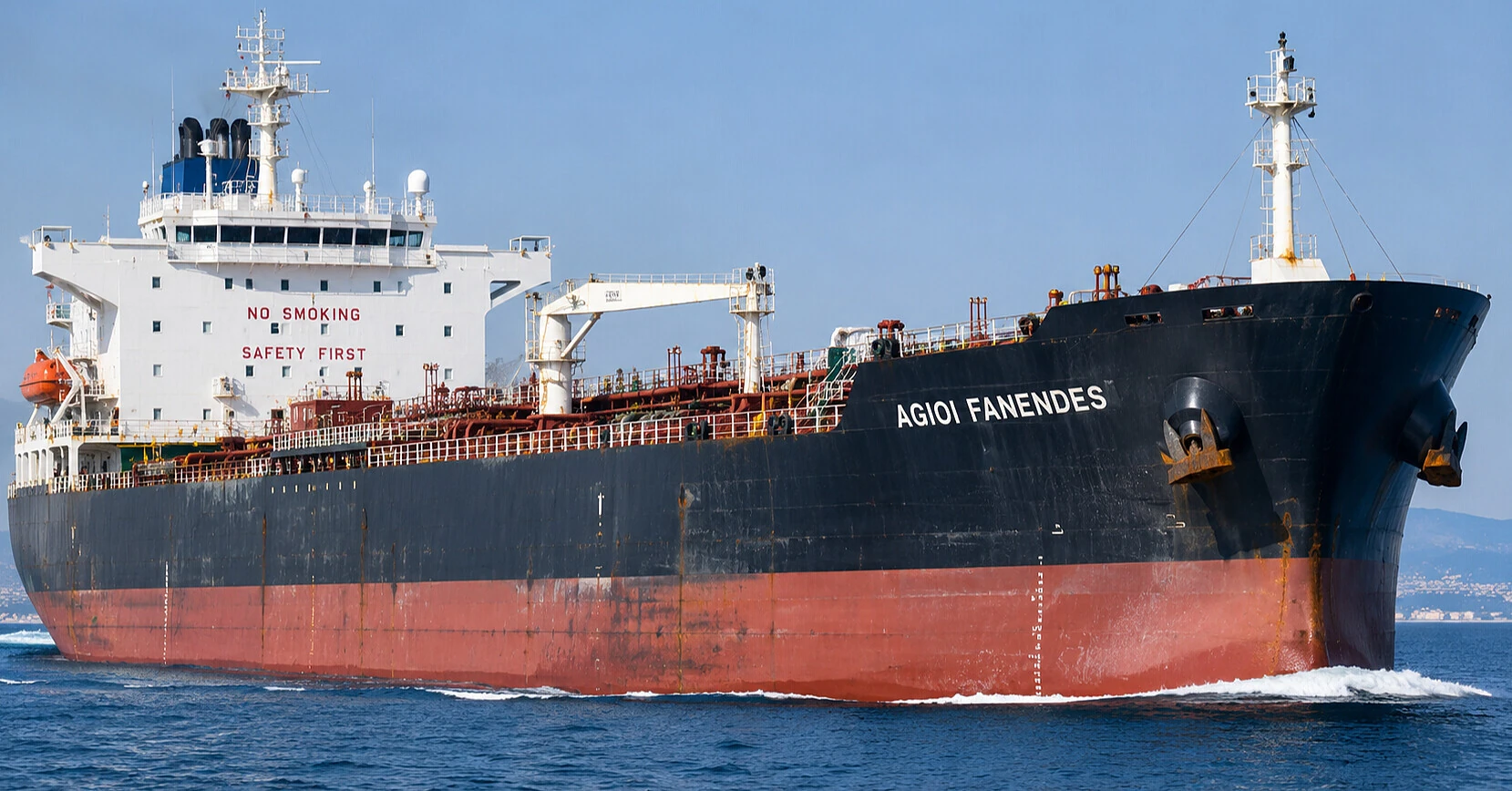
The tanker Agioi Fanendes, carrying Russian diesel fuel toward the United States, turned around approximately 400 nautical miles from New York. The vessel changed course without reaching the American coast, casting doubt on the implementation of the fuel arrangements between Donald Trump and Vladimir Putin.
Bloomberg reported this on November 10, citing port documents and vessel tracking data.
According to the agency, the tanker is carrying about 40,000 tons of ultra-low-sulfur diesel fuel. That is equivalent to almost 300,000 barrels of petroleum products.
The vessel initially indicated a US-bound destination, but changed course approximately 740 kilometers from New York. Since Monday, November 9, the tanker has been sailing in a zigzag pattern, not approaching the intended port of destination.
The Agioi Fanendes has become another tanker with Russian diesel whose route changed after being dispatched toward the United States. Two other vessels carrying Russian fuel had previously also abandoned their original destinations.
The tanker Leruo, sailing under the flag of Sierra Leone, changed its destination to Brazil. Another tanker, the Talisman, after entering the Atlantic Ocean turned toward the Mediterranean Sea.
Thus, all three vessels, which were initially considered possible participants in the first deliveries of Russian diesel to the American market, either changed routes or remained without a confirmed unloading port.
The tanker Agioi Fanendes departed from the Russian Baltic port of Primorsk on October 22. According to initial vessel tracking data, its arrival off the US coast was expected on November 6–7.
However, the managing company Eastern Mediterranean Maritime earlier reported that the tanker was awaiting further instructions, and New York had not been finally confirmed as the destination. Information about the buyer of the Russian diesel was also not disclosed.
The route changes come amid legal uncertainty surrounding the agreement on supplies of Russian fuel to the United States. President Donald Trump announced it on October 9 after talks with Vladimir Putin.
According to the stated terms, Russia was to ensure the delivery of more than 300,000 tons of diesel fuel to the American and global markets in the first phase. A further increase in supplies was envisioned.
To implement the agreement, the US Treasury Department granted temporary authorization for certain transactions involving Russian diesel that had previously been subject to sanctions restrictions. The authorization is valid until April 7, 2027.
However, a legislative ban on the import of Russian energy resources, adopted after Russia's full-scale invasion of Ukraine in 2022, remains in effect in the United States.
This created a contradiction between the temporary authorization of the Trump administration and the current federal legislation.
New Jersey Governor Mikie Sherrill earlier warned port operators and companies involved in receiving petroleum products about the possible legal consequences of unloading Russian fuel. She stated that state authorities would use available legal mechanisms to prevent such deliveries.
American lawmakers also warned banks, shipping companies, and oil traders about the risks of participating in deals involving Russian petroleum products.
At the same time, the US Treasury Department insists that the authorization granted complies with current legislation. There has been no final court ruling on this dispute.
Kpler analyst Matt Smith earlier noted that American buyers are being cautious due to sanctions and legislative risks. In his assessment, the uncertainty surrounding the legal status of the supplies could have become an obstacle to unloading tankers on the US East Coast.
At the same time, the immediate reason for the Agioi Fanendes' turnaround has not yet been officially confirmed. It is also unknown where the vessel will go to unload and whether the Russian fuel will ultimately be delivered to American buyers.
The new supply complications arose amid high diesel fuel prices in the United States. The Trump administration had hoped that additional volumes of Russian petroleum products would help ease pressure on the fuel market.
However, experts previously doubted that the announced volumes could significantly affect American prices, given the scale of fuel consumption in the country.
As of November 10, there had been no confirmed unloading of Russian diesel fuel in American ports under the October agreements.
Sources: Bloomberg, Reuters, Radio Free Europe/Radio Liberty.
