
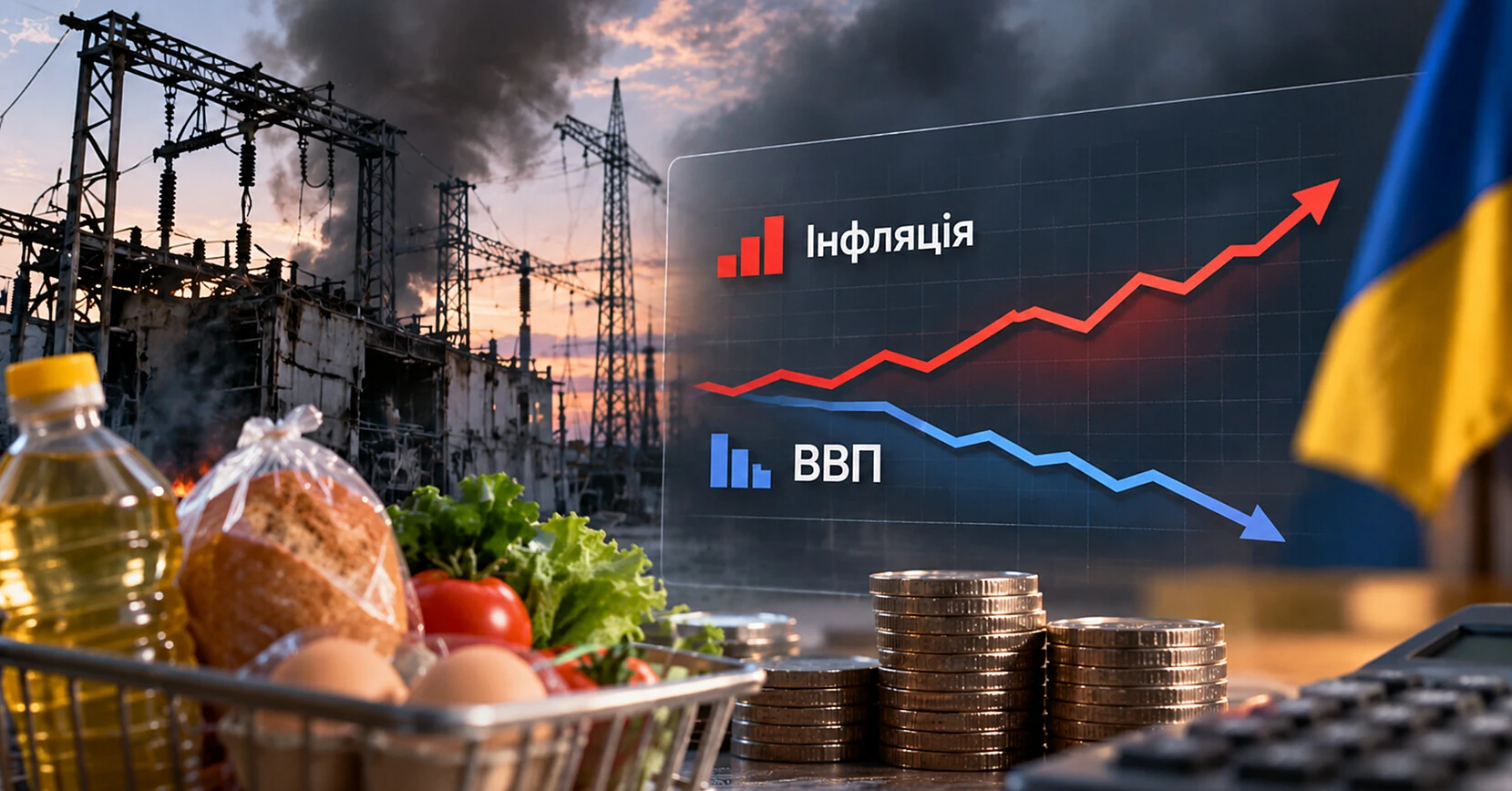
The Ukrainian economy has found itself in a situation where a decline in production is accompanied by accelerating inflation. This combination of indicators corresponds to the formal characteristics of stagflation, but the National Bank emphasizes that the current problems are caused primarily by the consequences of Russian aggression.
This is stated in the article by "Ekonomichna Pravda," which analyzed the latest macroeconomic indicators and received a commentary from the National Bank on the economic situation.
According to the State Statistics Service, in the third quarter of 2026, Ukraine's real GDP shrank by 0.7% compared to the same period last year. Compared to the previous quarter, the decline was 0.5% on a seasonally adjusted basis.
At the same time, inflation continues to accelerate. By the end of October, consumer prices rose by 11% year-on-year compared to 10% in September.
Stagflation is a situation where economic activity weakens or contracts, but prices continue to rise rapidly. For economic policy, such a combination creates a difficult problem: measures to stimulate production may further accelerate inflation, while strict price containment could deepen the economic downturn.
The NBU explained the reasons for the deterioration
The National Bank noted that current economic processes have signs of stagflation, but they cannot be explained solely by ordinary cyclical fluctuations.
The regulator attributes the deterioration primarily to war-related shocks that simultaneously limit the production capacity of enterprises and raise their costs.
Russian shelling of energy facilities, industrial enterprises, and warehousing infrastructure is reducing business production capabilities. The blockade of seaports and logistics problems complicate exports and increase transportation costs.
As a result, enterprises produce less but are forced to spend more on electricity, fuel, logistics, and restoration of damaged facilities. Part of these costs is gradually passed on to consumers through price increases.
As reported by Kurs Ukrainy, according to the NBU's October Inflation Report, intensified Russian attacks and the port blockade alone will worsen real GDP in 2026 by about 1.9 percentage points compared to the scenario without these shocks. The additional impact on annual inflation is estimated at 0.7 percentage points.
Economic forecasts for 2027 diverge
The National Bank forecasts that by the end of 2026, the Ukrainian economy will contract by 0.4%, and inflation will accelerate to 12.5%.
In 2027, the regulator expects a gradual improvement: GDP is to grow by 0.4%, and inflation will slow to 7.3% by the end of the year.
However, independent analysts suggest that economic difficulties may last longer.
According to KSE Institute, Ukraine's real GDP will contract by 0.3% in 2026 and another 0.6% in 2027.
Analysts attribute their more pessimistic scenario to the prolonged effects of Russian attacks, export restrictions, loss of industrial capacity, and possible weakening of consumer demand.
Meanwhile, KSE Institute expects inflation to remain above 13% through the third quarter of 2027 inclusive. This means that even with gradual recovery of economic activity, price pressure may persist for a long time.
A weak economy increases dependence on international aid
Another consequence of the economic downturn is a reduction in potential tax revenues. With weaker business activity, enterprises earn less income, and the state finds it harder to finance its expenditures from domestic resources.
According to KSE Institute estimates, the financing gap in Ukraine's state budget during 2026-2029 could amount to $99.5 billion even taking into account already pledged support from partners.
Experts emphasize that economic recovery will depend not only on price stabilization but also on protecting production infrastructure, restoring exports, and attracting investment.
A separate long-term problem remains the labor shortage caused by migration and demographic changes. Even after the end of the active phase of the war, this factor may constrain rapid economic recovery.
Thus, the further situation in the Ukrainian economy will largely depend on the intensity of Russian attacks, the stability of energy supply, the restoration of logistics, and the volume of international financial support.
Source: Ekonomichna Pravda, State Statistics Service, KSE Institute
