
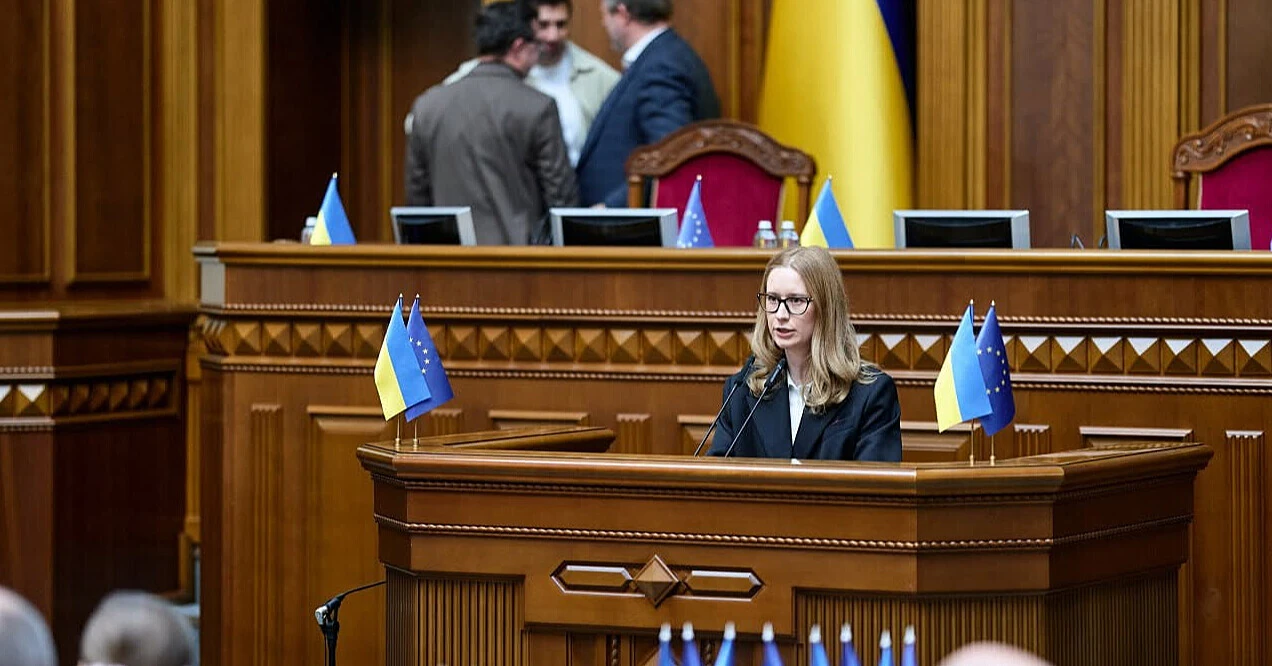
The Budget Committee of the Verkhovna Rada recommended that the parliament adopt the draft state budget for 2027 in the first reading. During the preparation of the document, deputies proposed to review the financing of "National Cashback", change the rules of large privatization, expand support for farmers, and increase the financial capabilities of local communities.
This was reported by the head of the Budget Committee of the Verkhovna Rada, Roksolana Pidlasa. The committee meeting took place on October 21, and the consideration of the bill in the first reading is expected approximately on October 28.
According to Pidlasa, deputies processed 5236 amendments to bill No. 16000. Based on the results of the review, budget conclusions have been formed, which the government must take into account when finalizing the document for the second reading.
Proposal to limit financing of "National Cashback"
One of the most notable proposals of the committee was the prohibition of using funds from the budget program for supporting production and entrepreneurship for payments of "National Cashback".
The draft budget provides 9.4 billion UAH for the corresponding program. According to committee members, this money should be directed directly to business development, not to consumer compensation for purchasing Ukrainian goods.
In addition, the government was proposed to separately assess the feasibility of further financing of "National Cashback" from the state budget.
At the same time, these are budget proposals, not a decision to cancel the program. Its further fate will depend on the government's position and the final version of the state budget.
Large privatization may be conducted with a reduction in the starting price
The committee also proposed to allow in 2027 auctions of large privatization with a reduction in the starting price.
The goal of the changes is to simplify the sale of state assets that have not been privatized for a long time. Among examples, Pidlasa named the Odesa Portside Plant and "Sumykhimprom".
The new mechanism is expected to help attract potential investors to objects that require significant investment for modernization or restoration of operations.
However, the proposed auction procedure has not yet entered into force. Its implementation will depend on further consideration of budget proposals.
New support mechanisms for farmers and enterprises
A separate package of proposals concerns agriculture and businesses operating under war risks.
In particular, the committee proposed to increase compensation for the cost of construction and reconstruction of livestock farms from the current 50% to 75%. Support may extend to farms for keeping cows, goats, and sheep, access roads to them, and milk processing facilities.
The government was also recommended to consider increasing the volume of preferential lending for farmers and introducing additional assistance for producers from territories of risky farming due to hostilities.
Among other initiatives are an additional 100 million UAH for humanitarian demining, expansion of war risk insurance program, and creation of a state support mechanism for transporting agricultural products from frontline regions.
For maritime logistics, it was proposed to provide guarantees of compensation for damage to owners, operators, and charterers of vessels that will suffer from military actions in the territorial sea of Ukraine or in the waters of open seaports.
Local communities may receive more funds
Important changes concern interbudgetary relations. The committee proposed that the government consider crediting an additional 4% of personal income tax, excluding military PIT, to community budgets.
According to Pidlasa's calculations, such a change would mean a loss of 18.2 billion UAH for the state budget, so the Cabinet of Ministers must determine sources of compensation for these revenues.
Another proposal is to consider not withdrawing reverse subsidy from local budgets. This could leave communities with additional resources, but at the same time would reduce state budget revenues by approximately 19.2 billion UAH.
In addition, it is proposed to increase funding for the State Regional Development Fund by at least 2 billion UAH, provide additional funds for compensation for destroyed housing, and expand housing programs for internally displaced persons.
In particular, funds planned to be accumulated from budgets of temporarily occupied territories are proposed to be used not only for housing construction but also for purchasing ready-made houses, converting premises into housing, social rent, and preferential lending.
Defense industry and other expenditures
In the defense sector, the committee proposed that the government consider doubling state guarantees for enterprises of the defense-industrial complex – up to 60 billion UAH.
Also, recommendations were supported for additional funding of housing for military personnel and creation of a subvention to communities for ensuring citizen training centers for national resistance.
Separately, the committee raised the issue of increasing monetary allowances for the military. Previously, "Kurs Ukrainy" already reported on support for the corresponding amendment to the State Budget-2027.
In the education sector, it was proposed to increase funding for scientific activities of institutions of the National Academy of Sciences by 700 million UAH, provide additional resources for shelters and energy independence of educational institutions, and find funds for a pilot project of teacher salary reform.
In the healthcare sector, the budget conclusions provide an additional 150 million UAH for the purchase of drugs for the treatment of certain neurological and neuromuscular diseases, as well as an instruction for the government to find funds for other expensive drugs and prosthetics for veterans.
All mentioned proposals still have to go through further stages of the budget process. The committee's recommendation does not mean that the Verkhovna Rada has already adopted the state budget or that all proposed expenditures have received financial support.
The bill is expected to be considered in the first reading on October 28. After that, the Cabinet of Ministers must finalize the document taking into account the parliament's budget conclusions.
Based on materials: Roksolana Pidlasa, Verkhovna Rada Budget Committee
