
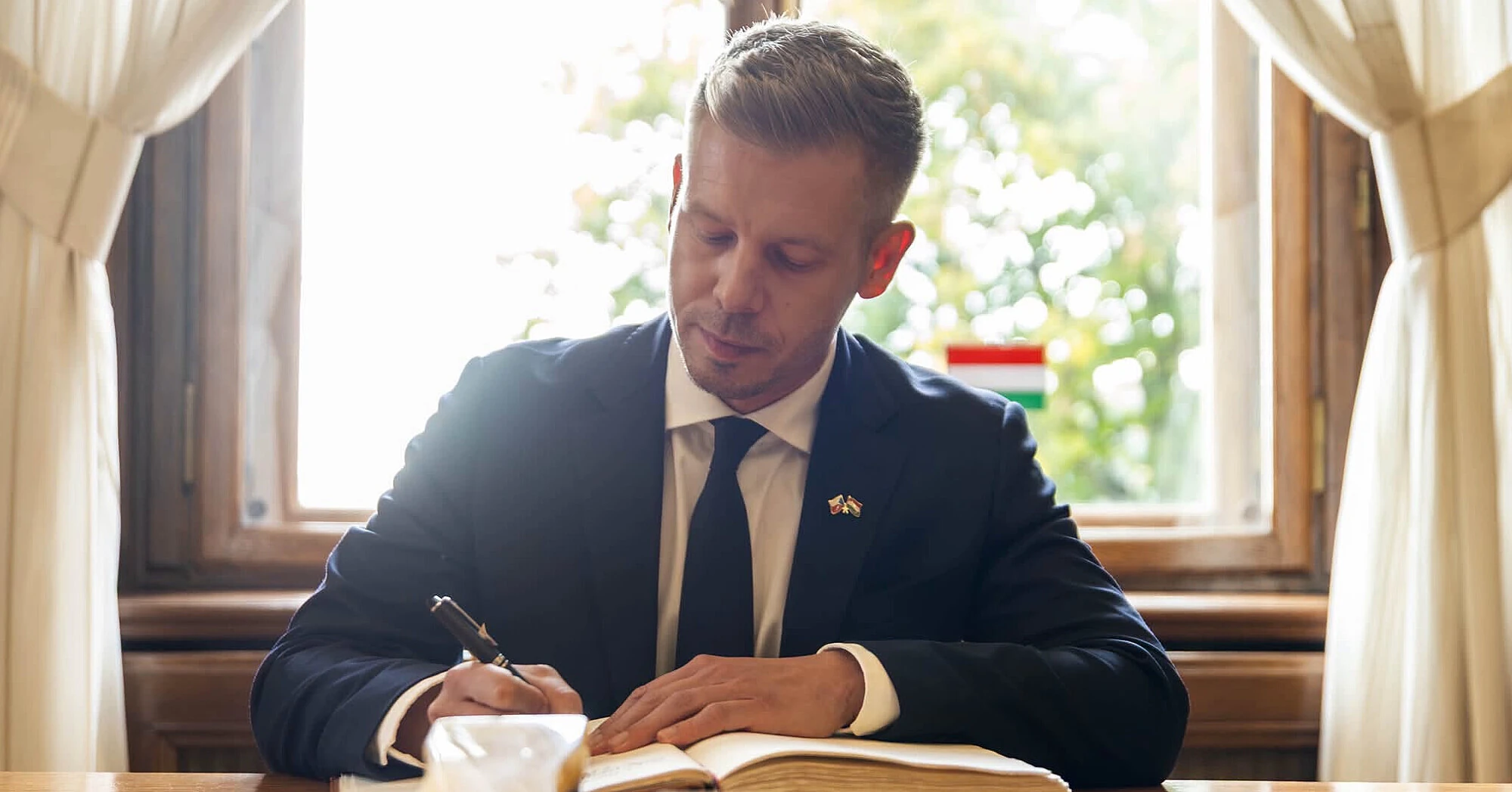
Hungarian Prime Minister Peter Magyar opposed linking the adoption of the next seven-year EU budget with commitments to further fund Ukraine. He does not consider the position of German Chancellor Friedrich Merz to be blackmail, though he says such an approach is wrong.
Magyar made the statement on Tuesday, November 10, at a joint press conference with Merz after talks in Berlin, Hungarian outlet 24.hu reports.
According to the head of the Hungarian government, the EU's long-term budget should primarily fund common European programs, including agriculture, regional development, support for businesses, and education.
"I do not think it is a good direction to tie the European budget, which ultimately concerns the EU itself, to any other issue," Magyar said.
He stressed he does not see the German chancellor's move as blackmail, but believes such framing is a bad signal to European partners.
"I do not perceive this as blackmail and do not want to use that word, since in today's world, everything is interconnected. But I am not sure this is the right signal," the prime minister explained.
Magyar also said Hungary cannot take on new multi-billion euro debt commitments to finance Ukraine. He explained the position by the difficult public finance situation and the need to reduce the budget deficit.
At the same time, the Hungarian prime minister stressed his country will continue providing humanitarian aid to Ukraine. He noted that Hungary accepts Ukrainian refugees and participates in ensuring European security, including protecting the EU's external borders and the airspace of the Baltic states.
According to Magyar, states' financial contributions to support common security must be assessed considering their economic capabilities and existing obligations.
Budapest separately objects to the draft EU budget for 2028-2034. Magyar believes the current document places excessive financial burden on Hungary.
According to him, under the present proposal, the country could become one of the largest net contributors to the EU budget per capita. For a state that receives support under the European cohesion policy, such an approach is unacceptable.
The Hungarian government intends to fight to preserve funding for agricultural and regional programs. Magyar also assured Budapest will participate constructively in budget negotiations.
German Chancellor Friedrich Merz, for his part, insists that funding Ukraine must be a shared responsibility of all EU member states.
At the press conference, he said continued financial support for Kyiv is directly tied to Europe's collective security. In his view, the corresponding commitments must be fully provided for in the next multiannual EU budget.
Merz recalled that in late 2025, 24 of 27 EU states agreed to participate in providing Ukraine with a €90 billion loan. But the chancellor does not consider continuing the practice of individual opt-outs to be the best solution.
Germany, as the largest contributor to the EU budget, seeks a more even distribution of expenses among member states.
It was reported earlier that Merz, in a letter to European Council President António Costa, made support for the new seven-year budget conditional on all EU countries being ready to take part in funding Ukraine.
Czech Prime Minister Andrej Babiš and Slovak Prime Minister Robert Fico also opposed such an approach. Fico called Germany's demands blackmail, while Magyar refused that label.
After the Berlin talks, the sides did not announce reaching a compromise. Merz said the issue of further support for Ukraine and distribution of the financial burden will be discussed in the coming days and weeks.
Magyar confirmed readiness to continue consultations in Berlin, Dublin and Brussels, stressing that Hungary intends to defend its financial interests in agreeing on the new EU budget.
Based on materials from: 24.hu, German Government.
